
Has the AI arms race changed mega-cap tech?
March 2026, Equity
- Key Insights
-
- The ideal conditions that fueled the outperformance of mega‑cap technology stocks over the past decade are no longer fully in place as the artificial intelligence (AI) race evolves.
- The AI arms race has introduced two structural shifts: More intense competition and much higher capital intensity.
- These changing dynamics have contributed to the T. Rowe Price Asset Allocation Committee’s underweight position in U.S. large‑cap stocks.
For much of the past decade, a small group of mega-cap technology companies has dominated U.S. equity markets. Their leadership was built on powerful structural tailwinds that allowed them to deliver extraordinary revenue growth, expanding margins, and exceptional shareholder returns.
But the AI arms race has dramatically changed the dynamics that drove that dominance.
During the 2010s, three major industries were fundamentally disrupted.
First, broadcast media shifted toward digital platforms, streaming services, and social media.
Second, on-premises computing infrastructure migrated to the cloud.
Third, brick-and-mortar retail gave way to online commerce.
Four companies—Alphabet, Meta, Amazon, and Microsoft—were at the center of that disruption.
They operated in what was close to an ideal competitive environment. Each was able to carve out relatively distinct niches within these transformational industries. Competition among them was limited, and the addressable markets were enormous.
The results were extraordinary.
Over the 10 years ending February 24, 2026, cumulative revenue growth for these four companies reached 499%, compared with just 81% for the broader Russell 3000 Index.
At the same time, operating margins expanded dramatically. Margins for the mega-cap four rose from 17% to 27% over that period, while margins for the broader market increased only modestly—from 13% to 15%.
Capital intensity was also unusually low. Much of their competitive advantage stemmed from intellectual property—essentially computer code—rather than heavy physical capital investment. That meant a smaller share of profits needed to be reinvested into capital expenditures, resulting in high free cash flow margins and exceptional shareholder returns.
That dynamic changed with the emergence of artificial intelligence.
AI represents both an enormous opportunity and a meaningful threat. It offers the potential to lead another wave of disruption—perhaps even larger than the cloud and mobile revolutions. But it also puts the current dominance of these firms at risk.
The AI race has introduced two structural shifts: more intense competition and much higher capital intensity.
First, competition has increased significantly. The mega-cap four are now competing directly with one another across overlapping AI platforms. Clear niches have yet to be firmly established. More importantly, they face credible competition from new entrants such as OpenAI, Anthropic, and xAI/SpaceX, all of which are expected to pursue major IPOs in the coming year.
Revenue streams that once appeared secure are now directly contested. In this environment, persistently high margins are more likely to be competed away.
Second, AI is far more capital intensive than prior waves of digital disruption.
Training and operating advanced AI models requires massive investments in data centers, semiconductors, and energy infrastructure. Analysts currently estimate that Alphabet, Meta, Amazon, and Microsoft will spend nearly USD1.3 trillion combined on capital expenditures during 2026 and 2027.
That represents a structural shift away from the low-capital-intensity model that defined their dominance over the past decade.
To be clear, these companies may ultimately reassert their leadership. Their balance sheets remain strong, their platforms are deeply embedded in the global economy, and their willingness to commit enormous capital toward AI leadership could reinforce their competitive positions.
But in the interim, they are operating in a far more challenging landscape—characterized by greater competition, rising capital intensity, and less certainty around long-term margins.
The ideal conditions that fueled the extraordinary outperformance of mega-cap technology stocks over the past decade are no longer fully in place.
As a result of these shifting dynamics, our Asset Allocation Committee currently maintains an underweight position in U.S. large-cap stocks. We’ll continue to monitor how competitive pressures and capital investment trends evolve as the AI cycle unfolds.
Over the last decade, a small group of mega‑cap technology companies has dominated U.S. equity markets. Their leadership was built on powerful structural tailwinds that allowed them to deliver extraordinary revenue growth, expanding margins, and exceptional shareholder returns. However, the AI arms race has dramatically changed the dynamics that drove that dominance.
During the 2010s, three major industries were fundamentally disrupted:
- Broadcast media shifted toward digital platforms, streaming services, and social media.
- On‑premises computing infrastructure migrated to the cloud.
- Brick‑and‑mortar retail gave way to online commerce.
Four companies—Alphabet, Meta, Amazon, and Microsoft—were at the center of that disruption. These companies operated in what was close to an ideal competitive environment, and each was able to carve out relatively distinct niches within these transformational industries. Competition among them was limited, and the addressable markets were enormous.
An ideal environment for growth

February 29, 2016, through February 24, 2026.
Past performance is not a guarantee or a reliable indicator of future results.
The specific securities identified and described are for informational purposes only and do not represent recommendations.
1 Market‑cap‑weighted index of Amazon, Alphabet, Meta, and Microsoft.
Source: T. Rowe Price analysis using data from FactSet Research Systems Inc. All rights reserved. Visit troweprice.com/marketdata for additional legal notices and disclaimers.
The results were extraordinary. Over the 10 years ending February 24, 2026, cumulative revenue growth for these four companies reached 499%, compared with just 81% for the broader Russell 3000 Index. At the same time, operating margins expanded dramatically. Margins for the mega‑cap four rose from 17% to 27% over that period, while margins for the broader market increased only modestly, from 13% to 15%.
Capital intensity was also unusually low. Much of their competitive advantage stemmed from intellectual property—essentially computer code—rather than heavy physical capital investment. That meant a smaller share of profits needed to be reinvested into capital expenditures, resulting in high free cash flow margins and exceptional shareholder returns.
The AI shift: Opportunity and threat
That dynamic has changed with the emergence of artificial intelligence. AI represents both an enormous opportunity and a meaningful threat. It offers the potential to lead another wave of disruption—perhaps even larger than the cloud and mobile revolutions. However, it also puts the current dominance of these firms at risk.
...The AI race has introduced two structural shifts: More intense competition and much higher capital intensity...
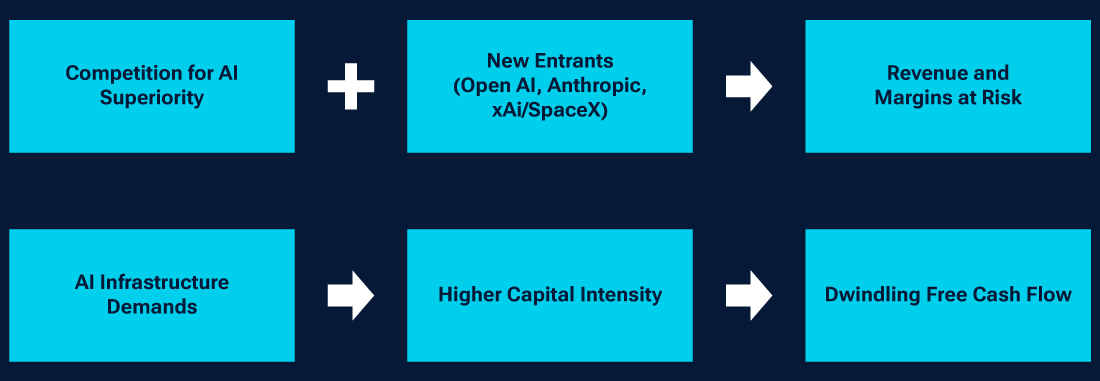
The AI race has introduced two structural shifts: More intense competition and much higher capital intensity.
- First, competition has increased significantly. The mega‑cap four are now competing directly with one another across overlapping AI platforms. Clear niches have yet to be firmly established. More importantly, they face credible competition from new entrants such as OpenAI, Anthropic, and xAI/SpaceX, all of which are expected to pursue major IPOs in the coming year. Revenue streams that once appeared secure are now directly contested. In this environment, persistently high margins are more likely to be competed away.
- Second, AI is far more capital intensive than prior waves of digital disruption. Training and operating advanced AI models requires massive investments in data centers, semiconductors, and energy infrastructure. Analysts currently estimate that Alphabet, Meta, Amazon, and Microsoft will spend nearly USD 1.3 trillion combined on capital expenditures during 2026 and 2027.1
That represents a structural shift away from the low‑capital‑intensity model that defined their dominance over the past decade.
The AI race has changed the dynamics
The specific securities identified and described are for informational purposes only and do not represent recommendations.
Conclusion
To be clear, these companies may ultimately reassert their leadership. Their balance sheets remain strong, their platforms are deeply embedded in the global economy, and their willingness to commit enormous capital toward AI leadership could reinforce their competitive positions.
But in the interim, they are operating in a far more challenging landscape—characterized by greater competition, rising capital intensity, and less certainty around long‑term margins.
The ideal conditions that fueled the extraordinary outperformance of mega‑cap technology stocks over the past decade are no longer fully in place.
The ideal conditions that fueled the extraordinary outperformance of mega‑cap technology stocks over the past decade are no longer fully in place. These changing dynamics have contributed to the T. Rowe Price Asset Allocation Committee’s underweight position in U.S. large‑cap stocks. We will continue to monitor how competitive pressures and capital investment trends evolve as the AI cycle unfolds.
 Timothy C. Murray, CFA
Capital Markets Strategist
Timothy C. Murray, CFA
Capital Markets Strategist

- Feb 2026
Are U.S. small-caps finally back?

Contact us
1 Source: T. Rowe Price analysis using data from FactSet Research Systems Inc. All rights reserved.
Additional Disclosure
For U.S. investors, visit troweprice.com/glossary for definitions of financial terms.
Important Information
This material is being furnished for informational and/or marketing purposes only and does not constitute an offer, recommendation, advice, or solicitation to sell or buy any security.
Prospective investors should seek independent legal, financial and tax advice before making any investment decision. T. Rowe Price group of companies including T. Rowe Price Associates, Inc. and/or its affiliates receive revenue from T. Rowe Price investment products and services.
Past performance is not a guarantee or a reliable indicator of future results. All investments involve risk, including possible loss of principal.
Information presented has been obtained from sources believed to be reliable, however, we cannot guarantee the accuracy or completeness. The views contained herein are those of the author(s), are as of March 2026, are subject to change, and may differ from the views of other T. Rowe Price Group companies and/or associates. Under no circumstances should the material, in whole or in part, be copied or redistributed without consent from T. Rowe Price.
All charts and tables are shown for illustrative purposes only. Actual future outcomes may differ materially from any estimates or forward‑looking statements provided.
The material is not intended for use by persons in jurisdictions which prohibit or restrict the distribution of the material and in certain countries the material is provided upon specific request.
Issued in the USA by T. Rowe Price Investment Services, Inc., distributor and T. Rowe Price Associates, Inc., investment adviser, 1307 Point Street, Baltimore, MD 21231, which are regulated by the Financial Industry Regulatory Authority and the U.S. Securities and Exchange Commission, respectively.
© 2026 T. Rowe Price. All Rights Reserved. T. Rowe Price, INVEST WITH CONFIDENCE, the Bighorn Sheep design, and related indicators (see troweprice.com/ip) are trademarks of T. Rowe Price Group, Inc. All other trademarks are the property of their respective owners. Use does not imply endorsement, sponsorship, or affiliation of T. Rowe Price with any of the trademark owners.
- 202603‑5254925