
Clients expect AI-savvy advisors. But fear not.
Practice Management
The message from clients and potential clients is clear: 71% of Americans with an advisor prefer they use AI for at least one professional purpose.1 Advisors don’t have the luxury of swearing off AI or failing to be front-footed about incorporating it into their practice. This is because an understanding of AI signals to clients that your practice is sophisticated and that you’re using technology on their behalf. Plus, enhancing productivity is just good business. By automating tasks that deliver limited return on time, you free up time for higher-value activities like prospecting and enhancing client service.
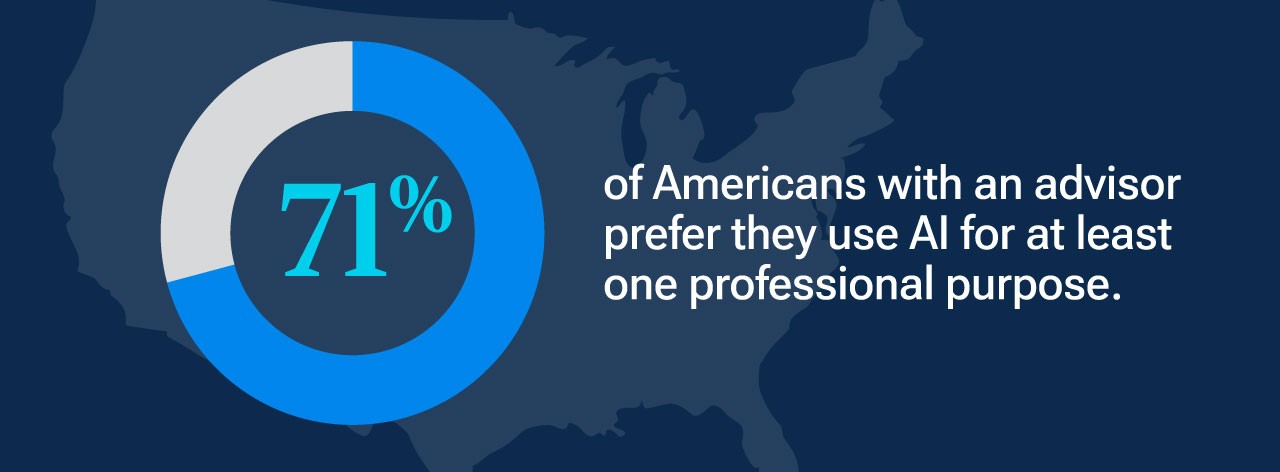
Source: Million Dollar Round Table (MDRT), MDRT Study: Half of All Advisors’ Clients Think Their Advisor Is Already Using AI, 2025.
Hey Siri, how AI savvy do I need to be?
If big AI‑expectation stats like the one above make you feel like you're getting left behind—like by now you should have upended your entire tech stack, automated every process, or be combing through your CRM for hidden client insights—you’re in good company. According to a recent T. Rowe Price survey of 182 advisors, while 83% are using AI at least monthly, 77% still don’t consider themselves advanced users.2 In other words, advisors are engaging—but very much in “early days.” And only 5% said they weren’t sure AI has real opportunity for their practice, which means nearly everyone sees upside, even if the roadmap isn’t fully drawn yet.
Sure, every technological revolution has its early adopters and power users—a small cohort that stands apart from the pack. But if you aren’t among them, you’re not out of luck. Upping your AI understanding and knowledge is possible. And it’s not just about communicating sophistication. The potential productivity gains are good for business.
For those seeking to ramp up their use and drive adoption deeper into their practice, it’s important to take a methodical approach. Don’t set out to master AI. Rather, start by identifying a specific need and gain knowledge as you explore if and how AI can help you solve it.
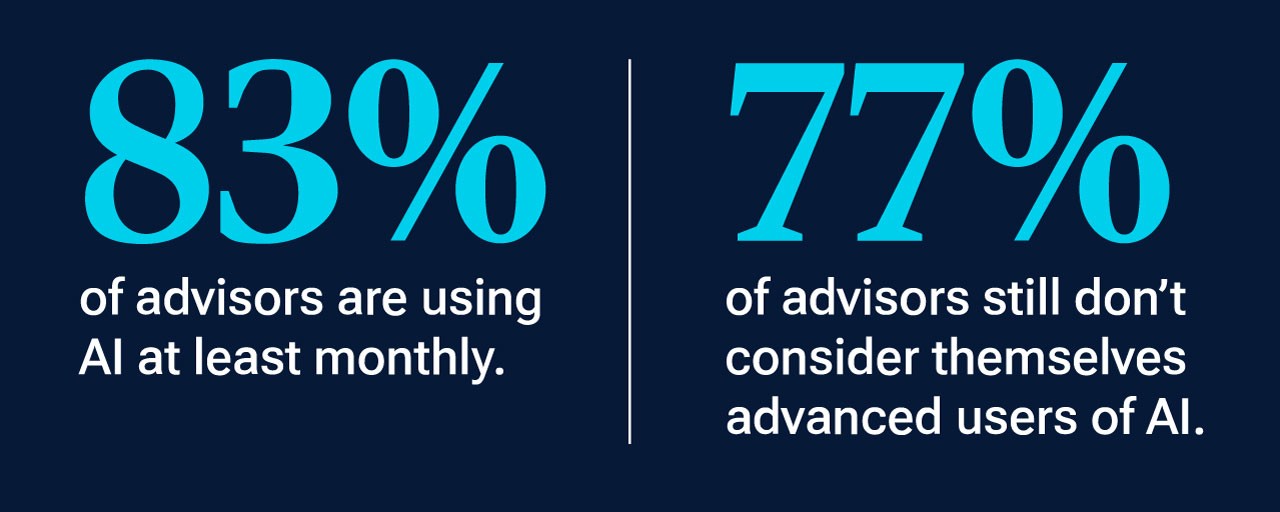
Source: T. Rowe Price, proprietary survey of 182 financial advisors conducted January 2026.
Ready to raise your AI game?
Colleges now offer full degrees and courses in AI for business. And for some, that level of depth and structured learning is the right path. Others need a clear, practical roadmap. Here are five steps to help you build knowledge, boost confidence, and integrate AI into your practice.
- Start with a business need. Instead of trying to adopt AI across your whole practice, start by focusing on a specific business need, such as research or note-taking. You could even consider asking AI itself for recommendations. Identify the tool matched to the task and focus on learning it. Along the way, you’ll build a broader understanding of AI and its capabilities.
- Get savvy about prompt. Tools like ChatGPT and Gemini are where many advisors encounter AI and find greatest utility. To tap their power, a good place to start is with prompts. Through short videos and tutorials on YouTube, Udemy, LinkedIn Learning, or similar platforms, you can build the skills needed to generate better outputs.
- Leverage specialists and build team capability. If DIY learning is not your strong suit, consider leveraging your broader team by either employing external specialists who can assess your needs and strategically integrate AI, or by selecting team members to build AI skills and making this part of their development plan.
- Connect with your peers. Nothing can replace the insights, hacks, and tips gained by those who have begun applying AI in their practices. Seek out forums where your fellow advisors trade AI knowledge and industry-specific use cases.
- Be discerning. AI is helpful but not perfect. Ensuring outputs are accurate, reliable, and free of bias requires discernment and double checking. Implement protocols around its use, share them with clients, and be transparent about how you’re employing it.
Integrating AI into your practice isn’t about keeping up with trends—it’s about confidently building AI into your practice. By starting small, learning deliberately, and staying thoughtful about its use, you can unlock meaningful efficiency gains and demonstrate the sophistication clients increasingly expect. Starting your AI journey today will best position you to capture the opportunities of tomorrow that this new technology will bring.
- Related Resources
Practice Management Pulse
Explore Practice Management
Curious where you really stand with AI? What’s your AIQ?

Contact us
1 Million Dollar Round Table (MDRT), MDRT Study: Half of All Advisors’ Clients Think Their Advisor Is Already Using AI, 2025.
2 T. Rowe Price, proprietary survey of 182 financial advisors conducted January 2026.
Please consult with your firm's compliance department to confirm which AI tools are permitted for use in accordance with your organization's policies and guidelines.
- 202603-5301467