
Helping clients make their charitable giving more tax efficient
Practice Management
Incorporating charitable giving into a financial plan is a way for you to help your clients maximize their philanthropic impact while minimizing taxes. For clients, charitable giving can be a powerful tool to boost the tax efficiency of a portfolio and reduce tax obligations. For advisors, engaging in charitable conversations can bring additional value to your client relationships.
One key challenge: Advising clients on charitable giving isn’t near the top of most financial advisors’ whiteboard. Three-quarters of financial advisors do not include philanthropy as part of their initial fact-finding with clients, despite 21% saying they saw a direct link between offering advice and winning new business.1 And when you consider that individuals accounted for 64% of the $499.3 billion in charitable giving in 2022 (see chart below), that’s a lost opportunity to connect with clients, deepen the relationship, add value, and accelerate the growth of your advisory practice.
Individuals top list of philanthropic givers
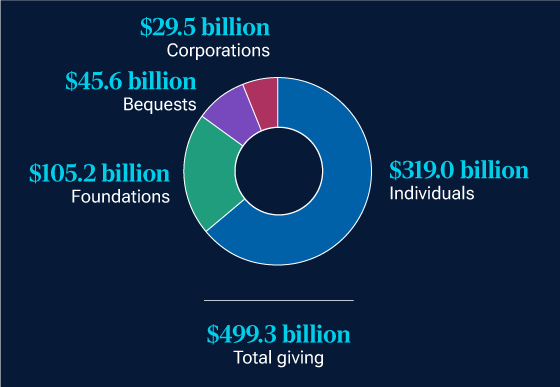
CCS Fundraising, 2023 Philanthropic Landscape, 12th Edition
It’s a win-win for you and your client. Financial advisory firms incorporating charitable planning into their practices have more assets under management, stronger organic growth, larger share of wallet, and a more loyal and trusting clientele, according to ThinkAdvisor.2
So, what’s your next move? If you’re looking to better serve your clients and help them achieve all their financial goals, you can fill that communication and planning gap by including charitable giving as an agenda item for all client meetings. In that conversation you could introduce your clients to charitable tax strategies and walk them through ways they can achieve two important goals: supporting charities important to them and maximizing their tax savings.
Stress that the real value you provide isn’t about recommending specific charities for your client to consider but rather helping them understand how gifting fits within their overall financial plan. Stick to your financial planning expertise. Focus your message on ways your client can give in a more tax-efficient manner.
Kick-start a charitable giving conversation
Since nearly all affluent clients give charitably, improving tax-efficient giving is a natural talking point. Start a conversation the next time you meet and don’t be shy about letting clients know there’s a smarter way to give than simply writing a check. That message should be well-received from clients, considering that 85% of donors responding to a CSS Fundraising survey cited an “income tax deduction” as a key motivation for giving.

CCS Fundraising, 2023 Philanthropic Landscape, 12th Edition
Start laying the groundwork now and check back in with the client as the fourth quarter approaches to gear up for tax season. Discussions about strategic charitable giving should be ongoing throughout the year to help clients better assess the ways they can optimize the tax benefits of giving as well as deepen the advisor/client relationship.
You can start a dialogue by asking questions about your client’s charitable giving history that will provide you with an opening to discuss tax-saving solutions. Examples include:
- What types of assets have you donated in the past?
- Do you itemize deductions on your tax return?
- How much of a tax break do you get for donating to charity?
Respond to your clients’ answers and grab their attention by sharing tax-saving facts related to charitable contributions, such as being able to avoid capital gains taxes by gifting long-term appreciated stocks and being able to deduct up to 60% of their adjusted gross income (AGI) for cash gifts to charity.
This is the time to tick off the strategies your client can employ and financial vehicles they can use to make tax savings an essential part of their charitable giving plan.
Three ways to save on taxes with charitable giving
Most clients probably aren’t aware of how they can give in a more tax-friendly way. You can help educate clients on charitable tax strategies available to them. And answer the key question: How can you use charitable giving to accomplish your philanthropic goals and improve the tax efficiency of your portfolio?
Here are three common strategies to donate to charity and save on taxes:
1. Donate appreciated assets. Most individuals donate by check or credit card. But giving cash means they may miss out on potential sizable tax savings. A better option may be to donate a long-term appreciated asset, such as a stock, which would trigger a sizable capital gain if sold. The benefit of donating appreciated assets is twofold:
- Your client avoids paying the capital gains tax.
- They will also qualify for a charitable tax deduction for the fair market value of the asset.
A suitable time to bring up this strategy with a client is during routine portfolio rebalancing. You can help them identify top-performing investments that are ripe for use as a tax-smart donation opportunity.
2. Boost tax savings by “bunching” contributions. Due to changes to the tax code that increased the standard tax deduction, it’s more difficult for taxpayers to benefit from itemizing deductions on their return. But utilizing a “bunching” strategy is a way to increase the dollar amount of your client’s deductions above the IRS’s standard deduction. If, for example, your client typically donates $10,000 to charity each year and has $15,000 in other deductions, they could bunch two years of charitable deductions into a single tax year to push their itemized total to $35,000, which is higher than the 2025 standard deduction of $31,500 (for married, filing jointly). That equates to $3,500 in additional tax deductions.
3. Give to charity through a donor-advised fund. Another easy giving strategy to consider is to contribute through an investment account specifically designed for charitable giving known as a donor-advised fund (DAF), such as those offered by T. Rowe Price Charitable. DAFs offer clients a triple-tax advantage. As soon as the client makes an irrevocable contribution of cash or long-term appreciated assets to the DAF, they are eligible for a same-year tax deduction up to IRS limits. And if they fund their DAF with appreciated assets, they’ll also avoid paying capital gains taxes. Another tax-friendly feature is that contributions have the potential to grow tax-free in the DAF before clients initiate disbursements to their favorite charities.
The bottom-line: Tax-smart giving can be a valuable topic to incorporate into your regular client conversations. Illuminating the benefits of tax-efficient giving not only can reduce your client’s tax burden, but it may also lead to greater client satisfaction and loyalty, helping you create deeper client relationships.
- Related Resources
Tax Efficiency 365
Educate clients on tax-efficient investment planning strategies to use throughout the year—and for every stage of life.
Explore Practice Management

Contact us
1 CAF (Charities Aid Foundation), "Advisers not meeting the needs of younger clients due to lack of philanthropy knowledge" (https://www.cafonline.org/about-us/press-office/advisers-not-meeting-the-needs-of-younger-clients-due-to-lack-of-philanthropy-knowledge)
2 Think Advisor, "Charitable Giving Advice Linked to More Asset, Faster Growth: Fidelity", by Michael S. Fischer, October 15, 2021, (https://www.thinkadvisor.com/2021/10/15/charitable-giving-advice-linked-to-more-assets-faster-growth-fidelity/)
Important Information
This material has been prepared for general and educational purposes only; it is not individualized to the needs of any specific donor and not intended to suggest any particular investment strategy is appropriate for you. Any tax-related discussion contained in this material, including any attachments/links, is not intended or written to be used, and cannot be used, for the purpose of (i) avoiding any tax penalties or (ii) promoting, marketing, or recommending to any other party any transaction or matter addressed herein. Donors are advised to seek professional tax advice regarding questions related to year-end donations.
The T. Rowe Price Charitable is an independent, nonprofit corporation and donor-advised fund founded by T. Rowe Price to assist individuals with planning and managing their charitable giving.
The specific securities identified and described are shown for illustrative purposes only and do not necessarily represent securities purchased or sold by T. Rowe Price. This information is not intended to be a recommendation to take any particular investment action and is subject to change. No assumptions should be made that the securities identified and discussed were or will be profitable.
- 202511-3668945