
The power of currency hedging: Three key benefits for investors
From the Field
- Key Insights
-
- U.S. investors often overlook foreign currency bonds due to their lower local yields or the perception that they carry too much risk.
- However, by hedging the currencies of foreign developed market bonds, investors can potentially diversify interest rate risk and earn higher yields—often surpassing those of U.S. Treasuries.
- While hedging the currency of emerging market bonds generally reduces the yield, it can help mitigate volatility.
With some foreign bonds offering lower local yields and others providing higher local yields but carrying greater currency volatility risk, it is unsurprising that many U.S. investors exhibit a “home bias” and allocate heavily to U.S. bonds. However, many of the perceived drawbacks of investing in foreign bonds can be overcome through currency hedging. In this article, we explore how currency hedging works and outline three key benefits for investors.
How currency hedging works
Currency hedging is a well‑established method for reducing the foreign exchange risk associated with investing in overseas assets. When investors hedge foreign bonds, they typically enter into a currency forward—a binding contract between two parties to exchange a certain amount of a currency for another currency at a fixed exchange rate on a specific future date. This allows both parties to effectively “lock in” the exchange rate on a future transaction.
For example, a U.S. investor buying a 10‑year French government bond might enter into a 12‑month forward contract to sell euros (going short) and buy U.S. dollars (going long) equivalent to their exposure. As the contract approaches expiry, the investor will evaluate the prevailing market conditions and proceed to close out the contract, settling the difference between the con-tract’s agreed price and the spot rate. The investor will then typically enter into another 12‑month forward con-tract. This “rolling” process is generally repeated throughout the bond’s holding period.1
Overall, an investor’s total return is equal to the bond’s coupon (distinct from yield), any capital appreciation or depreciation in the bond’s price, and the net return from a currency forward contract. An important feature of the latter is the “carry” component. This is the profit, or the cost, associated with the interest rate differential between the two currencies being swapped. When the interest rate of the currency being bought (long) is higher than that of the currency being sold (short), an investor can earn a positive carry, which can help enhance returns. By contrast, when the differential is negative, it results in a cost.
Three key benefits of currency hedging
1. Potential to boost yield
Hedging lower‑yielding developed market bonds back to the U.S. dollar can increase yields, allowing investors to earn more income. In the current environment, U.S. deposit rates are higher than most other developed market countries, which means the interest rate differential is positive. This offers investors the potential to earn a positive carry from currency hedging, which can enhance yields and boost returns.
For example, consider a hypothetical U.S. investor buying and hedging a 10‑year French government bond. On June 30, 2025, French 10‑year bonds yielded 3.28% at a price of 99.39. To purchase 100,000 par value, an investor would have required EUR 99,392 at the spot rate of 1.17873, or USD 117,156. To hedge the currency risk, the investor will enter into a 12‑month forward contract to sell the foreign currency (EUR) and buy U.S. dollars. Because deposit rates in Europe were lower than U.S. rates, the investor sells the foreign currency at a lower rate and receives a higher yield on the U.S. rate through the 12‑month forward contract, resulting in “positive carry” from the currency hedge. This is roughly equal to the USD Secured Overnight Financing Rate (SOFR) of 3.88% less the implied euro forward yield of 1.82%, which is equal to 2.06%. This is added to the 3.28% yield of the French bond for a total yield of 5.34%, which is more than 1% higher than the 10‑year U.S. Treasury yield of 4.23%.2
How hedging can help turn a lower yield into a higher one
(Fig. 1) Hypothetical example: Buying and hedging 10‑year French government bonds
| Transaction date | |
|---|---|
| Par value (EUR) | 100,000 |
| Yield | 3.28% |
| Coupon | 3.20% |
| Price | 99.39 |
| EUR/USD spot rate | 1.17873 |
| Total cost in USD | 117,156 |
| EUR/USD 12M forward rate | 1.2036 |
| After 12 months (assuming unchanged yields) | |
|---|---|
| Price of bond | 99.36 |
| Proceeds from sale of bond (EUR) | 102,560 |
| Convert to USD @ forward rate | 123,437 |
| Profit (USD) | 6,281 |
| Profit (%) | 5.36% |
| 10‑year U.S. Treasury yield (for comparison) | 4.23% |
| For informational purposes only | |
| USD 12M SOFR | 3.88% |
| Implied EUR forward yield | 1.82% |
As of June 30, 2025.
The Implied EUR forward yield = (Spot rate ÷ forward rate) + USD 12M SOFR ‑ 1. The price of the bond after 12 months is estimated using Bloomberg’s Fixed Income Horizon Analysis, where the transaction date yield, settle date, and horizon date of June 30, 2026, all serve as inputs. We assumed unchanged yields after 12 months, so the 10‑year U.S. Treasury yield quoted was the yield as of June 30, 2025. In actuality, bond yields typically fluctuate over time due to a variety of factors, including changes in the interest rate environment, inflation expectations, overall economic conditions, and supply and demand dynamics.
For illustrative purposes only and not representative of an actual investment or actual results. This is not to be construed as investment advice or a recommendation to take any particular investment action. See Appendix for additional information on this analysis.
Source: Bloomberg Finance L.P. Analysis by T. Rowe Price.
2. Helps to reduce volatility
Currency hedging can also be used to reduce the volatility from foreign currency in higher‑yielding emerging market bonds. For example, consider an investor looking at an emerging market local currency bond with a much higher yield—and greater volatility—than U.S. Treasuries. In this case, to hedge the volatility from currency risk would reduce the yield rather than boosting it as in the previous example of the French bond. Thus, a hypothetical investor seeking to buy 100,000 South African bonds maturing on March 31, 2033, yielding 9.36% at a price of 103.46, would need ZAR 103,460 or USD 5,841.
"Currency hedging can also be used to reduce the volatility from foreign currency in higher‑yielding emerging market bonds."
Andrew Keirle, Portfolio Manager
Assuming the investor wants to hedge all the bond’s currency exposure back to U.S. dollars, they would sell the South African rand forward 12 months at an implied yield of 6.84% and effectively receive USD SOFR of 3.88% for a net cost of hedging of 2.96%. Given that the yield the investor receives from owning the bond is 9.36%, the effective hedged yield is 6.4% (9.36% less 2.96%). Equivalent U.S. Treasury bonds were yielding 4.05% on June 30, 2025. In this case, the hedged South African bond yields less than the unhedged bond, but with much less volatility, and still outyields the U.S. Treasury bond.3
How hedging can help to provide stability
(Fig. 2) Hypothetical example: Buying and hedging South African bonds maturing in 2033
| Transaction date | |
|---|---|
| Par value (ZAR) | 100,000 |
| Yield | 9.36% |
| Coupon | 10.00% |
| Price | 103.46 |
| USD/ZAR spot rate | 17.7118 |
| Total cost in (USD) | 5,841 |
| USD/ZAR 12M forward rate | 18.2360 |
| After 12 months (assuming unchanged yields) | |
|---|---|
| Price | 103.115 |
| Proceeds from sale of bond (ZAR) | 113,115 |
| Convert to USD at the forward rate | 6,203 |
| Profit (USD) | 362 |
| Profit (%) | 6.19% |
| Yield on U.S. Treasury bond maturing 2033 (for comparison) | 4.05% |
| For informational purposes only | |
| USD 12M SOFR | 3.88% |
| Implied ZAR forward yield | 6.84% |
As of June 30, 2025.
The implied ZAR forward yield = (forward rate ÷ Spot rate) + (USD 12M SOFR – 1). The price of the bond after 12 months is estimated using Bloomberg’s Fixed Income Horizon Analysis, where the transaction date yield, settle date, and horizon date of June 30, 2026, all serve as inputs. We assumed unchanged yields after 12 months, so the yield on the U.S. Treasury bond quoted was the yield as of June 30, 2025. In actuality, bond yields typically fluctuate over time due to a variety of factors, including changes in the interest rate environment, inflation expectations, overall economic conditions, and supply and demand dynamics.
For illustrative purposes only and not representative of an actual investment or actual results. This is not to be construed as investment advice or a recommendation to take any particular investment action. See Appendix for additional information on this analysis.
Source: Bloomberg Finance L.P. Analysis by T. Rowe Price.
3. Diversification benefits
From a portfolio construction perspective, we believe having exposure to hedged foreign currency bonds offers significant diversification benefits. To provide an indication of the global opportunity set, Figure 3 shows the yields of 10‑year bonds from various countries when hedged back into U.S. dollars on June 30, 2025. As the chart shows, the yields available to U.S. investors from hedged foreign bonds are substantially different from the unhedged yields (illustrated by the teal diamonds). Typically, hedged yields are higher than unhedged yields for developed market bonds, while the reverse is the case for emerging market bonds.
“From a portfolio construction perspective, we believe having exposure to hedged foreign currency bonds offers significant diversification benefits.”
Jeanny Silva, Associate Portfolio Manager
Correlations also tell an interesting story as they vary across sovereign bond markets. Figure 4 shows that developed markets—excluding Japan and Italy—have the highest correlations with the U.S. bond market. By contrast, emerging markets have much lower correlations, suggesting they may provide potential diversification benefits. However, it should be emphasized that lower correlation or an attractive yield does not by itself provide a reason to purchase a bond—rather, it provides a signal that a bond is worth examining more closely. As yields move and prices fluctuate, we believe fundamental research, combined with active portfolio and risk management, will be necessary to outperform market benchmarks.
Hedged and unhedged foreign bonds offer very different yields
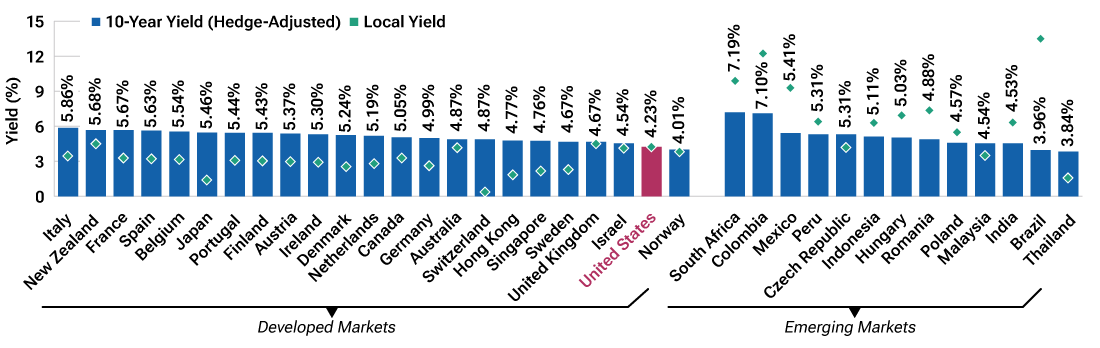
As of June 30, 2025.
The local and hedged yields displayed in Figures 1 and 2 may be slightly different than those figures displayed in Figure 3 due to differences in bid‑ask spreads and timing issues. Typically, three‑month forward contracts are used for hedging because they offer better liquidity but 12‑month contractswere used in the accompanying analysis for simplicity and ease of illustration. The teal diamonds represent the 10‑year unhedged yields and the statednumbers are the hedge‑adjusted 10‑year yields. Diversification cannot assure a profit or protect against loss in declining markets.
Source: Bloomberg Finance L.P. Analysis by T. Rowe Price.
Correlations vary across sovereign bond markets

As of June 30, 2025.
For illustrative purposes only. This is not to be construed as investment advice or a recommendation to take any particular investment action.
Past Performance is not a guarantee or a reliable indicator of future results.
The table shows the correlations of the 7–10 year monthly total returns USD‑hedged for each country versus the U.S. 7–10 year Treasury Index, as represented by the Bloomberg U.S. Treasury 7–10 Year Index. The starting dates differ due to data availability.
Canada is represented by the Bloomberg 7–10 Year Canada Total Return Index Hedged USD, Germany is represented by the FTSE Germany Government Bond Index 7–10 Year (Currency Hedged USD) , the UK is represented by the FTSE UK Government Bond Index 7–10 Year (Currency Hedged USD), Australia is represented by Bloomberg Australia 7–10 Year Government Bond Total Return Index Hedged USD, France is represented by FTSE France Government Bond Index 7–10 Year (Currency Hedged USD), Mexico is represented by FTSE Mexico Government Bond Index 7–10 Year Currency Hedged USD), the Czech Republic is represented by FTSE Czech Republic Government Bond Index 7–10 Year (Currency Hedged USD), Thailand is represented by FTSE Thailand Government Bond Index 7–10 Year (Currency Hedged USD), Japan is represnted by FTSE Japan Government Bond Index 7–10 Year (Currency Hedged USD), Italy is represented by the FTSE Italy Government Bond Index 7–10 Year (Currency Hedged USD), India is represented by Bloomberg 7–10 Year Indian Treasury Total Return Index Hedged USD, and China is represented by Bloomberg China 7–10 Year Total Return Index Hedged USD.
Source: FTSE, Bloomberg Finance L.P. Analysis by T. Rowe Price. See Additional Disclosure.
Conclusion
Most U.S. investors have the majority, if not all, of their fixed income allocations in U.S. bonds, which means concentrated exposure to U.S. interest rate risk and the U.S. credit cycle. Many investors hear the words “global bonds,” and they think of low yields or excessive currency volatility. But astute investors understand the benefits of using currency hedging to cast a wider net and invest in a larger opportunity set, finding higher yields, greater potential returns, and a reduction in portfolio risk.
Appendix
For Figure 1 and Figure 2 the results do not reflect actual trading or the effect of material economic and market factors on the decision‑making processes. The estimated results shown are hypothetical, do not reflect actual investment results, are not a guarantee of future results and are subject to numerous limitations. The results do not reflect actual market conditions including the ability/inability to purchase and sell on the dates indicated in the illustrative example. Certain assumptions have been made for modeling purposes that may not be realized. Management fees, transaction costs, taxes, potential expenses, and the effects of inflation have not been considered and would reduce returns. Actual results experienced by clients may vary significantly from the results shown. Data is subject to change. For Figures 1–3, the bond yield referred to is yield-to-maturity.
Forward contracts are usually over‑the‑counter (OTC) instruments, exposing them to higher risks than exchange‑traded derivatives. OTC instruments are subject to higher counterparty risk, market risk and liquidity risk. These instruments are typically only available to institutional investors because of default risk and the requirements for customization and capital. International investments can be riskier than U.S. investments due to the adverse effects of currency exchange rates, differences in market structure and liquidity, as well as specific country, regional, and economic developments. The risks of international investing are heightened for investments in emerging market and frontier market countries. Emerging and frontier market countries tend to have economic structures that are less diverse and mature, and political systems that are less stable, than those of developed market countries. Fixed‑income securities are subject to credit risk, liquidity risk, call risk, and interest‑rate risk. As interest rates rise, bond prices generally fall.
 Kenneth A. Orchard, CFA
Head, International Fixed Income
Kenneth A. Orchard, CFA
Head, International Fixed Income
 Andrew Keirle
Senior Portfolio Manager
Andrew Keirle
Senior Portfolio Manager
 Jeanny Silva
Co-Portfolio Manager
Jeanny Silva
Co-Portfolio Manager
 Terry A. Moore, CFA
Portfolio Specialist
Terry A. Moore, CFA
Portfolio Specialist

A new era of global high yield: Stronger, larger, and more diverse
An allocation offers investors a potential source of attractive risk-adjusted income.

Contact us
1 For illustrative purposes only. This is not to be construed as investment advice or a recommendation to take any particular investment action. Investments involve risks, including possible loss of principal.
2 Note the slight discrepancy between the hedged yield cited in the text and the profit cited in the table. The discrepancy here is due primarily to rounding.
3 In this example, the effective yield differs from the profit cited in the table due to a number of issues, including the timing of the coupon, bid/ask spreads, and rounding.
Additional Disclosures
Visit troweprice.com/glossary for definitions of financial terms.
London Stock Exchange Group plc and its group undertakings (collectively, the “LSE Group”). © LSE Group 2025. FTSE is a trading name of certain of the LSE Group companies. All rights in the FTSE indexes or data vest in the relevant LSE Group company which owns the index or the data. Neither LSE Group nor its licensors accept any liability for any errors or omissions in the indexes or data and no party may rely on any indexes or data contained in this communication. No further distribution of data from the LSE Group is permitted without the relevant LSE Group company’s express written consent. The LSE Group does not promote, sponsor or endorse the content of this communication.
Important Information
This material is provided for informational purposes only and is not intended to be investment advice or a recommendation to take any particular investment action.
The views contained herein are those of the authors as of September 2025 and are subject to change without notice; these views may differ from those of other T. Rowe Price associates.
This information is not intended to reflect a current or past recommendation concerning investments, investment strategies, or account types, advice of any kind, or a solicitation of an offer to buy or sell any securities or investment services. The opinions and commentary provided do not take into account the investment objectives or financial situation of any particular investor or class of investor. Please consider your own circumstances before making an investment decision.
Information contained herein is based upon sources we consider to be reliable; we do not, however, guarantee its accuracy.
Past performance is not a guarantee or a reliable indicator of future results. All investments are subject to market risk, including the possible loss of principal. All charts and tables are shown for illustrative purposes only.
T. Rowe Price Investment Services, Inc. For Institutional Investors Only.
© 2025 T. Rowe Price. All Rights Reserved. T. ROWE PRICE, INVEST WITH CONFIDENCE, the Bighorn Sheep design, and related indicators (see troweprice.com/ip) are trademarks of T. Rowe Price Group, Inc. All other trademarks are the property of their respective owners.
- 202509-4730680