
T. Rowe Price digital assets
Multiple tokens. One active strategy.
Discover risk-aware digital asset investing with our Active Crypto ETF (TKNZ)—the first actively managed, multi-token, spot exchange-traded product (ETP) available in the U.S.
The T. Rowe Price Active Crypto ETF is not an investment company registered under the Investment Company Act of 1940 and therefore is not subject to the same regulatory requirements as mutual funds or ETFs registered under the Investment Company Act of 1940. The Trust is not a commodity pool for purposes of the Commodity Exchange Act. Before making an investment decision, you should carefully consider the risk factors and other information included in the prospectus.
Digital assets at a glance
The investment landscape is changing. Help your clients understand the what, why, and how of digital asset investing.

What they are
A digital asset is anything of value in digital form that can be owned or transferred electronically, such as cryptocurrency (crypto)—a type that includes popular “tokens” like Bitcoin and Ethereum.

Reasons to invest
Crypto investing has evolved to offer investors more accessible and risk-managed opportunities for growth and diversification beyond stocks and bonds.

Ways to access
There are now multiple ways to invest in crypto—including directly from an exchange, which involves more complexity, or via regulated, professionally managed products like ETPs.
Introducing crypto 2.0
Go beyond the limitations of single-token and passively managed ETPs—with the first U.S. listed actively managed spot crypto ETP providing exposure to popular cryptocurrencies like Bitcoin, Ethereum, and more.
Active Crypto ETF (TKNZ)
An actively managed, multi‑token crypto ETP that offers exposure to a diverse range of leading cryptocurrencies. Using research and technical analysis to navigate trends and manage risk, the strategy seeks to outperform the FTSE Crypto U.S. Listed Index benchmark over the long term.
Fund facts
Exchange
NYSE Arca
Management fee
Gross: 0.90%
Net: 0.75%*
Number of holdings
10–15
Benchmark
FTSE Crypto U.S.
Listed Index
*The expense shown above reflects the sponsor’s net annual management fee of 0.75% by contractual fee waiver though 5/31/2027, and 0.90% thereafter.
Evolving opportunities
As investor access matures, digital assets like crypto sit at the intersection of cutting-edge innovation and mainstream finance.
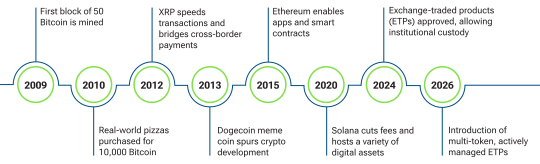
A brief history of crypto
After a groundbreaking white paper signaled the dawn of digital assets in 2008, a wave of early adopters welcomed the concept of a borderless, decentralized currency. The landscape has rapidly evolved—producing new cryptocurrencies, platforms, and applications.
New solutions to stubborn challenges
Assets under management have grown significantly since crypto ETPs were approved to hold tokens directly in 2024—indicating strong investor demand.
The persistent complexities of direct crypto ownership are a key reason why ETPs have emerged as a preferred solution. These vehicles provide crypto exposure with fewer obstacles and risks—especially as the market has evolved to offer multi-token and actively managed products.
Exchange-traded crypto growth
Want to learn more? Explore the history, evolution, and future of digital assets in our brochure.
Active is what we do
T. Rowe Price exchange-traded funds (ETFs) offer the agility of active management to adapt to changing markets.
Learn more about digital assets

Six myths of crypto
Discover the common misconceptions of crypto investing and what investors need to know.

Crypto edges into the mainstream
Frequently asked questions
Digital assets are items of value that exist in digital form and can be owned or transferred electronically. In investing, they most often refer to cryptocurrencies and blockchain-based tokens. Their value is typically driven by supply and demand, network adoption, and real-world use.
This category includes a wide range of assets with distinct characteristics and use cases. Examples include cryptocurrencies such as Bitcoin and Ethereum, utility tokens that power decentralized applications, stablecoins designed to track fiat currencies, and digital collectibles such as NFTs.
Because each type serves a different role, risk and return drivers can vary significantly. Evaluating adoption trends, underlying technology, and network activity can help investors better understand where value may emerge within this evolving asset class.
Digital assets can transfer value, power blockchain-based applications, and enable transactions without traditional intermediaries. Common use cases include:
- Payments and money transfers: Cryptocurrencies can be sent globally, often faster and at lower cost than traditional banking systems.
- Smart contracts and applications: Blockchain networks can run automated agreements that execute when specific conditions are met, reducing the need for intermediaries.
- Digital infrastructure: Tokens can power decentralized platforms for finance, computing, and data management.
Because many digital assets operate on transparent, tamper-resistant blockchain networks, they can improve efficiency, security, and accessibility across financial and technology systems.
Digital assets, including crypto, are generally considered a high-growth, high-volatility asset class. They typically play a satellite role in a diversified portfolio rather than serving as a core holding.
From an asset allocation perspective, they are often evaluated alongside equities or other growth-oriented alternatives. Returns are largely driven by supply and demand, as well as adoption and network effects. Small allocations—often in the low single digits—can influence portfolio outcomes while helping manage overall risk exposure.
As access has expanded through vehicles such as ETPs, digital assets can now be implemented more systematically. Exposure can be sized deliberately, monitored consistently, and integrated into existing portfolio frameworks.
Cryptocurrency (crypto) is a type of digital asset that uses distributed ledger technology to enable peer-to-peer transactions without a central authority. It can be used for payments, held as an investment, or used to power decentralized applications and networks.
Transactions are recorded on distributed ledgers, where data are shared across a network of computers rather than controlled by a single institution. This structure can increase transparency, improve efficiency, and reduce reliance on intermediaries.
Different cryptocurrencies serve different roles. Some are designed primarily as stores of value, while others support applications, facilitate transactions, or provide access to digital infrastructure. Understanding these distinctions can help clarify how each may fit within a portfolio.
Cryptocurrency regulation varies by country and continues to evolve as adoption grows. Many jurisdictions are developing frameworks focused on investor protection, anti-money laundering (AML), and fraud prevention, creating a more structured environment for digital asset investing.
Requirements can differ across regions, affecting how digital assets are traded, held, and reported. At the same time, increased regulatory clarity has supported broader institutional participation.
While the regulatory landscape remains dynamic, the overall trend points toward greater oversight and standardization—similar to other emerging technologies.
Crypto investing involves high volatility, regulatory uncertainty, and market-driven pricing. Prices are often influenced by sentiment, adoption, and liquidity rather than traditional fundamentals.
Market movements can be amplified by relatively low liquidity and rapid shifts in sentiment, leading to significant price swings. In addition, evolving regulations may introduce new risks or constraints depending on the jurisdiction.
Unlike traditional assets, many cryptocurrencies do not generate underlying cash flows, making valuation less straightforward. These factors make careful sizing, diversification, and ongoing monitoring especially important when considering an allocation.
Exchange-traded products (ETPs) are a broad category of investments that trade on exchanges. Exchange-traded funds (ETFs) are a specific type of ETP regulated under the Investment Company Act of 1940.
Both offer professional management, liquidity, and transparency. ETPs can provide exposure to assets such as commodities or cryptocurrencies, while ETFs generally hold registered securities such as stocks and bonds. Some ETPs use alternative structures—such as trusts—to hold assets that may not be permitted in an ETF.
Despite these differences, both ETPs and ETFs share common features, including intraday trading, pricing transparency, and accessibility through brokerage accounts.
Accessing crypto through an exchange-traded product (ETP) can provide a more familiar and practical approach than direct ownership. Instead of managing wallets, private keys, and crypto exchanges—which can introduce complexity and security risks—ETPs offer exposure through traditional brokerage accounts, with institutional custody and standard regulatory reporting.
The ETP structure can also provide access to professional management and, in some cases, diversified exposure across multiple tokens. This can help advisors integrate crypto more efficiently into portfolios.
While ETPs do not eliminate the risks of the asset class, they can simplify implementation and support a more disciplined portfolio construction process.
Contact us


Important Information
Consider the investment objectives, risks, and charges and expenses carefully before investing. For a prospectus or, if available, a summary prospectus containing this and other information, visit troweprice.com. Read it carefully.
ETFs/ETPs are bought and sold at market prices, not NAV. Investors generally incur the cost of the spread between the prices at which shares are bought and sold. Buying and selling shares may result in brokerage commissions, which will reduce returns.
Risk considerations: All investments are subject to market risk, including the possible loss of principal. The Eligible Assets have a relatively limited history of existence and operations compared to traditional commodities. There is a limited established performance record for the price of the assets and, in turn, a limited basis for evaluating an investment. Crypto assets (including the Eligible Assets) have experienced periods of extreme price volatility and their prices may be influenced by, among other things, trading activity and regulatory scrutiny of crypto trading platforms due to fraud, failure, security breaches or otherwise. To the extent that the Fund trades Eligible Assets on crypto platforms and other trading venues, these crypto trading platforms are relatively new. In addition, crypto trading platforms may be lightly regulated, unregulated, or may be non-compliant with existing and applicable regulations in one or more jurisdictions in which they operate. A market disruption, such as a government taking regulatory or other actions that disrupt the crypto asset market, can also make it difficult to liquidate a position. Crypto asset markets in the U.S. exist in a state of regulatory uncertainty, and adverse legislative or regulatory developments could significantly harm the value of the Eligible Assets or the Shares. Regulatory developments such as by banning, restricting or imposing onerous conditions or prohibitions on the use of crypto assets, mining activity, digital wallets, the provision of services related to trading and custody of crypto assets, the operation of the Eligible Asset Networks, or the crypto asset markets generally may adversely impact the value of the Eligible Assets and, therefore, of the Fund. See the prospectus for more detail on the fund’s principal risks.
T. Rowe Price Active Crypto ETF is organized as a Delaware statutory trust. The sponsor of the Trust is T. Rowe Price Sponsor LLC (the “Sponsor”). T. Rowe Price Investment Services, Inc. ("TRPIS") serves as the distributor of the Trust.
202604-5360377