

Article Test—with EM dash
Executive Summary
After a difficult 2015, and despite the prospect of continued weakness in resource-related areas, we see the potential for an uptick in economic growth in 2016. We anticipate that this improvement will be similarly reflected in Australian equity market returns.
In this Price Point, Randal Jenneke, Head of Australian Equities, explains why he is optimistic about 2016, the implications of Australia’s economic transition, and where he sees the best return opportunities emerging.
MORE THAN JUST A RESOURCES STORY
While many people view the Australian economy as being dominated by resources and commodity prices, in reality, this is not actually the case. The Australian economy is transitioning, with more relevant drivers of growth coming to the fore, giving us good reason for optimism in 2016.
The reason why resource areas attract so much attention is because the swings in a cycle, from peak to trough, are often large and spark big movements in commodity prices. Yet, only around 5%1 of the Australian workforce is in mining-related parts of the market. This is in significant contrast to the 40%2 of the workforce that is in retail, construction, and manufacturing. Therefore, from an employment perspective, what matters most are the service parts of the economy, where a much larger percentage of workers are concentrated.
The other key point to understand is that exports make up about 20%3 of the Australian economy, and of the 20%, 30%4 goes to China, which is the country’s biggest export partner. While trade with China is key, it is also important to understand that, compared with many other countries, exports are not a large percentage of the overall economy. Interestingly, one of the growing parts of the Australian export sector is services, specifically education and tourism. These sectors combined are now bigger than iron ore exports. A major change is the significant increase in tourism, driven by the fall in the currency. Having peaked at parity in mid-2011, causing inbound passenger numbers to largely stall, the Australian dollar is now roughly 72 cents5 against the U.S. dollar. This becomes very important from an employment perspective because, unlike the mining sector, the tourism part of the marketplace is very labor intensive. This is one of the reasons why the job market has surprised. Unemployment is currently around 5.9%6 (seasonally adjusted)—better than most people anticipated. Given that so much attention was focused on the mining-related impact, many people failed to pick up on what was happening in other sectors.
The improvement in tourism provides a boost to retail in two ways: More money is being spent by tourists coming to Australia, but there is also less outbound tourism, meaning more people are staying home and spending money. Outbound numbers have fallen from about 10%7 growth back in 2011, when the currency was at parity, to basically being flat at the moment.
Figure 1: Australia—Net Tourist Arrivals Versus Retail Sales
Growth in tourism reflected in improvement in retail sales
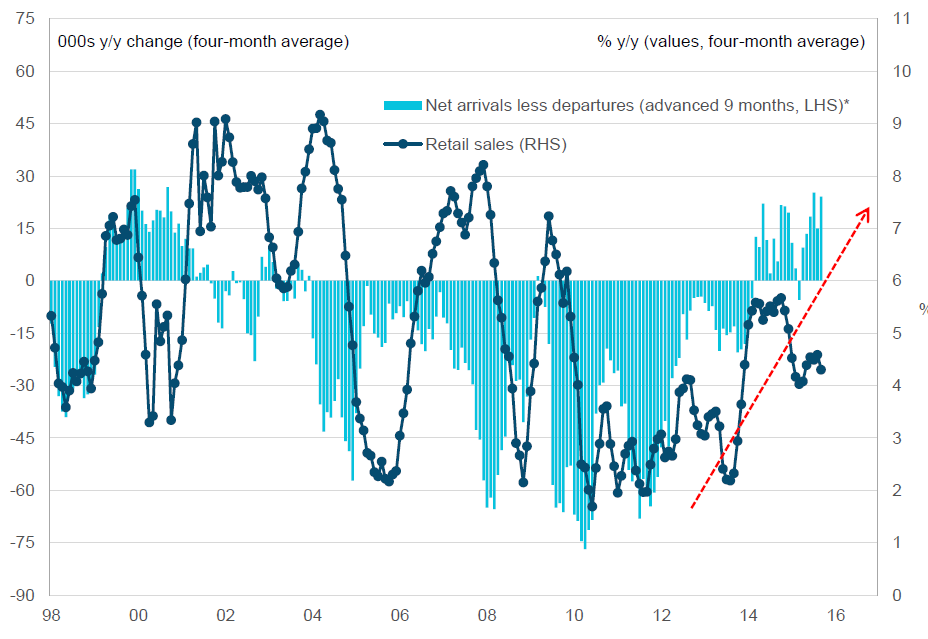
*Growth of short-term visitors less short-term resident departures.
Source: UBS Global Research, September 2015.
A REBALANCING ECONOMY
This is all relevant as it represents a rebalancing of the Australian economy. We are currently shifting away from the growth of five years ago, predominantly driven by the mining-related areas, toward growth driven by the domestic and service-related parts of the economy. Annual GDP growth in Australia has slowed to 2%,8 but we feel that the backdrop is improving and anticipate around 2.5% growth in 2016. Some of this will be driven by the resources sector, as a number of large projects move into the production phase, providing a substantial boost to output volumes. However, we also anticipate further positive impact from tourism while, at the same time, the falling Australian dollar is expected to stimulate the domestic manufacturing and services base.
HOUSING MARKET STRENGTH TO CONTINUE
One prominent area of the Australian economy currently is the housing market, where activity is at multi-decade highs. We anticipate this level of activity continuing for some time. This reflects the capacity constraints that exist, with demand/approvals far outstripping what is physically able to be built, leading to an elongated housing market cycle. Meanwhile, the Reserve Bank of Australia (RBA) also appears ready to ease rates if required. At its November meeting, the RBA kept rates on hold but introduced an easing bias into its accompanying statement. Given we have seen some moderation in housing demand, particularly on the investor side, the RBA appears content to take a wait-and-see approach. Inflation has surprised on the downside, so we believe that there is scope to cut if necessary.
In terms of Australia’s new prime minister, there certainly seems to be more of a can-do attitude compared with the previous administration. If we look at infrastructure, for example, this was going to be one of the signature areas of the previous leadership, but very little was actually achieved. Prime Minister Malcolm Turnbull has a different approach and is keen to get deals done, provided the projects make sense. As such, we anticipate progress on infrastructure development, which should provide a boost to growth and sentiment alike. More recently we have seen business and consumer sentiment improve in anticipation of positive change under the new Turnbull government.
THE CHINA IMPACT
We see the Chinese government continuing to support growth. We do not anticipate the big-bank fiscal stimulus of 2008, but if growth does continue to surprise on the downside, the government will continue to do more. The key consideration for Australia is China’s transition from an old to a new economy. Australia is more tied to the old economy—the large, industrial, fixed-asset investment part of China. That part of China’s economy is likely to be fairly muted in terms of growth and certainly not near the magnitude that we have seen in the past. However, more positively, we anticipate some stabilization, if not improvement, in commodity prices in 2016.
MARKET VALUATIONS APPEAR REASONABLE
Australian equity valuations look reasonable currently, trading at roughly 15 times one-year forward earnings, which is in line with the 20-year average.9 The Australian market also looks more attractively valued compared with global equities. Meanwhile, relative to other asset classes, the equity market again looks appealing, with fixed income, property, and infrastructure all appearing expensive. We expect earnings in 2016 to be pretty flat overall, but drilling down into their composition provides some interesting insights. Unsurprisingly, the major drag on forecast earnings into 2016 is the resource sector and the continuing impact of weak commodity prices. However, looking at earnings from other sectors, ex-resources, we envisage growth of around 5%–6% in 2016. Banks and financials are expected to increase earnings by around 4%–5% and general industrials by a similar amount. The best earnings growth is expected to come from more traditional, long-term growth areas like health care, which our analysis forecasts earnings to grow by around 15%–20%.10
EXPECTATIONS FOR BANKING SECTOR IMPROVEMENT
At the same time, while investors have flocked towards higher-yielding sectors over the past 12 months, such as infrastructure and property, other sectors such as health care and telecoms, have been derated. The banks have also struggled as a result of requirements to hold additional capital and ongoing concerns about a turn in the credit cycle leading to higher bad debts. However, we are not overly concerned about either issue. First, the banks have injected a lot of capital into their businesses, driven by postcrisis regulatory requirements—this now looks to be drawing to an end, which is likely to be positive for the sector. The second issue that has impacted domestic banks has been concerns around the bad debt cycle. The reality is that bad debt levels are at multi-decade lows, so the worry is that, while the situation cannot get much better, it can get considerably worse. So far we are not seeing evidence of this. We expect this scenario to continue, particularly for the domestic mortgage-based banks, where exposure is closely tied to the strong property market. While some of the business banks look more exposed and may be hit on some of their corporate loan exposure, at an overall level, we think the backdrop looks manageable.
The important point to remember about the Australian banking industry is that it is an oligopoly. This is perhaps best evidenced by the banks’ recent repricing of their mortgage books, essentially raising rates themselves without a shift in official interest rates. The action sends an important signal to the market that the oligopoly is still strong and functioning well. If you look at other oligopolies in Australia—supermarkets, general insurance, and telecoms—they are all breaking down. Banks remain the last strong oligopoly, which is a main reason why we have been allocating capital to the sector recently. With the capital requirement issue largely completed, and given the reasonable-looking credit cycle, we think that this is the most attractive the banks have looked in years.
Elsewhere, we like health care, building materials, gaming, and select industrials on the basis that valuations are still reasonable across these sectors. Second, there are stock-specific factors that are attractive, be it exposure to U.S. dollar-earning streams, unique business models, or dominant players in niche markets.
THE OUTLOOK IS NOT WITHOUT RISKS
In terms of potential market risks, valuations in the yield-related parts of the market are a worry, in our view. We have seen 20%–30%11 returns per annum from infrastructure and property in recent years, but how long can that continue? While the business models are reasonable, infrastructure companies, for example, are doing exactly what we saw in the lead-up to the global financial crisis—gearing up significantly in a very low-rate environment. Debt levels for one major infrastructure firm, for example, are higher today than they were pre-crisis, but investors seem comfortable to look past this in their quest for yield. Valuations look stretched in our view, with the risk profile increasing notably. This said, the outflow of capital from China is likely to continue, and we are seeing similar trends in Japan and other Asian countries. Some of this outflow will make its way to Australia, which should provide support to the local property market (and around the world), while other asset classes will continue to benefit also.
Perhaps the main immediate concern is the direction of interest rates. The market continues to price in low bond yields, with the expectation that they will remain low. If this scenario does not play out, for instance if the Fed needs to raise rates further or faster, then this will likely be a challenge for global markets generally, but especially for sectors regarded as bond proxies—like infrastructure. Investors should be clear about the fact that we are in a government bond yield bubble created by central banks, and exactly how this is unwound over the next few years is going to be very important for asset returns everywhere.
The interest rate normalization process is so important because markets, to a large degree, work on expectations. This is one of the reasons why companies around the world are not spending as much on capital expenditure, given there is an expectation that this low rate environment will change and they do not want to get caught short holding a lot of debt at the wrong point in the cycle. So what started out as good central bank policy to stimulate and support economies and markets is turning into a hindrance as it is stopping businesses from resuming normal activity.
With local and global economies looking reasonably healthy, a supportive domestic monetary environment, as well as the lack of attractive asset class alternatives, we believe that the Australian equity market offers the potential for improved returns in 2016.
1 UBS Global Research, September 2015.
2 UBS Global Research, September 2015.
3 UBS Global Research, September 2015.
4 UBS Global Research, September 2015.
5 Reserve Bank of Australia, December 2015.
6 Australian Bureau of Statistics, October 2015
7 UBS Global Research, September 2015.
8 Reserve Bank of Australia, November 2015.
9 Thomson Reuters, November 2015.
10 T. Rowe Price, November 2015.
11 Thomson Reuters, November 2015.
2015-GL-3117
重要情報
当資料は、ティー・ロウ・プライス・アソシエイツ・インクおよびその関係会社が情報提供等の目的で作成したものを、ティー・ロウ・プライス・ジャパン株式会社が翻訳したものであり、特定の運用商品を勧誘するものではありません。また、金融商品取引法に基づく開示書類ではありません。当資料における見解等は資料作成時点のものであり、将来事前の連絡なしに変更されることがあります。当資料はティー・ロウ・プライスの書面による同意のない限り他に転載することはできません。
資料内に記載されている個別銘柄につき、売買を推奨するものでも、将来の価格の上昇または下落を示唆するものでもありません。また、当社ファンド等における保有・非保有および将来の組入れまたは売却を示唆・保証するものでもありません。投資一任契約は、値動きのある有価証券等(外貨建て資産には為替変動リスクもあります)を投資対象としているため、お客様の資産が当初の投資元本を割り込み損失が生じることがあります。
当社の運用戦略では時価資産残高に対し、一定の金額までを区切りとして最高1.265%(消費税10%込み)の逓減的報酬料率を適用いたします。また、運用報酬の他に、組入有価証券の売買委託手数料等の費用も発生しますが、運用内容等によって変動しますので、事前に上限額または合計額を表示できません。詳しくは契約締結前交付書面をご覧ください。
「T. ROWE PRICE, INVEST WITH CONFIDENCE」および大角羊のデザインは、ティー・ロウ・プライス・グループ、インクの商標または登録商標です。
ティー・ロウ・プライス・ジャパン株式会社
金融商品取引業者関東財務局長(金商)第3043号
加入協会:一般社団法人日本投資顧問業協会/一般社団法人投資信託協会
