

Asian Equities: An Improving Outlook, but Expect Further Volatility
Executive Summary
- After a difficult 2015, the outlook for the Asia ex Japan region looks more promising in 2016, with supportive macro influences and appealing valuations expected to encourage capital inflows. Moderating growth in China remains a headwind; however, the transition toward lower, but more sustainable, growth is likely to be a positive for the region over the long term.
- In this Price Point, T. Rowe Price Asia ex Japan Equity Strategy Portfolio Manager Anh Lu explains why she remains optimistic about Asia ex Japan, the implications of China’s economic transition, and where she sees the best return opportunities emerging.
While growth rates in Asia ex Japan remain below their longer-term potential and markets continue to show volatility, on balance, we remain broadly positive about the outlook for 2016, although we expect a mixed overall environment. We anticipate incremental improvements in a number of economies over the coming year, while we should also start to see some improvement in corporate earnings delivery.
Perhaps most significant is the fact that Asia ex Japan market valuations currently appear cheap compared with global equity valuations. At the end of October 2015, a relative valuation discount, the size of which we have not seen for over a decade, had opened up between Asia ex Japan equities, trading at a price/earnings (P/E) multiple of 11.45x, and global equities, trading at 15.98x P/E (Figure 1). If earnings growth improves in 2016, as we expect they will, this could support an upward rerating of the Asian index. Also encouraging is the fact that a number of the macro influences that have previously worked against the region now appear to be easing. The sharp decline in the oil price is one such example that is very supportive for the majority of countries in the Asia ex Japan region.
Figure 1: Asia Ex Japan Valuation Appeal
As of 31 October 2015
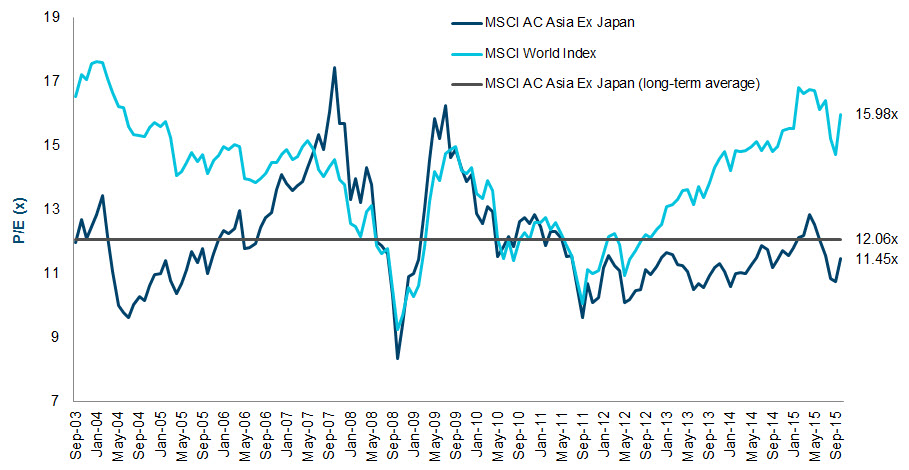
Sources: FactSet, MSCI AC Asia Ex Japan, and MSCI World, in USD.
Past performance is not areliable indicator of future performance.
IF THERE WAS EVER ANY DOUBT…
As to the major influence that China continues to exert across the Asia ex Japan region, one need only look to the volatility of recent months, with equity markets across the region tumbling in sympathy with the dramatic third-quarter slump in the Chinese stock market. This served to highlight the country’s slowing economy, as well as the significant knock‐on effects for both commodity and currency markets, due to China’s position as one of the world’s biggest consumers of oil and metals. A policy decision in August to weaken the renminbi reference rate raised further fears about the health of the country’s economy and led other regional currencies to tumble as investors fled riskier assets. At the end of October 2015, the MSCI AC Asia ex Japan Index was down to -7.72%, year-to-date, underperforming the MSCI World Index (+1.88%) by more than 9%.1
THE CHINA REBALANCING CHALLENGE
We expect to see a gradual slowdown in the world’s second‐largest economy over the coming years, as China continues to transition away from state-funded, investment-led growth toward a more market-driven model, where consumption and services are the main growth drivers. In early November, China outlined its latest five-year economic growth plan (plenum), reinforcing its commitment to slower, more sustainable, and environmentally friendly growth with an emphasis on social support structures. In the meantime, as recent actions have shown, the Chinese government has a number of policy options it can implement in order to encourage economic growth and underpin confidence in local markets.
While we remain concerned by the imbalances within the Chinese economy (rapidly rising credit growth and deteriorating demographics, for example) and the challenges of rebalancing growth without causing major systemic stress, we also recognize the potential for certain sectors and stocks to benefit from the transition, and from what is evidently a reform‐minded government in China. Further progress in social reform (positive for consumption) and state-owned enterprise (SOE) reform (better incentivizing of managers via stock ownership, etc.) would make us incrementally more positive on some segments of the stock market. Overall, we continue to favor new economy (Internet and consumer) stocks. Among our largest absolute positions are names that include China’s dominant PC/mobile social platform, the country’s leading search engine, and two of the largest e-commerce companies. All stand to benefit as e‐commerce and mobile search penetration accelerates. We also look for opportunities in select SOEs where we see the potential to benefit from structural reform. Conversely, we have no exposure to Chinese banks due to ongoing concerns about rising bad debts and the quality of balance sheets.
IS INDIA READY TO DELIVER?
As the fastest-growing economy in the region, we remain optimistic about India’s prospects for positive change over the medium term. However, we acknowledge that this is a multiyear process, and we are mindful that certain stocks/sectors are already pricing in much of the anticipated good news. In the near term, we need to see earnings growth coming through in order to justify these premium valuations. GDP forecasts for 2015 were revised downward in August, prompting swift action from the central bank in a bid to boost growth. A larger‐than‐expected half a percentage point cut in interest rates has, so far, failed to have a sentiment-boosting effect, with investors seemingly concerned about the pace of reform as well as being disappointed in the earnings delivery. We believe the economy is improving and that reform is on the agenda; however, expectations as to delivery probably need to be reset with a longer time frame in mind. More positively, India is a particularly heavy importer of oil and has continually battled against fiscal deficits and high inflation. However, as the price of oil has declined over the past year, so too has inflation fallen to a record low, allowing the Reserve Bank of India to commence an easing cycle. We remain overweight India, with a portfolio balanced between domestic cyclicals and export beneficiaries. Our top relative positions include one of India’s largest private banks with a well‐known retail banking brand and two leading IT services exporters, both with strong global exposure.
OLD-FASHIONED STOCK PICKING, FOCUSING ON HIGH-CONVICTION IDEAS
Of the developed Asian markets, our largest overweight position is in Hong Kong. This is not so much a result of a particular view on the local economy or the links with China, but rather it is driven by stock-specific factors. We find that Hong Kong is the primary listing for some of the regions and, indeed, the world’s leading businesses. Our exposure includes companies from a range of sectors, including financial and real estate names through to consumer brands. Elsewhere, we continue to underweight some of the other larger and more externally facing emerging markets of Asia—notably South Korea and Taiwan. That said, both markets are home to a number of large, multinational companies that are global leaders in their fields. We continue to look for and identify companies that have been able to diversify outside of the domestic markets in search of growth. We are concentrating our exposure on companies that are expanding, or have the potential to expand, their market share, either locally or abroad. A good example of this is our holding in Taiwan’s largest convenience store operator, which successfully expanded its franchise operations from Taiwan to eastern China and the Philippines.
TWO SMALL STOCK MARKETS, BUT HOME TO 350 MILLION PEOPLE
Cheaper oil and food commodities have provided a major boost for the Philippine economy, given that consumption accounts for a substantial proportion of national GDP. Meanwhile, a combination of overseas foreign worker remittances and the business process outsourcing industry growing at a rapid pace has led to a virtuous cycle, with income growth leading to consumption and property sales, which in turn leads to more private sector investment and employment creation. Balancing the strong macro picture is the fact that the Philippines is a small stock market, so opportunities are few and tend to trade at relatively high multiples, making selectivity important. The Philippines will also see a new president elected in May 2016, an event that may see some associated market volatility. Our largest relative position is in the Philippines’ largest bank (by loans and assets), which is so well placed given the early stage of the credit cycle.
While we are currently underweight in Indonesia, this is a market where we see turnaround potential. While growth has disappointed in recent years, we anticipate the economy will bottom out in 2016, while there is scope to cut interest rates, if necessary, in order to boost growth. Indonesia’s President Widodo looks to be consolidating his power and pushing ahead with his liberal reform agenda, including trade deregulation. Momentum is also building in terms of infrastructure development and levels of foreign investment. Our exposure currently includes the country’s largest and best-quality bank, as we expect it will be a late beneficiary of the rate cut cycle.
A KEY RISK
A key risk to our constructive outlook remains the U.S. rate-hiking cycle; by the start of 2016, we may have seen the first increase in nine years. When interest rates do start to rise, markets may suffer a mini sell‐off as the hunt for higher yields pulls money out of Asian bonds and currencies; however, this is widely expected and so priced in to valuations. Furthermore, if rates move moderately higher because the U.S. economy is doing well, that would be good for the global economy, including Asian markets. We should be mindful, however, that a more aggressive hiking cycle than anticipated is not yet priced in to Asia ex Japan stocks.
POTENTIAL VOLATILITY BRINGS WITH IT OPPORTUNITY
Importantly, a number of macro factors are turning positive, and some of the external vulnerabilities that regional economies showed in the face of rising global yields in mid‐2013 have eased. For those economies with external deficits, notably India, much progress has been made toward closing those deficits to more manageable levels, and currencies have adjusted downward, further cushioning the potential impact of rising interest rates going forward. Regarding China, the long-term economic trend is set to continue, in our view, with growth slowly moderating as the government focuses on the quality and sustainability of the growth, rather than the magnitude. In the near term, the support mechanisms are available, if required, in the form of fiscal stimulus, rate cuts, and reserve requirement ratio cuts. We also expect to see a managed devaluation of the renminbi over the coming year as China moves to a more flexible exchange regime. For the region at large, investors can expect further periods of China-related fear and optimism but also stock markets that continue to provide good opportunities for long-term investors to add to the Asia ex Japan asset class.
MSCI makes no express or implied warranties or representations and shall have no liability whatsoever with respect to any MSCI data contained herein. The MSCI data may not be further redistributed or used as a basis for other indices or any securities or financial products. This report is not approved, reviewed, or produced by MSCI.
1Source: Thomson Reuters as of 31 October 2015, in USD.
2015-GL-3079
重要情報
当資料は、ティー・ロウ・プライス・アソシエイツ・インクおよびその関係会社が情報提供等の目的で作成したものを、ティー・ロウ・プライス・ジャパン株式会社が翻訳したものであり、特定の運用商品を勧誘するものではありません。また、金融商品取引法に基づく開示書類ではありません。当資料における見解等は資料作成時点のものであり、将来事前の連絡なしに変更されることがあります。当資料はティー・ロウ・プライスの書面による同意のない限り他に転載することはできません。
資料内に記載されている個別銘柄につき、売買を推奨するものでも、将来の価格の上昇または下落を示唆するものでもありません。また、当社ファンド等における保有・非保有および将来の組入れまたは売却を示唆・保証するものでもありません。投資一任契約は、値動きのある有価証券等(外貨建て資産には為替変動リスクもあります)を投資対象としているため、お客様の資産が当初の投資元本を割り込み損失が生じることがあります。
当社の運用戦略では時価資産残高に対し、一定の金額までを区切りとして最高1.265%(消費税10%込み)の逓減的報酬料率を適用いたします。また、運用報酬の他に、組入有価証券の売買委託手数料等の費用も発生しますが、運用内容等によって変動しますので、事前に上限額または合計額を表示できません。詳しくは契約締結前交付書面をご覧ください。
「T. ROWE PRICE, INVEST WITH CONFIDENCE」および大角羊のデザインは、ティー・ロウ・プライス・グループ、インクの商標または登録商標です。
ティー・ロウ・プライス・ジャパン株式会社
金融商品取引業者関東財務局長(金商)第3043号
加入協会:一般社団法人日本投資顧問業協会/一般社団法人投資信託協会


