

Global Markets: China and Global Market Volatility
THE DEVALUATION
On August 11, 2015, China’s central bank allowed its currency to weaken by 1.9% against the U.S. dollar—the largest one-day devaluation in two decades. Some observers believe China took this action to spur its economy and exports and to improve its international competitiveness. The currency has fallen further since then, amounting to about a 4% devaluation. It is possible that further devaluation will be allowed to occur.
Over the past three years, the U.S. dollar has strengthened against the Japanese yen, the euro, and many emerging markets currencies. However, China’s yuan had been loosely pegged to the rising U.S. dollar. While the U.S. economy has strengthened, China’s economy has weakened on a relative basis, resulting in a steady erosion of its global competitiveness. China has been steadily losing ground to other exporters due to rising labor costs, so it makes sense that there has been growing pressure on the currency on a trade-weighted basis.
While boosting the economy appears to be part of China’ motivation to devalue, we believe China’s decision was also intended to move toward a more flexible, market-oriented exchange rate, with the ultimate goal of making the yuan a fully floating global reserve currency, such as the U.S. dollar, the euro, pound, and yen are today. Last May, the International Monetary Fund (IMF) urged China to achieve a floating exchange rate within two to three years and said it will decide in September 2016 whether the Chinese yuan would be eligible for the status of a reserve currency. Longer term, the country aims to open up its capital markets and its currency to foreigners.
China, however, faces some significant obstacles to achieving this goal. Because China is a command economy, allowing the exchange rate to be driven by market forces is a major step. In addition, the authorities have to manage the market’s expectations to stanch the capital outflows from China likely to result from the devaluation and market sell-off.
As China allows its currency to be more flexible, the market will expect the yuan to depreciate. Those expectations could create a self-fulfilling prophecy and lead to more capital outflows and even more pressure to depreciate. To avoid that undesirable scenario, the authorities are reassuring the market that they have plenty of foreign currency reserves to support the currency.
In the near term, given China’s slowing economy and the divergence in global central bank policy, we anticipate continued pressure for capital to flow out of China and further yuan weakness.
China Real GDP Year-to-year % Change
As of June 30, 2015
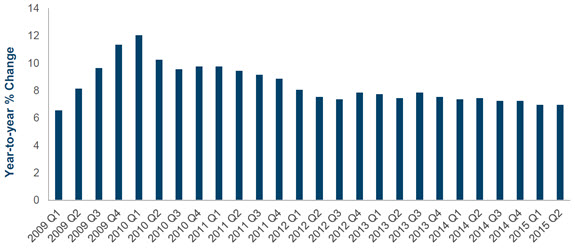
Source: China National Bureau of Statistics
THE ECONOMY
The government’s unsuccessful attempts to stem the stock market selloff have renewed investors’ fears that China’s economy is lagging the official 7% growth target for 2015, which ranks as China’s slowest growth rate in a quarter century. Recent data suggest that core parts of the economy—such as exports and manufacturing—have been declining. However, China maintains sufficient firepower to provide support for the economy in coming months.
China’s economy has been driven by manufacturing, which is experiencing a significant slowdown. However, the economy is shifting more toward domestic services and consumption, a secular shift that will take many years and would be a positive development over the long term. Indeed, China’s economy is still growing faster than that of virtually every other major economy, but the rate of growth will continue to decelerate as its economy matures and becomes more developed and balanced.
China has experienced a dramatic run-up in domestic leverage, and that has historically been correlated with financial problems and economic slowdowns in many countries. As a result, it is difficult to predict how much the economy will slow over the coming years. Until the financial markets are comfortable with the “new normal” of a slower growth trend in China, investor uncertainty will likely persist about how China is managing its economy as it becomes more market-driven.
Indeed, we’ve long believed that China’s transition from a state-controlled to a more market-driven financial system would be part of a lengthy learning curve. We would not be surprised to see a pause in this process or periods in which the government reverts to prior policies to manage its financial system and the overall economy.
CAPITAL FLIGHT
The capital outflows from China and other emerging markets intensified over the past week, raising fears of a repeat of the 1997-1998 Asian currency crisis. However, there are significant differences between now and then.
Currently, debt levels have risen sharply across Asia, but debt is largely domestically owned and denominated in local currencies. Inflation is low, and most of the region runs current account surpluses. Additionally, countries with current account deficits are in much stronger financial positions since the “taper tantrum” in 2013 sparked an emerging markets selloff. Foreign exchange reserves are generally high, and financial institutions across the region are functioning well. While there could be more volatility as the Federal Reserve begins to raise interest rates, we believe Asian economies should successfully weather rising rates, especially if the Fed proceeds gradually as expected.
Another difference is that in 1997, several Asian countries had accumulated large amounts of U.S. dollar denominated debt that they could not service as their currencies declined in value. In contrast, China’s corporate sector by and large has not had access to foreign-denominated debt. Some pockets in the corporate sector have conducted foreign currency borrowing, particularly in the property and natural resources areas. But on the whole, the currency mismatch is more limited, so there is less potential for a violent adjustment as we saw in Southeast Asia in the late 1990s.
One reason capital is flowing out of China is that there are more attractive places to invest given the slowing economy. Indeed, the Chinese government is actively encouraging corporations to invest abroad. Another reason is that because China has maintained capital controls for so long, domestic companies and individuals have very few foreign assets and are not globally diversified. As capital controls are relaxed, investors will likely seek to acquire foreign assets to create more diversified portfolios.
THE STOCK MARKET
Leverage is one factor that drove the China market up so swiftly and down so dramatically this year. The average Chinese household was able to invest on margin, which is advantageous for investors when the market rises, but can be painful in down markets. In response, the government has tightened much of the margin financing that was available to individual domestic investors, tempering the speculation that helped drive the market over the past year.
Amid the extremely sharp selloff in China and other Asian emerging markets, valuations in some sectors are becoming more attractive.
Our Asian and emerging markets portfolios are focused on higher-quality companies, and we have extremely limited exposure to firms with stressed balance sheets. We have been adding to positions in our high-conviction holdings throughout the region.
The onshore Chinese stock market—called the A-shares market—is largely restricted to mainland investors who tend to be short-term oriented with a get-rich-quick mentality. As such, we focus most of our Chinese investments in stock markets outside the mainland, notably Hong Kong—a much more mature, less volatile market. While we believe the A-shares market is still overvalued, particularly among small-cap stocks, we are finding attractive opportunities in some of the large blue-chip stocks.
2015-GL-2432
重要情報
当資料は、ティー・ロウ・プライス・アソシエイツ・インクおよびその関係会社が情報提供等の目的で作成したものを、ティー・ロウ・プライス・ジャパン株式会社が翻訳したものであり、特定の運用商品を勧誘するものではありません。また、金融商品取引法に基づく開示書類ではありません。当資料における見解等は資料作成時点のものであり、将来事前の連絡なしに変更されることがあります。当資料はティー・ロウ・プライスの書面による同意のない限り他に転載することはできません。
資料内に記載されている個別銘柄につき、売買を推奨するものでも、将来の価格の上昇または下落を示唆するものでもありません。また、当社ファンド等における保有・非保有および将来の組入れまたは売却を示唆・保証するものでもありません。投資一任契約は、値動きのある有価証券等(外貨建て資産には為替変動リスクもあります)を投資対象としているため、お客様の資産が当初の投資元本を割り込み損失が生じることがあります。
当社の運用戦略では時価資産残高に対し、一定の金額までを区切りとして最高1.265%(消費税10%込み)の逓減的報酬料率を適用いたします。また、運用報酬の他に、組入有価証券の売買委託手数料等の費用も発生しますが、運用内容等によって変動しますので、事前に上限額または合計額を表示できません。詳しくは契約締結前交付書面をご覧ください。
「T. ROWE PRICE, INVEST WITH CONFIDENCE」および大角羊のデザインは、ティー・ロウ・プライス・グループ、インクの商標または登録商標です。
ティー・ロウ・プライス・ジャパン株式会社
金融商品取引業者関東財務局長(金商)第3043号
加入協会:一般社団法人日本投資顧問業協会/一般社団法人投資信託協会
Executive Summary
China’s recent moves to devalue its currency amid slowing economic growth have sparked sharp declines in global markets. While the Chinese government moved to arrest the slide by cutting interest rates and reducing reserve requirements to encourage bank lending, the investment environment is likely to remain volatile for some time. In this Price Point, Eric Moffett, portfolio manager of the Asia Opportunities Strategy, and Chris Kushlis, a fixed income sovereign analyst covering Asian markets, explain the reasons for the market turmoil, the challenges China is likely to face, and their perspective on investment opportunities as a result of market dislocations.


