

Global Equities: Getting Ready for the Next Phase of the Cycle
EXECUTIVE SUMMARY
The low-growth, low-yield environment that has persisted since the global financial crisis has significantly influenced investor and corporate behavior and established a conventional wisdom that we are in a period of secular stagnation. Businesses have been reluctant to invest and investors have favored defensive strategies, pouring money into lower-volatility and yield-oriented segments of the market, irrespective of signs of a growing bubble.
However, given the lack of both replacement and expansionary investment, we’ve seen tighter capacity and bottlenecks form in some industries—creating the opportunity for pricing power and revenue growth with even modest improvement in demand. A global boom in mergers and acquisition (M&A) is accelerating this process of capacity rationalization.
Indeed, rather than a “new normal” economy, we expect the “old normal” will emerge with improving returns on capital leading to rising capital investment, corporate expansion, wage inflation, and increasing demand.
Investors should be positioning their portfolios for the next phase of the cycle as the Federal Reserve signals raising rates later this year. Those who remain in a deflationary mind-set—clinging to yield-oriented securities and defensive sectors—may regret the missed potential opportunities offered by an expanding global economy and a fundamental change in corporate thinking.
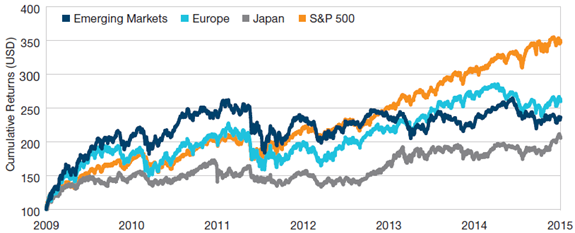
March 2015 marked the six-year anniversary of global equity markets bottoming, with the subsequent recovery delivering some of the best returns in a generation. Markets defied strong economic and geopolitical headwinds, as well as intense investor skepticism in some quarters.
Global equities have gained 188% over the recovery period (as measured by the MSCI AC World Index), led by the United States, which has seen profit growth surge, ironically, amid one of most tepid economic recoveries within a bull market cycle over the past 30 years.
Unprecedented monetary stimulus and historically low interest rates have been major catalysts for the resurgence in equity markets. At the same time, however, the magnitude of the accommodation by central banks, amid a persistently sluggish economic environment, has dramatically affected investor psychology and capital allocation decisions by businesses. Market participants have responded to this stimulus with a deep pessimism for the global economy.
In a world that has been deleveraging since the financial crisis, many investors, corporate chief executives, and Boards of Directors have fallen prey to a deflationary, defensive mind-set sustained by the view that we are trapped in a prolonged low-growth, low-yield environment—a new normal or period of “secular stagnation,” as described by economist and former US Treasury Secretary Lawrence Summers.
Figure 1: U.S. Leads Global Market Recovery: Regional Returns (in USD) from the Market Bottom
March 9, 2009, to March 31, 2015
Investors and CEOs Play Defense
One manifestation of this paradigm has been a market rally led decisively by defensive sectors. Investors have flocked to less volatile and higher-yielding equities, believing that they would deliver bond-like volatility with equity-like returns. We believe this has given rise to a yield-oriented market bubble that is still unwinding today.
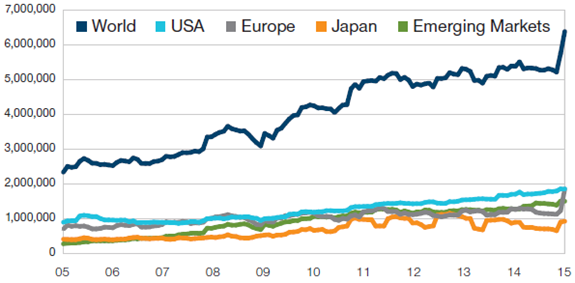
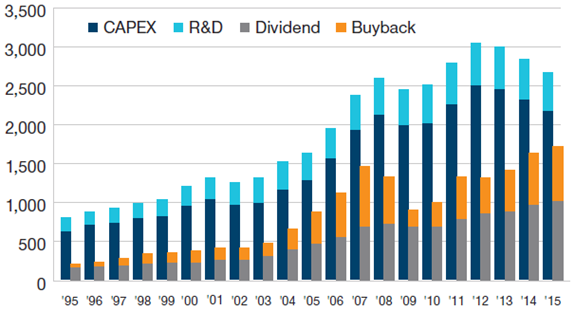
Companies have shown similar caution with a reluctance to invest in their businesses, opting to cut costs and allocate their growing stockpiles of cash to share repurchases and dividend increases to satisfy investors and boost their stock prices.
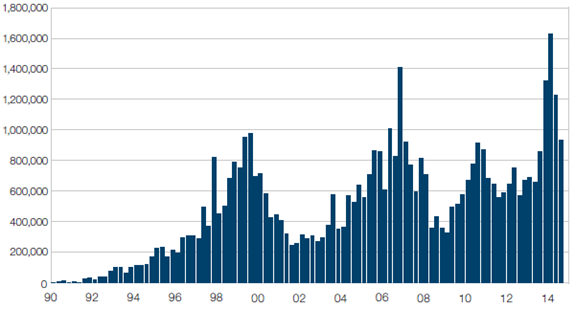
Recently, there have been signs of change in this approach to capital allocation, indicating animal spirits may finally be returning. With relative stealth, corporate management teams over the past year have embarked on what may become one of the greatest M&A sprees ever, taking advantage of cheap money while it lasts and the market’s favorable reception to deals. The stock market is rewarding and reinforcing this behavior, as the stocks of both the acquirer and the acquired have risen on such announcements—an unusual development given the historical failure of acquisitions in terms of shareholder value creation.
Figure 2: Global M&A Announcements Transaction Value Quarterly ($USD)
As of March 31, 2015
Source: FactSet.
Figure 3: Cash on Balance Sheets ($USD) Aggregate of All Companies in MSCI Index
January 2005 to March 2015
Source: FactSet.
This M&A boom is enabling companies to realize cost efficiencies and benefit from industry consolidation. They are moving from a mind-set of returning capital outright to deploying it to consolidate industries.
The surge in activist investment in recent years has also been a catalyst for these trends, pushing managements to return capital to shareholders or deploy their record-high cash hordes into M&A and other strategic initiatives to unlock value. We believe the rise in investor activism itself can be viewed as a reaction to the extremely cautious business behaviour since the financial crisis.
However, capital expenditure and investment continues to languish and will be needed as an important driver of incremental demand in the next phase of the economic cycle. Excluding energy investment, capital expenditure in the U.S. is still below the level reached in 2007. This contrasts with production capacity utilization in the U.S. and Europe, which is now approaching levels prior to the financial crisis. Such tightening could be a precursor of inflation and, eventually, an investment cycle.
These developments have tightened capacity and created bottlenecks in some parts of the global economy, including housing in the United States and United Kingdom, skilled labor, and even segments of commercial banking, which has seen significant consolidation over the past five years.
Other examples include commercial cement, which has moved from excess capacity to virtually no availability in most major U.S. markets until 2016, and U.S. shortages of many injectable drugs. In Spain, the number of major banks has fallen from about 40 to just a handful, as the struggle for survival has forced industry consolidation.
On the positive side, this trend has created a fertile environment for improving return on capital. Even a moderate pickup in demand will provide opportunity for greater pricing power, a powerful driver of stock returns. This will spur corporate spending and wage inflation, which will support further economic expansion.
Indeed, new normal economic behaviour is steadily returning us to the old normal economy. Improving returns on capital should lead to greater capital investment, corporate expansion, wage inflation, and increasing demand.
To be sure, moving beyond a deflationary, defensive mind-set to an inflationary mind-set takes time, but it is already underway. One reason companies are acquiring each other at a record pace is precisely because the price of acquisition will be higher tomorrow and the quality of the target company likely less attractive. The more investors and companies become concerned with prices rising in the future, the more economic activity is pulled into the present.
The contrast between the energy and airline industries since the global financial crisis provides a mirror image of how this transition from a deflationary to inflationary mind-set can unfold across an industry’s life cycle.
Figure 4: Global Investment and Payout ($USD)
As of February 28, 2015
Sources: FactSet, Citi Research, Worldscope.
Figure 5: Global Listed Corporate Investment/Payout Ratio
As of February 28, 2015
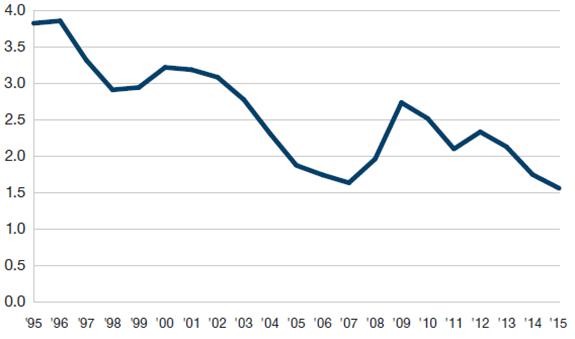
Sources: FactSet, Citi Research, Worldscope.
ROLE OF THE FED AS CATALYST
In the shorter term, investors are worried about the potential effect on markets and the economy when the U.S. Federal Reserve reverses policy and starts raising short-term interest rates. Looking through the noise of first tapering and now tightening, such a move by the Fed has real positive implications and should ultimately serve as a catalyst in this transition from a deflationary to inflationary mind-set.
We believe investors should be asking themselves three questions regarding Fed policy in order to assess the future:
Are interest rates going to rise in the next two or three years?
We believe yes. In our view, the job of Federal Reserve Chair Janet Yellen is to remove excessive accommodation from the U.S. economy and move toward normalization.
Is this going to affect U.S. financial assets?
There will be more volatility, especially in bond markets, but also in stocks that have benefited from the low-yield, slow-growth environment as investors begin adjusting to a new paradigm in which the price of money goes up. While broader equity assets may experience volatility as well, this will provide an invaluable opportunity to refresh portfolios given the longer-term trend of an improving global economy.
Will the Fed’s rate increases lead to a recession?
We doubt it. When an economy is overheating and the Fed is forced to raise rates to exert harsh but necessary control, investors worry that growth will slow or collapse. In this case, the U.S. economy is certainly not overheating, and rate rises are likely to be modest and gradual. In short, we’re not moving from the largest level of monetary accommodation in a generation to tight monetary control overnight; we are seeing a gradual process of normalization from an extreme that many have come to misperceive as “normal.”
The Fed is walking a tightrope of setting policy based on the path of economic growth and inflation while being mindful that the timing and communications surrounding policy change could influence market behavior and undermine business confidence.
We believe that rising rates should eventually spur economic activity as investors and companies realize that prices tomorrow will be higher than they are today. Rate normalization will cause less deflationary behavior and make people think differently about the future; this is how an inflationary mind-set begins to take hold.
Meanwhile, as investors worry about rising rates in the U.S., central banks in Europe and Japan are pursuing more accommodative policies, which should help jump-start those economies, especially as currency movements redistribute relative growth to some extent. Economic cycles in other developed markets are lagging the U.S. recovery, but we expect that the same deflationary to inflationary process will eventually unfold in those regions.
PORT FOLIO POSITIONING WITH AN EYE TO CHANGE
As we go through this transition, investors should consider how they want to be positioned for the next two or three years. We focus on businesses with improving economic returns over time - driven by innovation, changing industry structure, regulation, and other forces - and we try to be there early.
As the regime of excessive accommodation comes to an end, we want exposure to companies that see profits and margins rise along with interest rates, so we find large U.S. financials attractive. This sector has faced stiff headwinds, but it is one of the few in the U.S. market where valuations are historically low.
While financial companies have been constrained in the amount of capital they can pay out, the tough regulatory environment should start to improve or at least stabilize. Leading banks will benefit from rising rates and volatility during the transition to a more inflationary economy. The returns of those businesses should improve.
Given our expectation that we are likely to see a healthier global economy than many investors expect, we have also increased our focus on companies that will benefit from tight supply conditions after years of underinvestment, industry consolidation, and capacity retrenchment.
These include industrials, such as aerospace, transportation, non-residential construction, and home building materials firms. We are also overweight technology and consumer discretionary stocks—areas where there is significant change and industry structures and pricing can improve quickly. We have been underweight sectors that have benefited from the defensive yield trade, such as consumer staples, utilities, and telecommunications.
Many of our technology holdings are Internet companies, where we see phenomenal change and real long-term economic benefits to successful innovators. The shifts toward greater connectivity, mobility, and use of cloud software applications are powerful long-term trends, and the markets for consumer and enterprise technology products are expanding in all regions.
Innovation and the potential for medical breakthroughs have created investor frenzy for biotechnology, but stock valuations have reached levels that are bound, at some point, to lead to investor disappointment. We worry about a sector rotation out of biotechnology stocks, especially as other areas of the global economy show signs of life. Longer term, however, the health care sector is a fertile area for growth given the secular trends of an aging population in developed markets and a wealthier population in emerging markets.
The normalization in U.S. interest rates and changes in investor psychology and corporate behavior will create more volatility but also attractive investment opportunities. Investors should be prepared to take advantage of the new regime—looking beyond the near-term challenges to a different environment than the one that has prevailed in recent years.
If there is a bubble in today’s market environment, it is the widespread belief in secular stagnation. The future holds great promise, and we want to give global investors an opportunity to participate in the opportunities to come.
Figure 6: Regional and Sector Positioning of the Global Focused Growth Equity Strategy
As of March 31, 2015
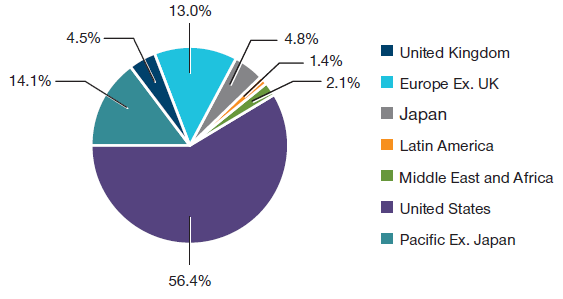
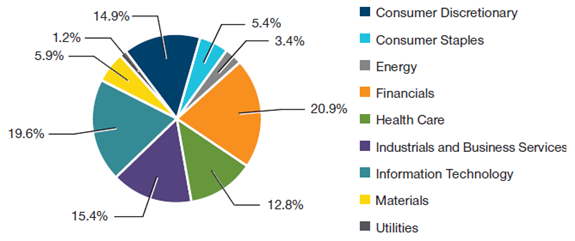
Source: T. Rowe Price.
The figures represented do not include data from Canada, which accounts for 3.06% of the portfolio.
2015-GL-1815
重要情報
当資料は、ティー・ロウ・プライス・アソシエイツ・インクおよびその関係会社が情報提供等の目的で作成したものを、ティー・ロウ・プライス・ジャパン株式会社が翻訳したものであり、特定の運用商品を勧誘するものではありません。また、金融商品取引法に基づく開示書類ではありません。当資料における見解等は資料作成時点のものであり、将来事前の連絡なしに変更されることがあります。当資料はティー・ロウ・プライスの書面による同意のない限り他に転載することはできません。
資料内に記載されている個別銘柄につき、売買を推奨するものでも、将来の価格の上昇または下落を示唆するものでもありません。また、当社ファンド等における保有・非保有および将来の組入れまたは売却を示唆・保証するものでもありません。投資一任契約は、値動きのある有価証券等(外貨建て資産には為替変動リスクもあります)を投資対象としているため、お客様の資産が当初の投資元本を割り込み損失が生じることがあります。
当社の運用戦略では時価資産残高に対し、一定の金額までを区切りとして最高1.265%(消費税10%込み)の逓減的報酬料率を適用いたします。また、運用報酬の他に、組入有価証券の売買委託手数料等の費用も発生しますが、運用内容等によって変動しますので、事前に上限額または合計額を表示できません。詳しくは契約締結前交付書面をご覧ください。
「T. ROWE PRICE, INVEST WITH CONFIDENCE」および大角羊のデザインは、ティー・ロウ・プライス・グループ、インクの商標または登録商標です。
ティー・ロウ・プライス・ジャパン株式会社
金融商品取引業者関東財務局長(金商)第3043号
加入協会:一般社団法人日本投資顧問業協会/一般社団法人投資信託協会
