

Oil price volatility: Focus on the fundamentals to navigate your way to long-term rewards
Executive Summary
There has been much focus and scrutiny in the media about the sharp fall in oil prices, but what does this really mean for Middle East, Africa and Frontier markets?
In this Price Points, Oliver Bell, portfolio manager for T. Rowe Price’s Global Frontier Markets and Middle East & Africa strategies, discusses who the winners and losers are from oil price declines. However, he also highlights why an increasingly large opportunity set allows experienced managers to navigate their portfolio through some of the volatility in oil prices.
STRUCTURAL CHANGES CAUSING A FALL IN OIL PRICES
Global oil prices have fallen sharply over the last six months. Much of this has been caused by a rise in the U.S. dollar and a general slowdown in global economic activity, especially in places like China and other emerging markets. However, the rise of shale–fracking and recent decisions from OPEC are causing more structural headwinds for oil prices.
Forecasts for U.S. energy production have risen dramatically in recent years as new technologies for oil and gas production have revolutionized the market. For the U.S., oil imports are down one-third in the last five years, and the U.S. is adding 1m – 1.5m barrels a day to their annual production at the moment. That is equivalent to the size of Libya when it is operating at full capacity.
The shale revolution is not unique to the U.S., however. The U.S. Energy Information Administration (EIA) analysis group has stated that there are in excess of 1.5 trillion shale resources elsewhere in the world, with Russia, China, Argentina and Libya in the top five (U.S. is second to Russia).
My colleague, Shawn Driscoll, who manages the T. Rowe Price Natural Resources strategies, has been saying for some time that oil prices were unsustainably high, and that oil prices could fall below the US$60-a-barrel range over the next couple years. For him, how low depends on just how much technological innovation continues to cut drilling break-even costs.
WHAT DOES THIS MEAN FOR MIDDLE EAST, AFRICA AND FRONTIER MARKETS?
The impact varies country by country. Some of the large energy-exporting countries like Saudi Arabia, UAE, Kuwait, Iraq, Nigeria, and Qatar will suffer, but most emerging and frontier market countries are net oil importers (Figure 1). They should benefit from lower oil costs, especially those where the energy deficit makes up the bulk of their current account deficit.
Figure 1.Lower oil prices - Winners & Losers
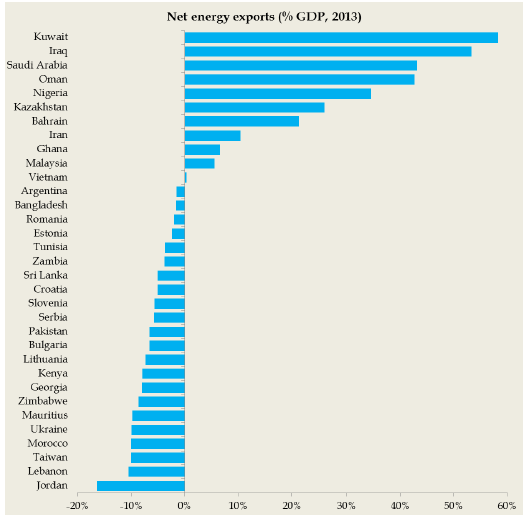
Sources: Renaissance Capital, IMF
Within the oil-producing countries, each have different fiscal breakeven prices for oil. Currently, only Qatar and Kuwait (at US$62 and US$55, respectively, in 2014) have a breakeven oil price below the current level. The rest, ranging from US$73 (Abu Dhabi) to US$122 (Bahrain) are already facing fiscal deficits at current oil prices. Oman has sold off most as it has the highest breakeven oil price – furthermore the Emir of Oman has not been seen in public for some time, raising concerns for his health, and hence, concerns around succession planning.
Nigeria and Kazakhstan are the two countries we are most concerned about. In Kazakhstan, the currency is linked to the Russian ruble, and has already devalued by 18% this year. However, if you mark to market currency today – they may have to devalue by another 30%.
Nigeria, one of the largest economies in Africa, is also one of the continent's leading energy producers, but the consistent fall in oil price has had a severe impact on the country’s external reserves. It has spent billions of dollars attempting to shore up the Nigerian naira, but was eventually forced to devalue its currency in November. Nigeria’s central bank has also been forced to raise interest rates from 12% to 13% in a bid to stem foreign reserve losses.
RETAIL DRIVEN MARKETS MEAN SENTIMENT IS OVERRIDING FUNDAMENTALS
This has obviously had a knock-on effect to stock markets. After a long period of outperformance, Africa, Middle East and Frontier markets have given up some of their gains. This is not unexpected as 55% of the MSCI Frontier Markets index is dominated by energy exporters (Kuwait and Nigeria together account 44%, plus Kazakhstan, Bahrain and Oman).
However, we see this as a potential opportunity for experienced investors. Most of these markets are retail driven; hence sentiment tends to override the fundamentals. Therefore, we believe many stocks have fallen by more than their fundamentals deserve. This has created some interesting opportunities in each region.
The circumstances are also different than 2008, with the GCC and particularly their banking systems in a very strong position. Many of the Gulf countries have ample reserves and huge sovereign wealth funds (in most cases a multiple of GDP). This should continue to provide them with a cushion as oil prices stay below breakeven prices. We expect the governments of Saudi Arabia, Qatar and UAE to continue with their current economic programs and infrastructure role out as they remain focused on creating jobs for their young populations. As a consequence we see the current dramatic falls in some of these markets as an opportunity to build some long-term positions in key quality companies across the region.
IT'S NOT ALL ABOUT OIL
It is also important to recognize that while many of the countries we can invest in rely on the oil price for sources of revenue for the government, there are in reality very few energy companies listed and therefore investable. The opportunity set for investors is biased away from the energy sector, so the broad structural changes creating robust top-down credentials that we have witnessed over the last few years should provide a positive backdrop for companies across many sectors. For example, we can still find a number of companies that can generate at least 20% annual earnings growth at present.
Across both the Frontier and Middle East & Africa regions, we are investing in companies that should not be materially impacted by fluctuations in energy prices:
MIDDLE EAST
Despite its heavy reliance on oil, Saudi Arabia has been spending aggressively internally, and they are in the midst of spending close to US$700 billion on infrastructure projects across the kingdom. This includes building several “economic cities” across the country, and the government is making major financial commitments to develop the country’s electricity grid, rail network, waterworks, and telecommunications network.
Saudi banks, in particular, are an especially good investment opportunity as financing is the first step in any infrastructure project. In addition, the Saudi Riyal is pegged to the US$ (at a rate of 3.75), and as a result any move in interest rates by the U.S. Federal Reserve are instantly reflected in Saudi Arabia. For the banks, especially corporate banks, this is very positive for margins. Saudi Arabia is one of the few markets, globally, that rising U.S. interest rates will be taken positively.
Qatar has started a mega-build-out ahead of the FIFA World Cup soccer tournament to be held there in 2022. The country is expected to spend at least US$140 billion on transportation infrastructure, including roads, a metro system, and airport expansion. Banks and infrastructure-related companies are likely to be significant beneficiaries of the heightened government spending.
In the United Arab Emirates, many companies are benefiting from a faster-than-expected and broadening recovery in the property and banking sectors, driven by the country’s emergence as a trade and transportation hub. This has seen increased tourism and Dubai has become somewhat of a safe-haven amid unrest in Middle East countries such as Syria and Libya.
Both Qatar and the UAE have also gained greater attention from emerging market investors after their upgrade from frontier to emerging markets by MSCI.
AFRICA
Sub-Saharan Africa has some of the fastest-growing economies worldwide, including Nigeria, Ghana, Kenya, and Zambia. We are particularly attracted to the banking sector in this part of Africa, especially in Nigeria, where bank balance sheets are much stronger than in the past following a system-wide clean-up of bad loans and the establishment of a “bad bank” in the last couple of years. Outside of the banking sector, we like some consumer staple companies. There are a number of companies that can properly leverage the huge growth in consumer spending within Africa.
South Africa offers one of the best ways to access the African footprint. The country has several companies with some of the best management teams in the emerging markets universe, a well-developed financial system, and companies with successful penetration into other African countries where growth is stronger. Often these companies can provide exposure to parts of Africa which are otherwise inaccessible to investors (due to a lack of liquidity or a stock market).
ASIA
The opportunity set in Asia, as with other frontier markets, is majorly focused on the financials sector. Encouragingly, financials is an area where we see a tangible difference between the emerging and developed world. The banking systems in frontier and emerging market countries have also been through a crisis in the past 20 years. Having learnt from the painful experience of excess leverage and a severe bad debt cycle, lending practices have been improved in many countries, and banks therefore tend to operate on a more traditional basis. Most concentrate on taking deposits, making loans to consumers and to businesses, and processing transactions; this model is very supportive of profitability, if well-managed.
Valuations are also generally favourable. There are many banks trading at high single-digit to low double-digit levels when considering forward looking price-to-earnings ratios. Many frontier banks are also generating exciting, but also sustainable return on equity levels. 20% per-annum growth is not uncommon, especially in Pakistan and Sri Lanka. In addition, with a macroeconomic backdrop that is becoming more positive, and a de-leveraging cycle predicted to come to an end by the end of 2014, it is an opportunity to own some promising companies for the medium term at very attractive levels.
MANAGING VOLATILITY AND SPIKES IN COMMODITY PRICES
The relative performance of our strategies has been relatively resilient through the recent oil price moves, as we have held a view for some time now that energy prices would decline and settle at lower levels. Therefore, the investment case for many of our holdings has not materially changed. Indeed some of the slightly weaker countries at a macroeconomic level have strengthened thanks to the currently softer oil price, so we may look to add opportunistically to stocks that have suffered in the general sell-off.
In particular, we had already positioned ourselves strongly in Asian frontier markets, due to the number of interesting companies we had identified through our research process. With most of the countries in Asia being net oil-importers, the fall in prices should provide a further boost to companies and government current account balances.
Investors will now however, in all likelihood, have to accept a new normal in oil prices as structural headwinds has the potential to limit prices going forward. This means that investors should be more cautious on countries that are heavily reliant on oil revenues to services their current accounts.
However, as sentiment tends to drive prices in many of these markets, we have found that if you focus on the fundamentals it can help to reap long-term rewards. We have found that the best long-term results come from looking beyond short-term volatility, by adopting a constant focus on fundamentals. Ultimately, identifying the best investment opportunities in a stock universe and applying conviction to those ideas within a diversified portfolio will help to provide the strongest platform to deliver returns over the long run. As oil prices fluctuate, investors should continue to do their research, identifying who are the real winners and losers.
Most importantly, the long-term fundamental reasons for investing in Africa, Middle East and Frontier Markets remain robust, and with the flexibility of a broad range of investments, across a large opportunity set, the asset class offers genuine opportunities to generate positive returns. Equity investors, while continuing to be aware of the potential for volatility in the short term, should recognize the long-term opportunities some of these markets offer.
2014-GL-1203
重要情報
当資料は、ティー・ロウ・プライス・アソシエイツ・インクおよびその関係会社が情報提供等の目的で作成したものを、ティー・ロウ・プライス・ジャパン株式会社が翻訳したものであり、特定の運用商品を勧誘するものではありません。また、金融商品取引法に基づく開示書類ではありません。当資料における見解等は資料作成時点のものであり、将来事前の連絡なしに変更されることがあります。当資料はティー・ロウ・プライスの書面による同意のない限り他に転載することはできません。
資料内に記載されている個別銘柄につき、売買を推奨するものでも、将来の価格の上昇または下落を示唆するものでもありません。また、当社ファンド等における保有・非保有および将来の組入れまたは売却を示唆・保証するものでもありません。投資一任契約は、値動きのある有価証券等(外貨建て資産には為替変動リスクもあります)を投資対象としているため、お客様の資産が当初の投資元本を割り込み損失が生じることがあります。
当社の運用戦略では時価資産残高に対し、一定の金額までを区切りとして最高1.265%(消費税10%込み)の逓減的報酬料率を適用いたします。また、運用報酬の他に、組入有価証券の売買委託手数料等の費用も発生しますが、運用内容等によって変動しますので、事前に上限額または合計額を表示できません。詳しくは契約締結前交付書面をご覧ください。
「T. ROWE PRICE, INVEST WITH CONFIDENCE」および大角羊のデザインは、ティー・ロウ・プライス・グループ、インクの商標または登録商標です。
ティー・ロウ・プライス・ジャパン株式会社
金融商品取引業者関東財務局長(金商)第3043号
加入協会:一般社団法人日本投資顧問業協会/一般社団法人投資信託協会


