

Australian Equities: What gives active managers a competitive advantage?
Sustainably generating alpha is not an easy task, but at T. Rowe Price we believe there are certain attributes investment managers can build that improve the odds of success.
Randal Jenneke, Head of Australian Equities, shares his views on what matters when seeking competitive advantage as a fundamental active manager.
WHAT IS COMPETITIVE ADVANTAGE IN ACTIVE INVESTMENT MANAGEMENT?
The goal of active investment managers is to deliver investment performance over and above a market average, measured by a relevant benchmark after fees. Managers who are able to achieve such results over longer-term periods of time are said to have “investment skill”. It is important to highlight the role that time plays in the assessment of skill, as luck can influence results in the shorter term.
But what is investment skill? Simply, this refers to the ability to generate alpha by investing in a portfolio of companies that do better than the market average. We believe that investment skill stems from an investment manager’s competitive advantage. This competitive advantage enables managers to identify investment opportunities where the manager’s expectations (as reflected in earnings, returns, valuation etc.) differs from that of the market, as discounted in share prices. Whether these expectations prove to be right or wrong is what generates alpha.
WHAT ATTRIBUTES DRIVE COMPETITIVE ADVANTAGE?
Analytical advantage—this refers to the ability to interpret information and form superior judgments (through detailed analysis and/or understanding of probabilities). This advantage is ultimately the function of the quality of people, their experience and the importance of technical expertise. Experience and technical expertise can play a significant role. In certain industries, for example, mining, healthcare and information technology, technical expertise can provide a superior understanding of the investment issues and the probabilities of likely outcomes.
For mining companies, it is critical to understand that ultimately the ability of a company to earn an economic return from a geological asset comes down to the quality of the ore body, its core geochemical attributes and the marketability of the end product. As an example, after a site visit to a small-cap iron ore producer last year, we identified ore body quality issues, with a greater-than-expected presence of in-situ low-grade material. The company was extracting excessive waste material within the modeled pit shell that was subsequently marketed as a low-grade product outside the envisaged product specification. This highlighted potential mine planning concerns and ultimately manifested itself in higher costs and lower realised prices, negatively impacting the economics of the operation. Subsequently, the stock significantly underperformed the market.
Systemic advantage—this is about how you structure your investment process to systematically tilt the odds of success in your favour. Firstly, focus on identifying the market characteristics that lead to outperformance and, secondly, take advantage of market behaviour. We have identified through our proprietary research and analysis the key factors that we believe determine outperformance in the Australian equity market over time. These factors are: quality (returns and earnings growth) and valuation. We believe a sound investment process should be based around these factors and/or other factors that have shown outperformance.
There are some simple things we can do when designing the investment process: (1) Take a long-term approach—the market is short-term focused so think and act long term; (2) Don’t extrapolate— stock markets extrapolate current performance, so analyse where a company sits in its business cycle and focus on the impact of structural factors and (3) Think in terms of probabilities and ranges— Prospect Theory shows that people misprice risk due to loss aversion, so think about potential outcomes in terms of probabilities and their possible ranges.
Information advantages—this relates to being able to access relevant and important information used in the decision-making process in a timely manner. This advantage is most pronounced when you know something someone else doesn’t. So how do we do this? Most investment professionals tap in to the same or similar information sources: company meetings, meetings with suppliers, customers, competitors, industry contacts, journals and newspapers and third-party providers (such as stockbrokers). This is not to say everyone gets the same information, they don’t. We believe firms that have greater leverage in some capacity can get better access.
The biggest challenge for any domestic investor when it comes to information gathering is how to deal with businesses that operate in overseas markets. While companies will provide access to executives who run these divisions and relevant information, local market knowledge and information is lacking. The most common approach to tackling this issue is to: (1) travel to these overseas markets to conduct company meetings and/or (2) rely on third parties for information (stockbrokers). This approach has many limitations. First, corporate access overseas is likely to be vastly inferior to domestic access due to lack of relationships. Second, reliance on third parties means this information is tainted by their perspective. Finally, how do you put into context the partial information you are accessing?
AROUND 44% OF AUSTRALIAN COMPANY EARNINGS COME FROM OFFSHORE
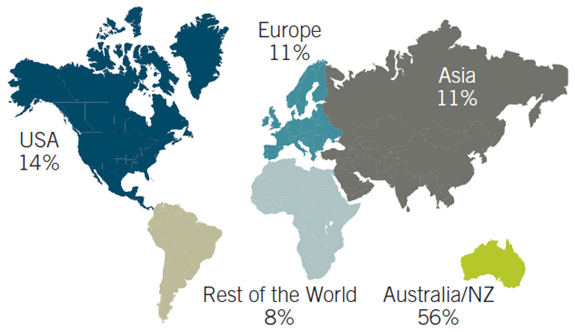
Sources: FactSet, UBS; analysis by T. Rowe Price
There is another and potentially very powerful way to tackle this challenge, which is to access internal resources. This approach is only available to organisations that have broad global research and local presence. But this is not enough. There are plenty of global organisations that operate in many markets around the world, but they are not well connected with each other. They tend to operate in silos. To make this approach work, you need the right business culture and incentivisation structure. Firms that can work in this collaborative manner and share information can be expected to have an advantage not easily replicated by their competitors.
DOES LUCK PLAY A ROLE?
There is much written and said about the role “luck” plays in influencing investments returns, and, therefore, how we should think about investment skill. The extent to which luck influences results is a function of many things, including how decisions are made, the concentration or diversification of portfolios, factor biases and of course time. Time is a critical factor when assessing the impact of luck.
Theoretically, luck is symmetrical, with an even chance of “good” or “bad” luck being likely. This is important because with the passage of time and the more decisions that are made, luck should even out and, therefore, not be a significant factor influencing investment returns. This should particularly be the case for well-diversified portfolios (from a risk perspective), where there are not huge exposure differences to any one security or factor. A sound investment process is the way good investment managers manage the variable that is luck. The corollary of this is that the investment results using a well-structured investment process over time to produce a well-diversified portfolio should represent a manager’s investment skill.
SUMMARY
The fundamental active investment management industry remains a very competitive one. Nevertheless, we believe certain investment managers can build competitive advantages, which can be difficult to replicate. For us, the attributes that determine and drive competitive advantage are relatively straightforward. It comes down to the quality of your people, the soundness of your investment process and how you tap in to information and insight your competitors are unable to access easily. Few organizations can claim to have strength in all three areas.
Without a doubt the hardest competitive advantage to achieve is an informational advantage. For a purely domestic manager, this is extremely unlikely, and for a global manager, it is imperative to have the right culture and incentives to promote the necessary collaboration to share information and knowledge.
Competitive advantage is not easy to achieve and may only be the preserve of the few firms who have the pre-conditions (resources, processes and culture) necessary to succeed at this task. For those who can achieve this, we believe the potential rewards for their stakeholders can be significant.
Important Information
This marketing communication is directed at institutional investors only. It is not intended for distribution to retail investors in any jurisdiction.
This document, including any statements, information, data and content contained therein and any materials, information, images, links, sounds, graphics or video provided in conjunction with this document (collectively, “Materials”) are being furnished by T. Rowe Price for your general informational purposes only.
The Materials are not intended for use by persons in jurisdictions that prohibit or restrict the distribution of the Materials, and in certain countries these Materials are only provided upon specific request.
Under no circumstances should the Materials, in whole or in part, be copied, redistributed or shown to any person without consent from T. Rowe Price. The Materials do not constitute a distribution, an offer, an invitation, a recommendation or a solicitation to sell or buy any securities in any jurisdiction. The Materials have not been reviewed by any regulatory authority in any jurisdiction. The Materials do not constitute investment advice and should not be relied upon. Investors should seek independent legal and financial advice, including advice as to tax consequences, before making any investment decision.
T. ROWE PRICE, INVEST WITH CONFIDENCE and the Bighorn Sheep design are, collectively and/or apart, trademarks or registered trademarks of T. Rowe Price Group, Inc. in the United States, European Union and other countries. This material is intended for use only in select countries.
