

Australian Equities:
Does High Yield Equal Quality?
EXECUTIVE SUMMARY
- There is a common misconception that highyielding stocks are also high-quality stocks, and that since yield stocks have recently outperformed the S&P/ASX 200 Index, now is not the time to be allocating capital to quality investment strategies. This article seeks to dispel those myths.
- We will argue that ‘yield’ and ‘quality’ are two distinct concepts. Whilst there is some overlap between the two categories, it is not as significant as many think. There are still many attractively priced ‘quality’ investment opportunities in the market today.
- We believe that in the fullness of time the current yield mania will be seen to be another short-term market theme, with little fundamental justification. Our view is that quality investing is the path to sustained wealth accumulation.
The dividend yields currently available in the Australian equity market are attractive lures for income seeking investors given the compression seen in the yields of traditional alternatives such as fixed income, cash, and term deposits. However, we believe buying such investments with little regard for the underlying fundamentals or valuation is often problematic.
What Are High-Yield Stocks?
High-yield stocks are companies that pay out a relatively high proportion of their cash flow as dividends and/or those that have higherthan- average dividend yields. In the short term, some companies may even borrow to pay dividends on an expectation of improving cash flows. However, borrowing to pay dividends ultimately is not sustainable.
Decisions on the level of the dividend payout ratio are financing decisions. These are decisions about the use of internally generated cash flow. They do not alter the value of a business, unless it can be argued that the capital paid out in dividends otherwise would have been reinvested at rates different to a company’s cost of capital. Reinvestment of internally generated cash flow can be good or bad for value creation.
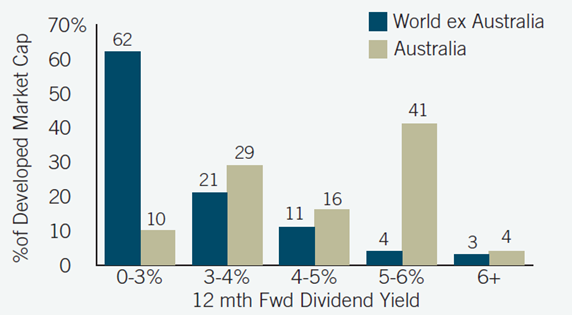
In the Australian context, high-yield stocks are generally also mature defensive businesses, including property, utilities, telecommunications, and consumer staples companies. Financial stocks are also high dividend payers but typically are not considered defensive due to their high level of operational gearing. These businesses generally tend to have lower growth prospects, which is one of the reasons why they have higher-thanaverage dividend payout ratios. One of the consequences of dividend imputation in the Australian market is a higher dividend payout ratio compared to other equity markets, as this is tax efficient for many shareholders (Figure 1, below).
Figure 1: 60% of ASX 100 Forecast To Yield More Than 4%, vs. Only 18% Internationally
As at 15 May 2013
% of index cap split by forward dividend yield
Sources: GS Global ECS Research Estimates, Factset, I/B/E/S
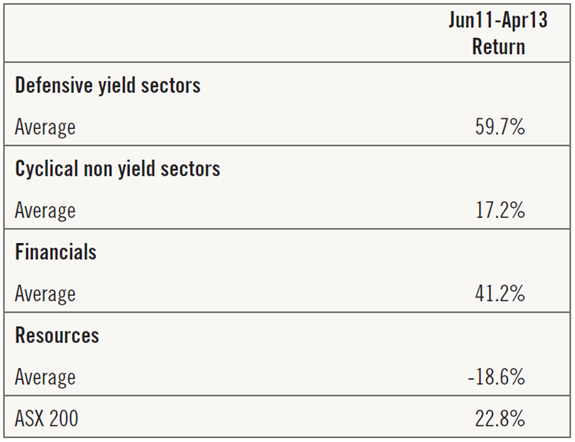
As Figure 2 below shows, defensives and financials have significantly outperformed the broad market since mid-201
Figure 2: Performance of Australian Equity Categories
Source: Goldman Sachs
WHAT IS QUALITY?
In investment terms, ‘quality’ refers to the characteristics of a company. There are many definitions of quality, but the way we define it at T. Rowe Price is based on the returns a company is able to generate and its rate of earnings growth. This definition relates directly back to fundamental value creation. ‘Quality’ can be good (creating value) or bad (destroying value). The returns and earnings growth generated by a company are a function of industry dynamics, competitive advantages, and management execution.
A company is a “high-quality” or “low-quality” stock irrespective of its yield. A high-yield stock may be a high or low quality company. The obvious implication of these statements is that “high yield” and “high quality” are not necessarily the same thing. Whether a company is high or low quality is not necessarily a function of its yield. It is driven by the returns it is able to generate and how quickly it is growing. Quality and yield are two distinct concepts.
WHAT HAS BEEN DRIVING THE CHASE FOR YIELD?
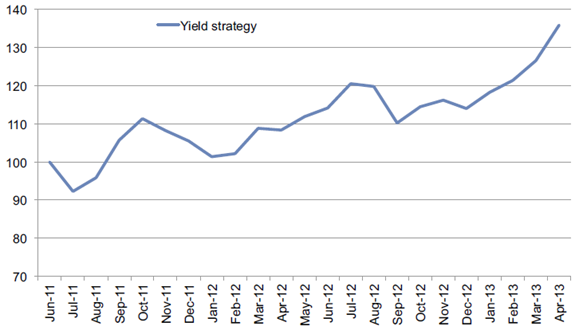
Since mid-2011, yield-based investment strategies have significantly outperformed both Australian and global equity markets, generating significant capital gains that have far outweighed the initial premise of these strategies, which is income generation.
Figure 3 shows the strong performance of a typical Australian yield-based strategy over recent years. The yield strategy in this graph is defined as the top quartile of Australian companies by yield (highest) as compared to the bottom quartile (lowest).
Figure 3: Performance of a Typical Yield-Based Strategy Yield Strategy (Top Q vs. Bottom Q Yield Stocks)
Source: Goldman Sachs
As with any short-term investment theme or ‘fad’ there are various factors driving investor behaviour. Some are fundamental and others are speculative. Key reasons cited for the current chase for yield include:
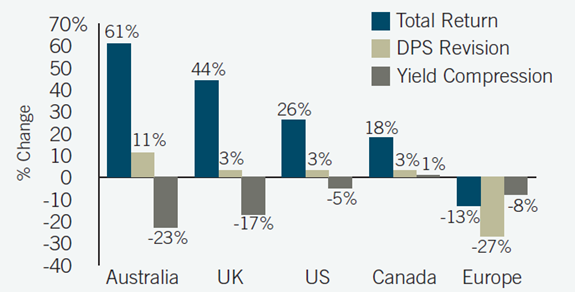
- Low yields on cash and government bonds, which has meant a lower discount rate and therefore higher earnings multiples. This has been a function of quantitative easing (QE) and weak global economic fundamentals. Central banks have boosted liquidity, some of which has flowed into higher-yielding stocks.
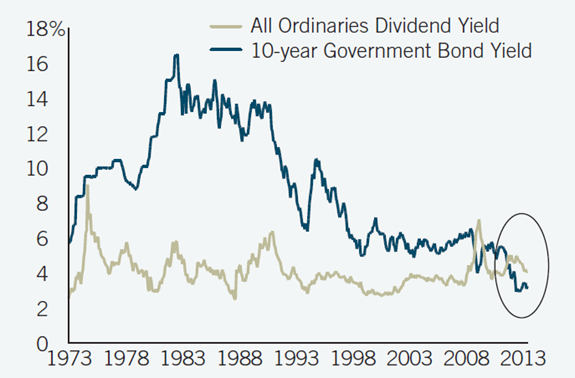
History shows a strong correlation between bond yields and the performance of higher-yielding stocks. When bond yields collapsed following the 2008 financial crisis and the onset of QE policies, spreads between them and equity dividend yields reached unprecedented levels (Figure 4). Australian high-yield stocks performed even better than yield stocks in other markets as Australia is a much higher yielding country (Figure 5).
- A reduced appetite for risk, which has led investors to move into perceived lower risk capital market sectors. In the equity market, these more defensive sectors also happen to be the higher yielders.
- Chasing past performance—a common feature of investment markets. This money is momentum driven, not valuation sensitive.
- The income needs of an aging population. As more investors have moved into retirement, their portfolios have changed. They have less need for capital gains and more need for income, and so have increased their allocations to higher-yielding stocks.
WHAT IS THE INVESTMENT OVERLAP BETWEEN YIELD AND QUALITY STRATEGIES?
As highlighted previously ‘Yield’ and ‘Quality’ are two distinct concepts. Whilst they are not necessarily the same thing, there is some overlap. How significant is this overlap?
To answer this question we can use T. Rowe Price’s proprietary Business Quality Assessment framework (refer to box on page 4 for a definition). Using this framework, we screened the ASX 100 Index as of 31 May 2013 to identify stocks that were rated A through D (i.e. high quality), that also had dividend yields in excess of 5%. This analysis revealed a total of 30 stocks that met both criteria. Interestingly, a breakdown of these stocks by quality category showed that only 40% were in the highest two categories (A and B), while 60% fell in the two lower quality categories (C and D) representing more mature businesses. Of the high-quality stocks in the ASX 100 Index with a dividend yield of less than 5%, almost two thirds consisted of companies in the A and B categories.
Our analysis highlights the fact that whilst there is some overlap between high-quality and high-yield stocks, it is not significant and there remains fertile investment territory for a quality investment strategy unrelated to yield. It also shows that the majority of the highest quality companies (A and B) are not high-yield companies, as their reinvestment requirements have resulted in lower payout ratios.
The T. Rowe Price proprietary Business Quality Assessment framework groups companies into six categories based on return on capital and future growth prospects.
A - expected to generate superior returns and grow earnings above market over time,
B - expected to generate superior returns with earnings growth comparable to the market average,
C - expected to generate superior returns with submarket earnings growth,
D - expected to generate market returns with positive earnings growth,
E - expected to generate inferior returns with earnings growth at or less than market average,
F - expected to generate inferior returns with earnings growth above market average.
This framework allows us to identify the ‘higher quality’ stocks within the Australian equity universe—those companies that we believe have the greatest potential to generate positive value creation and grow over time.
HOW HAS QUALITY PERFORMED?
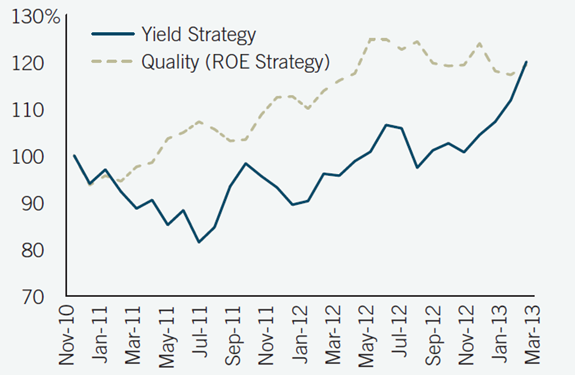
Over the last three years, a ‘quality’ focused Australian equity investment strategy (defined purely in terms of the returns a company is able to generate—i.e., return on equity) has performed just as well as a yield-oriented strategy (Figure 6).
Figure 6: An Australian Equity Yield Strategy vs. a Quality Strategy
Yield Strategy (Top Q vs. Bottom Q Yield Stocks) vs. Quality (ROE Strategy)
Sources: IRESS, Goldman Sachs Research
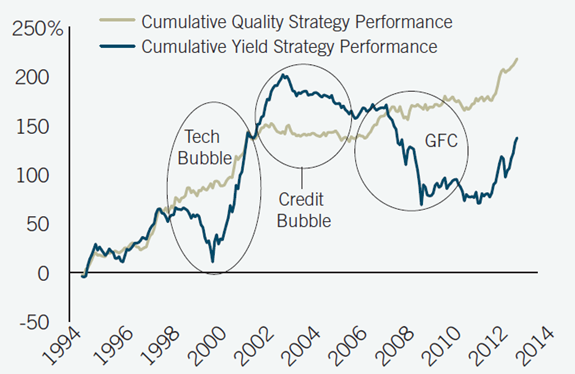
A longer term analysis of these strategies also shows that quality has performed better and has been a more consistent driver of outperformance than yield (Figure 7).
Figure 7: Cumulative Returns on Australian Equity Quality and Yield Strategies
As of 30 June 2013
Sources: Bloomberg, Datastream, Credit Suisse
Analysing the performance of quality stocks within the ASX 100 Index against T. Rowe Price’s Business Quality Assessment framework shows that in the time period running from 30 June 2011 through 30 April 2013, ‘high quality’ companies (those rated A through D) returned 39%, compared to a market return of 22.8% as measured by ASX 200 accumulation. This is evidence that a quality investment strategy can perform strongly even in environments widely considered more conducive for higher-yielding stocks.
Further analysis also reveals some interesting facts. In the period running from 30 June 2011 through 30 April 2013, there were 25 high-quality stocks within the ASX 100 Index with a dividend yield of less than 5% that outperformed the broad market. Further, the one-third of the ASX 100 that we have defined as high quality using our Business Quality Assessment Framework underperformed the Australian equity market. These stocks were predominantly low yielding stocks—i.e., they had dividend yields of less than 5%. This shows that there is still ample opportunity to construct an investment portfolio of attractively priced, high-quality companies, particularly when opportunities in the small-cap universe are considered.
CONCLUSION: YIELD PROVIDES INCOME, BUT QUALITY IS THE MORE RELIABLE PATH TO WEALTH ACCUMULATION
Whilst Australian yield strategies have outperformed the broad market in the last few years, so have quality investment strategies. It is important for investors to understand that yield investing and quality investing are not the same thing. Yield investing is predominantly about strategies providing income, whereas quality investing is about long-term wealth accumulation in the form of total return.
We believe that the large capital gains generated by yield strategies in recent years are unsustainable and cyclical in nature. From a fundamental perspective, the dividend policy of a firm does not alter its fundamental value. It can only affect value creation if this same capital is reinvested at rates different to a company’s cost of capital.
Whilst there is some stock overlap in the investment universe between quality and yield approaches, it is not as large as people may think—just 30% of the ASX 100 Index, according to our analysis. Furthermore, our analysis shows that the majority of faster growing high-quality stocks (the A and B rated businesses in our framework) are not classified as high-yield stocks, mainly due to their need to use internal capital to grow their businesses. These companies are creating value faster than the more mature high-yielding quality companies in our C and D categories.
In conclusion, our analysis shows that there are ample opportunities in the Australian equity universe to construct ‘high quality’ investment portfolios with low overlap to yield-oriented strategies.
Important Information
This material is provided for informational purposes only and is not intended to reflect a current or past recommendation, investment advice of any kind, or a solicitation of an offer to buy or sell any securities or investment services. This material provides opinions and commentary that do not take into account the investment objectives or financial situation of any particular investor or class of investor. Investors will need to consider their own circumstances before making an investment decision. Information contained herein is based upon sources we consider to be reliable, we do not however guarantee its accuracy. Past performance cannot guarantee future results. All charts and tables are shown for illustrative purposes only. The views contained herein are as of July 2013 and may have changed since that time.
