
Bonds backed by franchise fees or internet bills? The rise of esoteric ABS.
August 2025, Fixed Income
- Key Insights
-
- We continue to find value in some esoteric asset‑backed securities (ABS), including those backed by franchise royalties or fees and fiber‑optic collateral.
- Whole business and fiber ABS are relatively insulated from tariff risks, which differentiates the segment from much of investment‑grade corporate credit.
- When analyzing the credit of a whole business deal, we look for issuers with long operating histories across multiple economic cycles, among other factors.
The asset‑backed securities (ABS) market has evolved from its origins in securitizing auto loans and credit card receivables to now encompass almost anything that generates a somewhat predictable cash flow. We have been finding value in some of these more esoteric ABS deals, particularly ones backed by franchise royalties or fees as well as fiber‑optic cable infrastructure or receivables. Why? These ABS feature relatively unique collateral that tends to be protected by high barriers to entry, strong brand value, or both. Moreover, they are largely insulated from tariffs, which is particularly appealing in the current environment.
Looking under the hood of whole business ABS
(Fig. 1) What we look for when analyzing the credit quality of a whole business ABS deal
| An experienced management team, sponsor, and backup manager that can take over management of the SPV1 if the sponsor gets into financial difficulty |
| A highly franchised business model where stable cash flows from the less volatile royalty or franchise payments make up the vast majority of the deal cash flows |
| Strong financial metrics, including supportive debt service coverage ratio2 levels and positive same‑store sales |
| Widely recognized brand equity that is likely to survive and continue to generate cash flows to the trust, even in an unlikely bankruptcy scenario |
| Bankruptcy‑remote structure that includes investor‑friendly performance‑related triggers and covenants3 |
Unlike much of the ABS market, whole business securitizations share some characteristics—such as lack of material principal amortization—with corporate bonds. However, the structure of whole business ABS makes them similar to other types of ABS, whereby the issuer is bankruptcy remote1 and the cash flows are generated only from the collateral held within the trust.2 Companies frequently issue whole business ABS as an alternative to high yield bonds and loans, often using the proceeds to pay off current obligations that carry much higher coupon rates than the new whole business‑backed debt.
Large service‑related franchise businesses, many of which are household names in the U.S., issue whole business deals. Quick‑service restaurants, such as Dunkin Brands and Domino’s, were pioneers in the sector and have been joined by issuers from other industries such as Planet Fitness within fitness, ServePro in cleaning and restoration, and Primrose in education.
Collateral is typically the issuer’s main revenue‑generating assets
The collateral backing whole business deals is generally a first‑priority interest in a company’s primary revenue‑generating assets—hence the “whole business” name. The majority of this collateral consists of franchise fees and royalties but can also include intellectual property (IP) and IP licensing agreements, rental income, or interest in real property. When issuing whole business ABS, the company establishes a special purpose vehicle (SPV) to collect cash flows and make coupon payments to bondholders. This SPV is the same as the trust for traditional ABS and is bankruptcy remote.
Subsector spotlight: ABS backed by fiber‑optic infrastructure or internet connectivity bills
Fiber-optic-backed ABS are a slight twist on whole business securitizations. The collateral in these deals can be fiber‑optic infrastructure or customer contracts for internet connectivity—current or future. This collateral is often restricted to a particular geographic area.
For deals backed by consumer fiber receivables, we don’t view consumer credit quality deterioration as a major risk—people (and businesses) tend to prioritize paying their internet bill over other obligations. This is not true for traditional auto loan-backed ABS, for example.
New supply of U.S. whole business ABS lags 2024
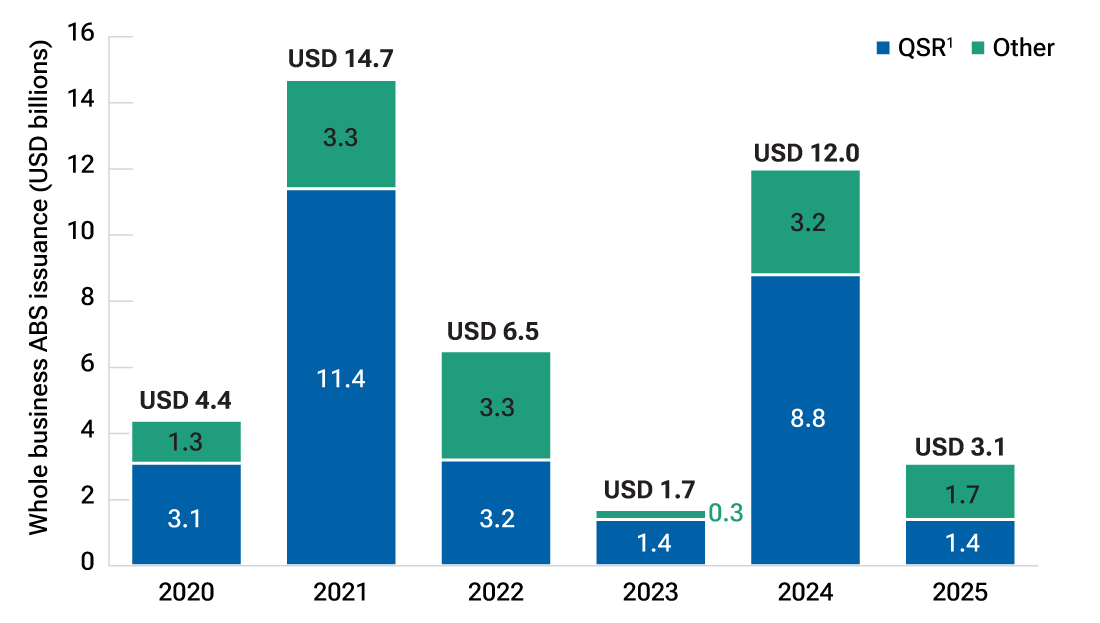
Year‑to‑date 2025 issuance through July 23.
Source: Finsight.
1 QSR=quick-service restaurant chain.
Issuers of fiber‑backed deals often have non-investment-grade credit ratings and use the ABS market to refinance their existing high yield bonds, becoming exclusively ABS issuers. Frontier Communications, which Verizon is acquiring, and Zayo Group are examples of fiber‑backed ABS issuers. These issuers tend to be highly leveraged and will often need to refinance their debt. If rates increase, it could be uneconomical for them to refinance—or they could be forced to do so at higher rates.
Because each fiber deal is unique, we undertake a thorough evaluation involving collaboration between our securitized credit analysts and our team of high yield credit analysts, who often follow these issuers’ corporate credit closely when analyzing fiber securitizations.
For deals backed by fiber‑optic end‑consumer receivables, we examine:
- The stability of the revenues generated by the assets, sometimes measured by customer churn and diversification
- The length of service contracts
- The number and type (cable, fixed wireless) of internet service competitors in the geographic area
When analyzing fiber‑optic infrastructure‑backed ABS, we look at a different set of factors, including:
- Barriers to entry in terms of the difficulty and expense for a competitor to recreate the underlying infrastructure assets
- Stability of contracts and the credit quality of the counterparties to the contracts, which are often businesses with investment‑grade credit ratings
- The concentration of customers; deals backed by a smaller number of customers can give them too much individual pricing power
- Historical customer turnover
“...whole business and fiber ABS are relatively insulated from tariff-related risk....”
Evan Shay, Securitized credit analyst
Value relative to investment‑grade corporates or traditional ABS
When searching for relative value among fixed income sectors, we compare the yield available on whole business and fiber ABS with the yield on investment‑grade corporate bonds and traditional ABS with similar credit quality. We keep in mind that whole business and fiber ABS are relatively insulated from tariff‑related risk, which differentiates the segment from investment‑grade corporate credit. We’ve recently been finding value in whole business and fiber deals in the secondary market and have been active in the primary market as well.
 Walter Peppelman
High Yield Corporate Credit Analyst
Walter Peppelman
High Yield Corporate Credit Analyst
 Evan Shay
Securitized Credit Analyst
Evan Shay
Securitized Credit Analyst

Contact us
1 Legally insulated from the asset liquidations that could be required if the issuer enters bankruptcy.
2 The trust collects cash flows and makes coupon payments to bondholders.
Additional Disclosure
Where securities are mentioned, the specific securities identified and described are for informational purposes only and do not represent recommendations.
Risks: Fixed-income securities are subject to credit risk, liquidity risk, call risk, and interest-rate risk. As interest rates rise, bond prices generally fall. Asset-backed securities are complex instruments and are not suitable for all investors. Certain asset-backed securities are subject to pre-payment risk where principal is returned prematurely to investors, resulting in lost future interest payments and re-investment risk. Some asset-backed securities may have structures that make their reaction to interest rates and other factors difficult to predict, making their prices volatile and they are subject to liquidity and valuation risk. Investments in high-yield bonds involve greater risk of price volatility, illiquidity, and default than higher-rated debt securities.
Important Information
This material is being furnished for informational and/or marketing purposes only and does not constitute an offer, recommendation, advice, or solicitation to sell or buy any security.
Prospective investors should seek independent legal, financial and tax advice before making any investment decision. T. Rowe Price group of companies including T. Rowe Price Associates, Inc. and/or its affiliates receive revenue from T. Rowe Price investment products and services.
Past performance is not a guarantee or a reliable indicator of future results. All investments involve risk, including possible loss of principal.
Information presented has been obtained from sources believed to be reliable, however, we cannot guarantee the accuracy or completeness. The views contained herein are those of the author(s), are as of August 2025, are subject to change, and may differ from the views of other T. Rowe Price Group companies and/or associates. Under no circumstances should the material, in whole or in part, be copied or redistributed without consent from T. Rowe Price.
All charts and tables are shown for illustrative purposes only. Actual future outcomes may differ materially from any estimates or forward‑looking statements provided.
The material is not intended for use by persons in jurisdictions which prohibit or restrict the distribution of the material and in certain countries the material is provided upon specific request.
Issued in the USA by T. Rowe Price Investment Services, Inc., distributor and T. Rowe Price Associates, Inc., investment adviser, 1307 Point Street, Baltimore, MD 21231, which are regulated by the Financial Industry Regulatory Authority and the U.S. Securities and Exchange Commission, respectively.
© 2025 T. Rowe Price. All Rights Reserved. T. Rowe Price, INVEST WITH CONFIDENCE, the Bighorn Sheep design, and related indicators (see troweprice.com/ip) are trademarks of T. Rowe Price Group, Inc. All other trademarks are the property of their respective owners.
- 202508‑4694125