

Global Equities: History Doesn't Repeat Itself, But . . .
Executive Summary
We have been through so much as investors over the last few years. The low-growth, low-yield environment that has persisted since the global financial crisis has significantly influenced investor and corporate behavior.
In this Price Point, David Eiswert, portfolio manager for T. Rowe Price’s Global Focused Growth Equity Strategy, explains why there are factors building that will change the current deflationary mind-set. He also highlights what areas should benefit from the normalization in U.S. interest rates and the transition to a more inflationary environment.
Global equity investors have experienced a range of emotions in recent years. While we have seen a breadth of sentiment spanning from despair to optimism (we have never quite reached euphoria), we believe that the low-growth, low-yield environment that has persisted since the global financial crisis has also influenced underlying investor and corporate behavior.
Concerns over the likelihood of a “fundamental” recovery in the global economy has meant that even in times of optimism, equity markets have been climbing a wall of worry. This has led to many investors favoring defensive strategies, unusual during a bull market, directing capital into lower volatility and yield-oriented segments of
the market.
Meanwhile, many corporate outlooks focused on a “new normal” economy of low or no growth, resulting in a deflationary and risk-averse mind-set. One benefit of the absence of investment-minded spirits among corporates is that dividends have been increasing and share buybacks have been plentiful. To us, this is a rational response as investors have demanded more yield, and rewarded the share prices of those companies that buy back stock, while simultaneously penalizing “old normal” corporate investment practices, including capital expenditure. In short, why invest for the future when I can have the cash today?
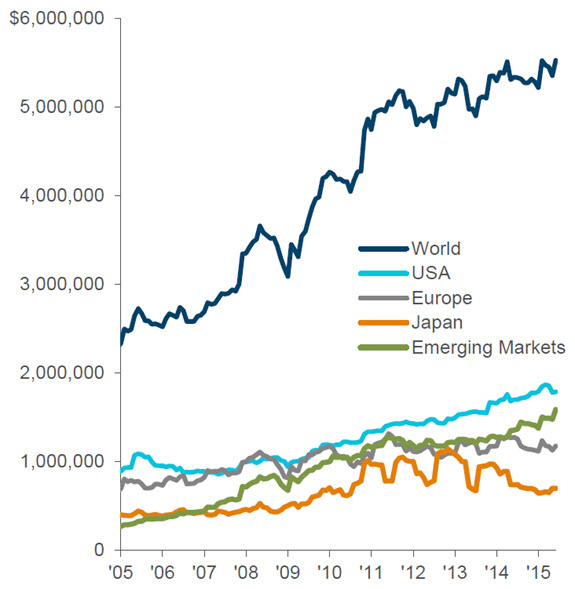
However, there are signs that the landscape is changing. From almost out of nowhere, we have seen a global boom in mergers and acquisitions (M&A) activity (Figure 1) that can already be defined as one of the largest takeover sprees ever. While history urges caution regarding the success of such activity, there are key differences today. This includes the unprecedented cheapness of debt, at least until rates normalize, high cash levels on global balance sheets (Figure 2), and the absence of excessive leverage leading into this M&A cycle.
Capital expenditure and investment continues to languish, however. Broader patterns of corporate investment outside of M&A will be needed as an important driver of incremental demand in the next phase of the economic cycle. What we are encouraged by is that industry conditions are beginning to tighten through a lack of investment and through M&A activity, which is now being cheered by investors, given the high levels of profitability being acquired versus the low borrowing cost acquired. This is creating bottlenecks in some parts of the global economy, including housing in the U.S. and UK, skilled labor, and even segments of commercial banking. One common theme is that these industries have seen significant consolidation over the past five years and that ultimately creates pricing power when taken to its conclusion.
This trend is clearly assisting in the creation of a fertile environment for improving return on capital within some industries. Even a moderate pickup in demand will provide opportunity for further pricing power, a powerful driver of stock returns. We believe that a broadening of this trend will spur corporate spending and wage inflation over time, which will support further economic expansion. New normal economic behavior could actually be steadily returning us to the old normal economy.
Moving beyond a deflationary, defensive mind-set to an inflationary one takes time, but it is already underway. One reason companies are acquiring each other at a record pace is because the price of acquisition will be higher tomorrow and the quality of the target company likely less attractive. The more investors and companies become concerned with prices rising in the future, the more economic activity is pulled into the present. Old normal behavior is alive and kicking in one sense.
WHAT IS A FED TO DO?
In the short term, investors are clearly worried about the potential impact on markets and the economy when the U.S. Federal Reserve starts raising short-term interest rates. Looking through the noise of first tapering, and now, tightening, such a move by the Fed has real positive implications and should ultimately serve as a catalyst in this transition from a deflationary to inflationary mind-set.
There will be more volatility, especially in bond markets, but also in stocks that have benefited from the low-yield, slow-growth environment as investors begin to adjust to a new world in which inflation is not a one-way trend. While broader equity assets are already experiencing volatility as a result of U.S. rate and China growth concerns, we believe these episodes will provide invaluable opportunities to refresh portfolios, given the longer-term trend of an improving global economy.
DON’T BE CAUGHT OUT IN THE DEFENSIVE TRAP
As we go through this transition, investors should consider how they want to be positioned for the next two to three years. We would encourage investors to consider their exposure to companies that will see profits and margins rise alongside interest rates. U.S. financials remain attractive, while businesses with improving economic returns over time—driven by innovation, regulation, and other forces—should be of focus.
As U.S. interest rate normalization materializes, sparking changes in investor psychology and corporate behavior, this will create volatility but also attractive investment opportunities. With a longer-term time horizon and willingness to be contrarian, we believe investors should be prepared to look beyond near-term challenges toward a different environment than the one that has prevailed in recent years. Rather than a ’new normal‘ economy heralding the need for a defensive mentality, we may see old normal economic spirits returning giving credence to Mark Twain’s quote - “History doesn’t repeat itself, but it does rhyme”.
Figure 1: Global M&A Announcements Transaction Value Quarterly ($MM)
Figures shown in U.S. Dollars
As of 30 June 2015
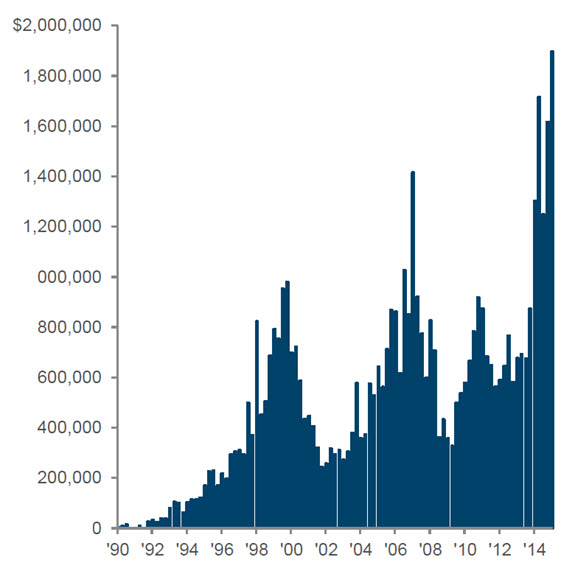
Figure 2: Cash on Balance Sheets ($MM)
Aggregate of all companies in MSCI index
Figures shown in U.S. Dollars
January 2005 to June 2015
Past performance is not a reliable indicator of future performance.
Source: FactSet.
2015-GL-2684
重要情報
当資料は、ティー・ロウ・プライス・アソシエイツ・インクおよびその関係会社が情報提供等の目的で作成したものを、ティー・ロウ・プライス・ジャパン株式会社が翻訳したものであり、特定の運用商品を勧誘するものではありません。また、金融商品取引法に基づく開示書類ではありません。当資料における見解等は資料作成時点のものであり、将来事前の連絡なしに変更されることがあります。当資料はティー・ロウ・プライスの書面による同意のない限り他に転載することはできません。
資料内に記載されている個別銘柄につき、売買を推奨するものでも、将来の価格の上昇または下落を示唆するものでもありません。また、当社ファンド等における保有・非保有および将来の組入れまたは売却を示唆・保証するものでもありません。投資一任契約は、値動きのある有価証券等(外貨建て資産には為替変動リスクもあります)を投資対象としているため、お客様の資産が当初の投資元本を割り込み損失が生じることがあります。
当社の運用戦略では時価資産残高に対し、一定の金額までを区切りとして最高1.265%(消費税10%込み)の逓減的報酬料率を適用いたします。また、運用報酬の他に、組入有価証券の売買委託手数料等の費用も発生しますが、運用内容等によって変動しますので、事前に上限額または合計額を表示できません。詳しくは契約締結前交付書面をご覧ください。
「T. ROWE PRICE, INVEST WITH CONFIDENCE」および大角羊のデザインは、ティー・ロウ・プライス・グループ、インクの商標または登録商標です。
ティー・ロウ・プライス・ジャパン株式会社
金融商品取引業者関東財務局長(金商)第3043号
加入協会:一般社団法人日本投資顧問業協会/一般社団法人投資信託協会


