

European High Yield: What's Left for Investors?
EXECUTIVE SUMMARY
The European high yield market has grown in size, depth, and liquidity since the financial crisis. The rapid growth has helped the asset class generate strong returns over the last few years, leaving some investors questioning whether there is still value left. We strongly believe that there is, and investors that turn away now could miss out on some great opportunities.
In this Price Points, T. Rowe Price’s portfolio manager for European High Yield, Michael Della Vedova, provides his latest thoughts on the asset class, and where to look for opportunities to add value.
NEW ISSUERS
New issuers offer a good way of finding fresh opportunities in European high yield markets. Around one in every three companies that brings a new deal to the primary market has never done so before. This is a trend we expect to continue as tighter bank lending standards drive companies to the public markets for their financing needs. Investors should not shy away from these new issuers, as they help broaden and diversify the asset class’ opportunity set. Moreover, first-time issuers typically pay higher premiums. That does not make them all attractive though as credit intensive research is required to identify the successful stories. Looking at a company’s credit quality, cash flow and management structure is a good starting point, but the assessment should not end there. The issuer’s full capital structure alongside the maturity and liquidity profile of its debt also need to be evaluated. To get a full picture of the company and the potential risks involved from investing, all these areas must be analysed. This entails hard work, but is rewarded by higher premiums, and in an environment where yields on some eurozone government bonds trade in negative territory, such opportunities cannot be ignored.
OPPORTUNITIES IN SINGLE-B RATED ISSUERS
Investors can also find opportunities by looking beyond the BB-rated universe as more value can be found in B-rated names. Although this riskier segment of the market can suffer more during bouts of volatility, from an absolute yield and relative return standpoint it can be much more attractive. Yields are excessively low in the BB-rated sector, which is considered the safest part of the market, but in my opinion can represent a value trap as I feel investors are not being fully compensated for the potential risks involved.
CONSIDERING THE FULL OPPORTUNITY SET
We believe it is important to consider the widest opportunity set possible when selecting securities. Once we have identified an issuer we like, we then screen for the security that provides the best investment, irrespective of currency. The euro’s sharp depreciation against the dollar in recent months has made it cheaper for European corporates to raise money in dollars and swap it back into euros. As a result, dollar issuance from European-based companies is expected to increase as they take advantage of the cheaper funding costs. For investors, this adds diversity to the European high yield market and broadens the opportunities available to capture premiums, while the currency risk can be hedged back into euros.
TECHNICAL BACKDROP SUPPORTS
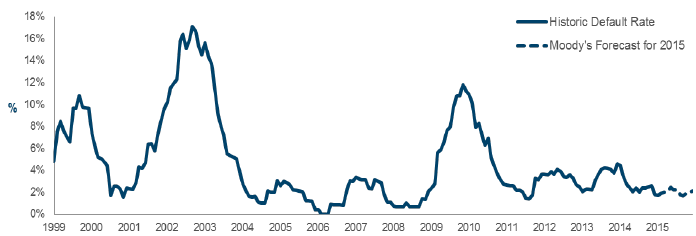
The overall backdrop in European high yield markets remains favourable for investing. Fundamentals are supportive with the default rate low. See figure 1 below. Encouragingly, signs are emerging that economic conditions in the eurozone are improving. This could feed through into a better operating environment and corporate profits later on in the year. The European Central Bank’s announcement in January that it is expanding asset purchases is also supportive as it ensures the low interest rate environment will continue for a prolonged period. While all these factors are complimentary for investing in European high yield, the biggest determinant of returns from the asset class will come from security selection. By casting the net wider and doing fundamental research, investors can uncover the best opportunities and be rewarded for it.
Figure 1. European High Yield Trailing 12-month default rate (%) From December 1999
As of 31 December 2014
Sources: Moody’s and T. Rowe Price
2015-GL-1499
重要情報
当資料は、ティー・ロウ・プライス・アソシエイツ・インクおよびその関係会社が情報提供等の目的で作成したものを、ティー・ロウ・プライス・ジャパン株式会社が翻訳したものであり、特定の運用商品を勧誘するものではありません。また、金融商品取引法に基づく開示書類ではありません。当資料における見解等は資料作成時点のものであり、将来事前の連絡なしに変更されることがあります。当資料はティー・ロウ・プライスの書面による同意のない限り他に転載することはできません。
資料内に記載されている個別銘柄につき、売買を推奨するものでも、将来の価格の上昇または下落を示唆するものでもありません。また、当社ファンド等における保有・非保有および将来の組入れまたは売却を示唆・保証するものでもありません。投資一任契約は、値動きのある有価証券等(外貨建て資産には為替変動リスクもあります)を投資対象としているため、お客様の資産が当初の投資元本を割り込み損失が生じることがあります。
当社の運用戦略では時価資産残高に対し、一定の金額までを区切りとして最高1.265%(消費税10%込み)の逓減的報酬料率を適用いたします。また、運用報酬の他に、組入有価証券の売買委託手数料等の費用も発生しますが、運用内容等によって変動しますので、事前に上限額または合計額を表示できません。詳しくは契約締結前交付書面をご覧ください。
「T. ROWE PRICE, INVEST WITH CONFIDENCE」および大角羊のデザインは、ティー・ロウ・プライス・グループ、インクの商標または登録商標です。
ティー・ロウ・プライス・ジャパン株式会社
金融商品取引業者関東財務局長(金商)第3043号
加入協会:一般社団法人日本投資顧問業協会/一般社団法人投資信託協会
