

Global Equity Perspectives: The Problem With the “New Normal” Economy
EXECUTIVE SUMMARY
Tremendous global stimulus efforts are having varied effects on developed markets. They have been powerfully positive in the U.S. but muted in Europe and Japan.
The distortions of extraordinary liquidity, yield chasing behavior, and “new normal” capital investment behavior is creating significant midterm risks and opportunities.
The absence of capital expenditure and investment has driven capacity down in many industries, creating a fertile environment for improving return on capital should incremental demand rise.
We are positioned for an improving economic environment in the developed world, with a particular focus on owning companies that will benefit from bottlenecks caused by years of corporate underinvestment.
AN ECONOMIC MIXED BAG
The U.S. recovery is proceeding at a sufficient pace, but Europe’s recovery has slowed considerably, and Japan has seen the progress ignited by “Abenomics” dampened by its formidable structural challenges. Meanwhile, emerging markets remain a mixed bag, as reform-minded politicians have driven many markets higher even in the face of an ongoing downshift in natural resources demand and the specter of a strengthening dollar.
The European Central Bank’s (ECB) attempts to stimulate the eurozone economy by offering low interest rate loans to banks to spur lending have so far received a lukewarm response as banks have borrowed only a fraction of the available funds. With Continental Europe not recovering as quickly as hoped, the potential for more stimulus is likely.
However, despite some recent disappointments, we are convinced that the global economy will remain on a healthy upward trajectory. Business conditions and industry dynamics are broadly favorable, while the extended period of underinvestment experienced since the financial crisis will ultimately yield a strong capital expenditure cycle. More specifically, we believe that flagging European growth will benefit from the conclusion of the ECB’s Asset Quality Review and its ongoing stimulus measures.
THE “NEW NORMAL”: MISCONCEPTIONS ARE A DANGEROUS GAME
Since 2008, many investors have focused on the idea of a “new normal” economy defined by low growth in the developed world and, consequently, low returns for equities and fixed income. Because of this, many central banks are still infusing liquidity, corporations are conserving cash, and investors are chasing yield and stocks that perform like bonds. Overall, there appears to be an overall deflationary mind-set that has formed, which could potentially persist for years. In some ways, we appear to be in a yield-chasing bubble.
BOTTLENECKS WILL ULTIMATELY DRIVE EXPANSION
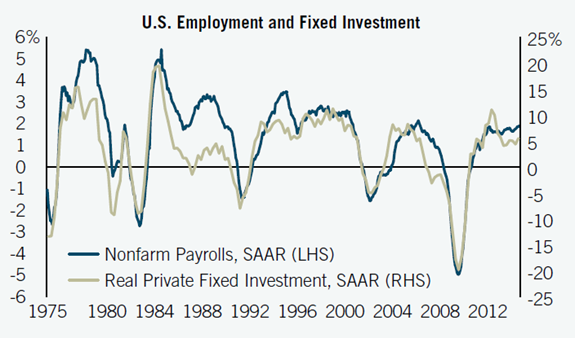
Bottlenecks are generally formed when enough time passes with significant underinvestment, downsizing, or consolidation, leading to supply curves steepening with even slight improvement in demand. This, in turn, causes a sizable increase in price and high incremental returns. A producer’s typical response to this environment is to invest because prospective returns become too attractive. While we believe this response will initially be more cautious and measured than in the past, we do not believe that decision making has changed to the extent that opportune price environments and return-generating opportunities will be ignored. As economies improve and wages and employment grow, we expect the historical pattern of corporate investment to increase (Figure 1), given the broadening return opportunities available for businesses.
Figure 1: A strengthening economy and an improving labor market have typically spurred a capex cycle
As at 30 June 2014
Source: Haver Analytics
We are already seeing signs of this. For example, cement is already sold out until 2016 in most major U.S. markets. In the airline industry, after years of airline consolidation, seat price increases are now outpacing inflation, even without the growth in add-on fees. At some point, airlines will begin adding new planes as the incremental returns improve.
Headlines can also sometimes be deceiving. For example, the eurozone as a whole has less debt and lower budget deficits than the United States. Despite the many short term obstacles to growth, a number of eurozone countries have implemented tough measures to deal with their deficits: slashing budgets and instituting pension, labor, and financial reforms that previously would have been incomprehensible. For example, before the financial crisis, there were approximately 45 banks in Spain; after the reforms, there are likely to be only six. The same sort of consolidation has happened in Greek banking.
These bottlenecks will increase incremental returns and, ultimately, drive expansion of corporate spending and wage inflation. In turn, we expect that this will yield further economic expansion and, eventually, rising inflation.
HOW ARE WE PLAYING THE GAME?
The tide is gradually turning against the invisible bottlenecks formed by the behavior of investors, CEOs, boards and governments, and our bottom-up choices in our portfolio are aligned accordingly. Alongside our continual search for compelling long-term growth companies, we are positioned for an improving economic environment in the developed world, with a particular focus on owning companies that will benefit from tight supply conditions as we reach the phase of the business cycle where corporations begin to accelerate their investment programs.
This is currently a contrarian view, and the potential for the new normal mind-set to remain may be hard to shift in the short term. However, time and patience should allow investors to reap the full benefits of the maturing equity market cycle as it begins to redistribute a growing pool of corporate profits.
Dispelling the deflationary mind-set may take a long time, but there are increasingly pockets—particularly in the more flexible, stable markets like the United States and United Kingdom—where price increases are back and incremental returns are already favorable. We have a positive view of financials. In Europe, we see a number of attractive opportunities given significant industry consolidation in recent years, as well as an attractive environment for banks to improve balance sheets by selling higher-risk loans to yield-seeking investors. U.S. capital markets also look attractive as valuations are relatively cheap due to conditions (low volatility, low rates, and peaking regulatory concerns) that we think will dissipate significantly over the next six to 18 months.
The health care sector is a fertile area for growth potential, given the long-term trends of an aging population in developed markets and a wealthier population in emerging markets. Growth potential is particularly promising for therapeutics and devices that treat cancer, diabetes, and hepatitis. We have a less favorable view of the health care providers group, as these businesses are likely to be challenged over the medium term by government reform initiatives.
We also have a high conviction in the technology sector, with a particular focus on Internet companies. The shifts toward greater connectivity, mobility, and use of cloud software applications are powerful long-term trends, and the markets for consumer and enterprise technology products are expanding in all regions.
Overall, our view is that drivers are in place for economic improvement and that companies demonstrating accelerating economic and earnings fundamentals continue to present compelling opportunities for investors. Indeed, the favorable side effect of softening sentiment has been that some of the very best businesses have seen valuations fall.
We remain confident in our ability to differentiate between those stocks with the improving and durable growth characteristics that will invariably deliver superior returns for our clients and those stocks (with both defensive and high-growth characteristics) that have unduly benefited from the market’s ongoing concern over the scarcity of growth. The path forward for equities will continue to be somewhat volatile, but it is one that we believe will be profitable for those investors who are willing to take a disciplined, long-term approach.
2014-GL-969
重要情報
当資料は、ティー・ロウ・プライス・アソシエイツ・インクおよびその関係会社が情報提供等の目的で作成したものを、ティー・ロウ・プライス・ジャパン株式会社が翻訳したものであり、特定の運用商品を勧誘するものではありません。また、金融商品取引法に基づく開示書類ではありません。当資料における見解等は資料作成時点のものであり、将来事前の連絡なしに変更されることがあります。当資料はティー・ロウ・プライスの書面による同意のない限り他に転載することはできません。
資料内に記載されている個別銘柄につき、売買を推奨するものでも、将来の価格の上昇または下落を示唆するものでもありません。また、当社ファンド等における保有・非保有および将来の組入れまたは売却を示唆・保証するものでもありません。投資一任契約は、値動きのある有価証券等(外貨建て資産には為替変動リスクもあります)を投資対象としているため、お客様の資産が当初の投資元本を割り込み損失が生じることがあります。
当社の運用戦略では時価資産残高に対し、一定の金額までを区切りとして最高1.265%(消費税10%込み)の逓減的報酬料率を適用いたします。また、運用報酬の他に、組入有価証券の売買委託手数料等の費用も発生しますが、運用内容等によって変動しますので、事前に上限額または合計額を表示できません。詳しくは契約締結前交付書面をご覧ください。
「T. ROWE PRICE, INVEST WITH CONFIDENCE」および大角羊のデザインは、ティー・ロウ・プライス・グループ、インクの商標または登録商標です。
ティー・ロウ・プライス・ジャパン株式会社
金融商品取引業者関東財務局長(金商)第3043号
加入協会:一般社団法人日本投資顧問業協会/一般社団法人投資信託協会


