

Why Invest in Asia?
LONG-TERM STRUCTURAL DRIVERS
1. Demographics
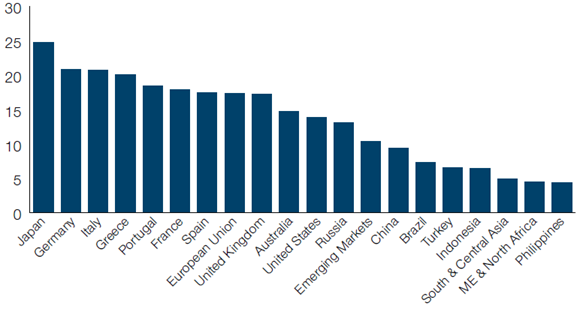
Even outside of the population mega-centres of China and India, several other countries in the Asia ex-Japan region have very sizeable populations. Today, Asia is home to nearly 4 billion people. Large domestic populations create attractive markets for companies. And if harnessed correctly, young labour pools can drive economic growth, especially if combined with productivity improvements. Of course the demographic dividend is not spread equally across the region. China, notably, but also the more developed parts of Asia, such as Korea, now have rising dependency ratios (see figure 1 below). This presents its own challenge for growth in these countries, but it can also create stock market opportunities in some sectors.
Figure 1: Early (Over 65) Dependency Ratio (% Population)
Sources: CIA World Factbook (31/12/2013)
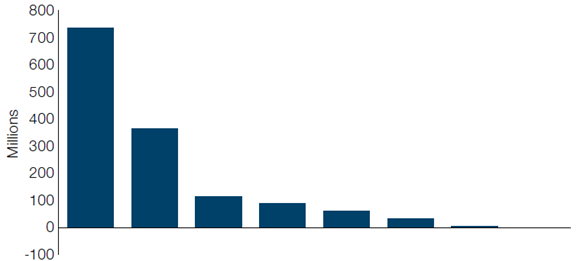
Other demographic trends are at work here. With rising industrialisation—a push to transfer unskilled or agricultural labour into more productive employment—rural workers are moving to the city. Urbanisation rates in Asia lag developed markets but are steadily rising (see figure 2 below).
Figure 2: Increase in Urban Population Over the Next 20 Years
Source: UNPD/CLSA. Based on the 2012 Revision of World Population Prospects
(United Nations, 2013)
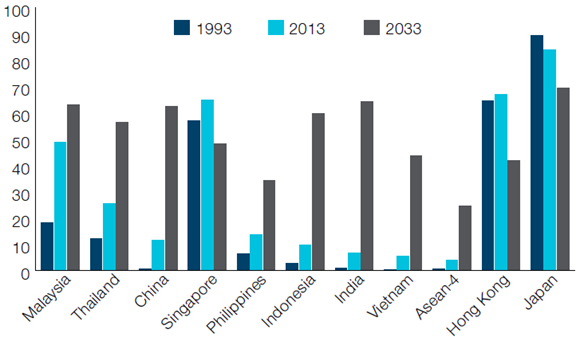
More skilled employment is resulting in rising wages across Asia, with many workers continuing to see incomes increase by double-digit percentages year on year. As a result, many Asian households are entering the sweet spot of middle class consumption when GDP/capita passes US $6,000 (see figure 3).
Figure 3: Middle Class Households as a Percentage of Total Households
Sources: UNPD/CLSA. Based on the 2012 Revision of World Population Prospects
(United Nations, 2013)
2. Expanding opportunity set
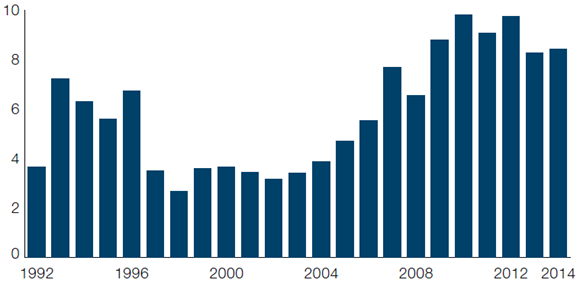
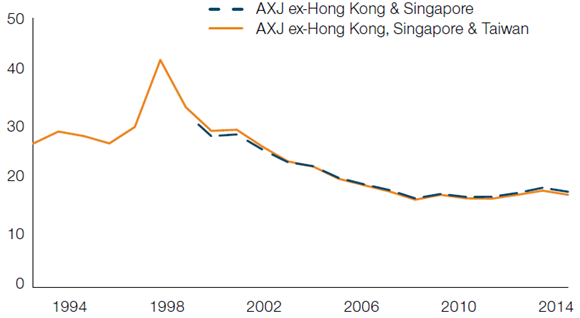
Our investment universe is likely to continue expanding rapidly over the coming decade and more. Arguably, there is more change happening in the Asia ex-Japan region than in other equity regions around the world. Not only is the entrepreneurial spirit of Asians resulting in many new companies being formed and rapidly evolving into large market cap companies, but whole new markets are opening up to us. Asia’s frontier markets will likely become increasingly investable as institutional reforms improve their operational framework, and if free-float market capitalisation grows, thus improving liquidity. China’s A-share market is also expected to gradually open further over coming years. This US $4.7 trillion1 stock market is still largely closed to foreign investors, with the approved access routes of QFII and RQFII now supplemented by the Shanghai-Hong Kong Stock Connect which has been gaining traction as regulators have worked to resolve operational issues. We anticipate that Stock Connect will expand in size and scope over time, and marks an important step in integrating the A-share market into global indices. The Asia ex-Japan region currently represents 8.4%2 of the market cap of the MSCI AC World Index, more than double its weight in the mid 2000s (see figure 4).
Figure 4: Asia ex-Japan as a Percentage of World Market Cap
Source: MSCI as of 31/12/2014
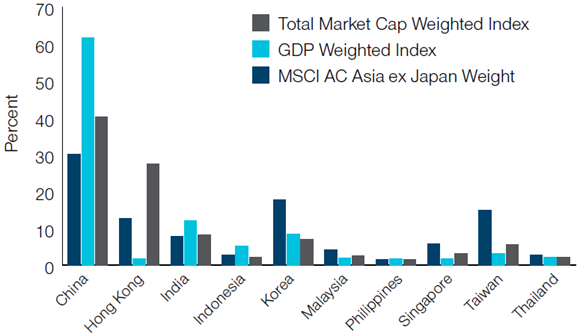
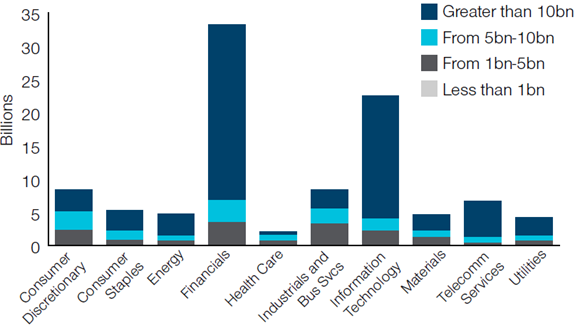
With economic growth and market expansion we expect this level to increase over coming years. For active investors this dynamism in the universe also provides opportunity to create substantial alpha. An index, by its very nature, is backward looking, a reflection of historical growth in market cap. A good active manager can exploit the inefficiencies in the index by investing ahead of change. We believe that many industries remain under-represented in the index today compared to their long term potential to deliver superior returns—for example we expect higher returns and therefore index market share gains from many consumer related industries over the next decade or more than from the energy or materials sectors which have similar index weights currently (see figure 5 below).
Figure 5: Index Not Representative of Investment Opportunities
Source: MSCI, FactSet, IMF as of 30/4/2015
3. Asia now home to world’s leading companies
Asia’s rising presence and impact on the world stage has also been reflected in its stock markets. Many Asian companies have matured into globally competitive and globally leading businesses. Taiwan Semiconductor Manufacturing Company has used its scale and cost advantages to dominate global market share in the semiconductor foundry industry. Samsung Electronics is now the number-one producer of smartphones. Even outside these manufacturing sectors, where Asia has traditionally had strength, Asian companies are innovating rapidly and exploiting their massive domestic markets for growth. In the Internet sector, Chinese companies now occupy three spaces in the top 10 Internet companies by market cap globally.
4. Greater economic and political stability
Asian economies recovered rapidly post the Global Financial Crisis. This was largely because Asia’s economies suffered their own financial crisis in 1997 with its roots in external deficits and foreign currency borrowing, and as a result, much more orthodox economic policy has been followed ever since. This has meant more freely floating currencies, less foreign currency debt, and higher FX reserves across the region (see figure 6 below).
Figure 6: External Debt as % of GDP
Source: CEIC, Morgan Stanley Research 31/12/2014
At the same time that economic performance has been improving, many Asian governments have become more stable and have worked on reform. Whilst progress on this front may have slowed recently, the improvements over the past decade have resulted in a structurally lower cost of capital across the region, creating a more supportive operating and investment climate for businesses. Profitability has improved as a result. Of course, some economies in Asia are still very much non-orthodox (China), and in others, external risks and inflation remain a concern, but the direction of change is likely to remain a positive one.
NEARER TERM OUTLOOK
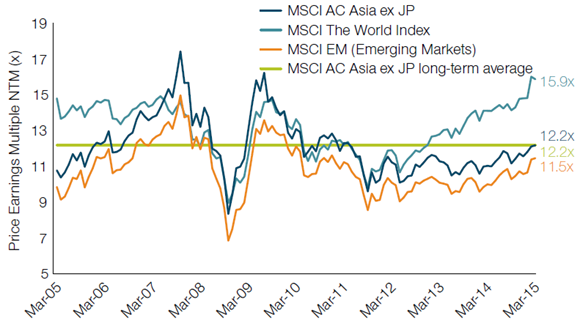
Asia ex-Japan equity markets have lagged their developed market peers in recent years, particularly the US equity market. Interestingly, Asia has comfortably outperformed the broader emerging markets index over the last one, three and five years. Whilst Asia’s underperformance of developed markets has started to turn in recent months, we believe we may only be at the start of a better performance cycle for the region. One of the key reasons behind our positive outlook is that valuations for the region are currently well below previous peak levels, and the gap with developed markets, for example, forward price to earnings, is currently sitting at near-decade highs (see figure 7 above).
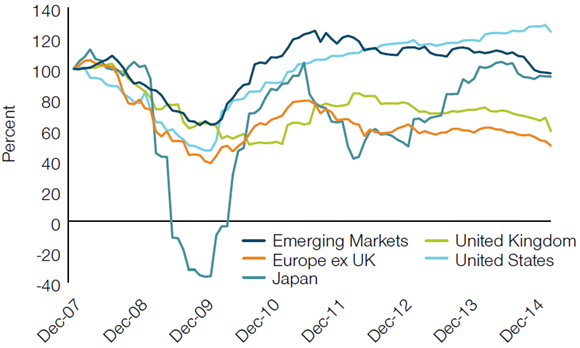
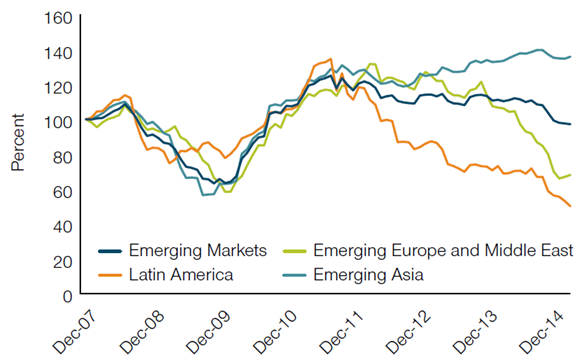
No doubt, both economic and earnings growth in emerging markets has disappointed since 2011, particularly in countries with high commodity exposure. Asia has outperformed broader emerging markets in terms of earnings, but here too, there has been a macro downturn and weakness driven by margins contracting as costs increased and capital expenditure (capex) rose (see figure 8 below).
Figure 7: Valuations Attractive Versus Developed Markets
Source: MSCI. Price to 12 months forward earnings from 31/3/2005 through 31/3/2015
Figure 8: Global Trailing Earnings (earnings per share)
Source: FactSet, MSCI. As at 31/3/2015
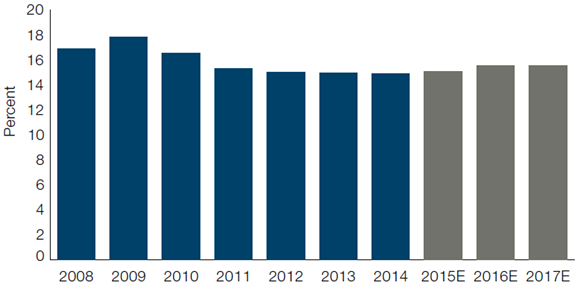
Recently, we’ve seen evidence that earnings growth in the region is on a rising trend once again. This is supported by margin recovery as greater capex discipline is implemented by management teams (see figure 9 below).
Figure 9: EBITDA1 Margins
Source: Factset as of 31/12/2014
1 Earnings before interest, tax, depreciation and amortization
We also believe that a number of key Asian markets have seen their economies bottom in the near term, and consensus expects most economies in Asia, with the clear exception of China, to see higher GDP growth in 2015 than in 2014.
In particular, we, and many market participants, are excited by the potential for improved reform momentum in Asia in the years ahead. This is particularly true where we have seen recent election of more reform-oriented governments. India arguably has the most to gain from an improved policymaking environment in the years ahead. The new government is expected to reduce subsidies and speed up investment approvals, which will improve business sentiment, lift corporate profitability and prompt a revival in investment. Longer term, the BJP has ambitions to develop India as a manufacturing and export hub, which will require reforms to labour laws and better infrastructure. Indonesia, too, should benefit from a new government that is, hopefully, more focused on tackling a high subsidy burden, infrastructure bottlenecks and poor labour laws. Even in China, there is a clear reform programme. Here, reform is less focused on growth—the Chinese economy will continue to slow in the years ahead—but more focused on efficiency and improving the quality of growth. We may see this in better SOE management, in efforts to encourage a cleaner environment and in the closure of some excess capacity as China’s industries seek to move up the value-add production curve.
Returning to the question of rising global yields, whilst the announcement in May 2013 that the Fed would begin the taper of quantitative easing (QE) caused panic amongst investors, we have yet to navigate the actual end of QE, and the inevitable increase in US policy rates, which will follow. Many key adjustments have been made in Asia over the past year, with inflation coming down, currencies at lower levels and current account deficits closing. However, it would be prudent to anticipate some market volatility around these upcoming monetary policy announcements. Such volatility could provide an excellent opportunity to add to the asset class for long-term investors. We expect that once the global monetary policy environment normalises once again, investors will be able to focus on the positive trends in Asia outlined in this paper, especially as a healthy US economy is a positive thing for Asia. Such an environment would be a supportive one for active, fundamental investors.
2015-GL-2011
重要情報
当資料は、ティー・ロウ・プライス・アソシエイツ・インクおよびその関係会社が情報提供等の目的で作成したものを、ティー・ロウ・プライス・ジャパン株式会社が翻訳したものであり、特定の運用商品を勧誘するものではありません。また、金融商品取引法に基づく開示書類ではありません。当資料における見解等は資料作成時点のものであり、将来事前の連絡なしに変更されることがあります。当資料はティー・ロウ・プライスの書面による同意のない限り他に転載することはできません。
資料内に記載されている個別銘柄につき、売買を推奨するものでも、将来の価格の上昇または下落を示唆するものでもありません。また、当社ファンド等における保有・非保有および将来の組入れまたは売却を示唆・保証するものでもありません。投資一任契約は、値動きのある有価証券等(外貨建て資産には為替変動リスクもあります)を投資対象としているため、お客様の資産が当初の投資元本を割り込み損失が生じることがあります。
当社の運用戦略では時価資産残高に対し、一定の金額までを区切りとして最高1.265%(消費税10%込み)の逓減的報酬料率を適用いたします。また、運用報酬の他に、組入有価証券の売買委託手数料等の費用も発生しますが、運用内容等によって変動しますので、事前に上限額または合計額を表示できません。詳しくは契約締結前交付書面をご覧ください。
「T. ROWE PRICE, INVEST WITH CONFIDENCE」および大角羊のデザインは、ティー・ロウ・プライス・グループ、インクの商標または登録商標です。
ティー・ロウ・プライス・ジャパン株式会社
金融商品取引業者関東財務局長(金商)第3043号
加入協会:一般社団法人日本投資顧問業協会/一般社団法人投資信託協会
Executive Summary
Asia ex-Japan is amongst the fastest-growing and most dynamic regions in the world. Home to more than half of the global population, many Asian countries are seeing powerful demographic trends boosting household income with resulting benefit to a wide range of industries and companies. The region’s stock markets are also seeing substantial evolution and change, presenting attractive opportunities to active investors. Having underperformed developed markets in recent years, and with a number of positive recent developments in politics and economics, now may be an opportune time to revisit the thesis for making an allocation to Asia ex‑Japan.