普徠仕(T. Rowe Price) 即將無法支援閣下現在的瀏覽器版本。為確保安全性和網站正常運作,請更新至最新版本的 Chrome、Edge、Safari或 Firefox。如果閣下使用的是辦公設備,請聯絡您的資訊科技管理員。

2026年10月, 股票
The market is hungry for artificial intelligence (AI) use cases that have the potential to generate strong returns on investment and scale into large addressable markets.
We believe that autonomous vehicles (AVs) could become one of the biggest AI applications as the technology approaches what could be its “ChatGPT moment” and scales commercially over the next three to five years. While the market is probably more familiar with robotaxis, the opportunity for self‑driving technology in the long‑haul trucking market is perhaps just as compelling. Over time, we see the technology moving into personal vehicles as well.
Autonomous driving is one of the most difficult engineering challenges in technology today. The credible players in this space have combined software and hardware into an architecture that can be validated from a safety standpoint and continuously updated to get better over time.
We see the potential for multiple winners in the robotaxi and long‑haul trucking markets over the long term, but as with most disruptive innovation, the first‑mover advantage is likely to be powerful.
Skepticism toward AV technology is not irrational given the fits and starts in this space over the last 15 years (Figure 1). However, we believe the commercial inflection across both the robotaxi and long‑haul trucking use cases should become clear in 2027 and beyond.
(Fig. 1) Key milestones and developments on the AV trail
For illustrative purposes only. The specific securities identified and described are for informational purposes only and do not represent recommendations.
Source: Various news reports and company disclosures.
Alphabet (Google)-backed Waymo, for instance, has driverless robotaxi fleets operating commercially in 15 U.S. cities. Near‑term expansion plans target 17 additional cities, including London and Tokyo, across a range of climates and urban layouts.1
Meanwhile, Aurora Innovation expects to end 2026 with more than 200 driverless Class 8 trucks on the road and “over 1,000 trucks” by the end of next year, with a goal of scaling to more than 30,000 by 2030.2
Fleet operators have also been more vocal over the past six months about the technological readiness of self‑driving trucks. For example:
If initial commercial deployments of self‑driving trucks prove successful, customer interest should grow as other fleet operators seek to catch up to early adopters.
We also see the potential for autonomous trucking to scale at a faster pace than robotaxis because customers already have the infrastructure in place on established long‑haul routes. Deploying a fleet of self‑driving electric vehicles efficiently in a city involves more of a logistics challenge and typically requires securing facilities for storing, maintaining, and charging the fleet.
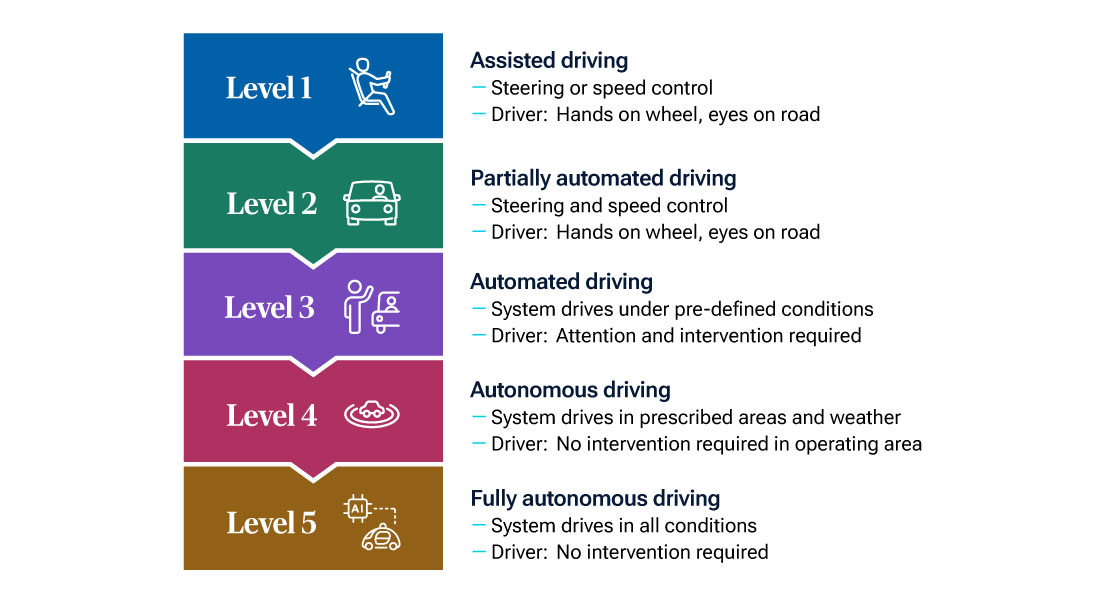
Much of the AV value proposition stems from the potential cost savings, efficiencies, and improved customer experience that can be unlocked by Level 4 autonomy (Figure 2), or systems that can operate without a driver in the vehicle.
(Fig. 2) The five levels of vehicle autonomy
Source: T. Rowe Price analysis, based on SAE International standards.
The potential for safer driving is at the core of many use cases for autonomous vehicles. These technologies may sometimes struggle with edge cases, which, by definition, are atypical and rare. However, autonomous driving systems also never get distracted, emotional, or tired. A body of government and academic research spanning the past five decades found that driver‑related factors, such as human error, impairment, distraction, or illegal maneuvers, have contributed to more than 90% of serious crashes.5
On the robotaxi side, the consistency of the experience is also part of the value proposition for consumers. And as the service scales within a market, it should be able to fill in time and geographic gaps, expanding availability later in the evening and into suburban and rural areas.
On the long‑haul trucking side, there is also a compelling economic use case.
Self‑driving trucks can improve fleet productivity and delivery times. Federal rules require drivers to rest 10 hours after spending 11 hours behind the wheel in a 14‑hour shift. On many long‑haul routes, such as the 17‑hour drive from Dallas to Phoenix, hours‑of‑service limitations would extend the journey to another day. A self‑driving truck could complete the route in a single day—effectively doubling the truck’s utilization.
Labor cost savings are also part of the proposition, along with the potential for autonomous trucks to reduce fuel consumption through more efficient driving and consistent speeds.
Staffing long‑haul routes was a challenge even before tighter enforcement of licensing and immigration rules. One logistics company, for example, has opted to transport packages via air freight instead of long‑haul trucks because of persistent driver shortages. Fleet operators can integrate autonomous trucks into their long‑haul routes where they have driver gaps and reprioritize their labor force to focus on short‑ and medium‑haul routes.
AV technology in commercial trucking is not a zero‑sum game; in our view, it is likely to augment human labor, not replace it.
There is a military saying: “Great leaders talk logistics, not strategy.” In the AV industry, the true leaders are talking safety validation, not technology architecture. Plenty of autonomous driving companies are running beta tests within narrow geographic fences and at low speeds. But a truly useful AV service must operate in a wider area, at varying speeds, on different roadways, and in all types of weather.
We believe safety is a critical gating factor for robotaxis and autonomous trucks.
Not only is it crucial to winning the trust of riders and regulators, but the economics of this disruptive technology hinge on achieving a level of reliability that justifies removing the driver and limits the need for remote supervision. Moreover, safer and more efficient driving may help lower insurance premiums for fleet operators—early datapoints on this front have been encouraging, in our view.
Regulatory risk is also asymmetric. A single accident can hinder deployment, especially if the operator has difficulty pinpointing and addressing what went wrong in its software or hardware.
Validating the safety of an AV is hard. In drug development, the Food and Drug Administration signs off on approved products; in the world of autonomous driving, the AV company typically bears responsibility for determining when its technology is ready for deployment.
The main players that are starting to commercialize their self‑driving technologies have taken different engineering approaches.
Based on valuation, the market appears to give Tesla significant credit for its robotaxi opportunity, likely reflecting the automaker’s history of innovation and the massive amounts of driving data generated by its fleet of electric vehicles.
Tesla’s camera‑only approach to autonomous driving results in lower hardware costs and reflects the view that the combination of more data and stronger AI eventually can deliver adequate levels of safety without the need for additional sensors.
The tradeoff is that vision‑only autonomy may struggle in adverse weather conditions and at higher operating speeds. Tesla’s decision to pursue a pure, end‑to‑end AI system also reduces transparency and predictability, which can make it harder to diagnose and correct operational flaws. Tweaking this black‑box model requires the injection of massive datasets in the hopes of addressing whatever shortcoming has emerged.
These drawbacks are less of a concern for the driver‑assistance software that Tesla offers as a subscription option in its vehicles. There, a driver is present to intervene. These challenges could impede Tesla’s deployment of driverless robotaxis that can operate unsupervised in a variety of environmental conditions.
Changing the placement of its cameras or adding sensors could require amassing a new dataset to retrain its model and reworking its manufacturing operation, which would likely be a time‑consuming and capital‑intensive process.
Other companies, such as Waymo and Aurora Innovation, have chosen system designs that emphasize redundancy and verifiability but involve a more expansive hardware set.
Cameras are augmented with radar and LiDAR6 that can sense vehicles, pedestrians, and other objects in and around the road well before they are visible. These multi‑sensor arrays are critical for operating at night, at highway speeds, and in dust and challenging weather conditions (Figure 3). The level of perception can sometimes seem superhuman.
(Fig. 3) AV sensors and hardware architecture explained
For illustrative purposes only.
Source: T. Rowe Price analysis.
(Fig. 4) Potential advantages and disadvantages
For illustrative purposes only.
Source: T. Rowe Price analysis.
As part of our due diligence, we experienced the technology ourselves, riding in an AV for more than 200 miles between cities. This trip—revelatory in its uneventfulness—included navigating side streets and heavy traffic, as well as driving in moderate rain. At one point on a highway, the driverless vehicle changed lanes for no apparent reason; a few seconds later, a police cruiser and the car the officer had pulled over came into view. The sensing power of LiDAR, which helps to give the AV more reaction time, was on full display while traveling at 70 miles per hour.
Compound software architectures also overlay multiple smaller AI models that include hard‑coded rules of the road, making it easier to identify where mistakes occurred, correct them, and validate the system for safe operation.
We believe companies using more redundant hardware and software architectures should have an advantage in scaling driverless operations, particularly as hardware costs decline and economies of scale take hold. In our view, LiDAR and radar sensor costs should follow the downward trajectory of automotive‑grade camera costs in the 2000s.
Rapid advances in AI, coupled with the emergence of a new generation of AV startups, naturally spark concerns that autonomous driving could be commoditized by fast followers.
In our view, first‑mover advantages should prove resilient, although continued diligence is necessary to assess the pace of improvement.
Developing an autonomous driving system that can reliably handle the complexities of city and highway driving in a wide variety of environmental conditions is extraordinarily difficult—a point underscored by the many AV companies that gave up and folded. Driverless technology that is 98% of the way there is still very far from being ready for commercial operation.
Meanwhile, the companies that are starting to commercialize their AV systems are ahead of the pack in key areas: logging real‑world miles across numerous cities and routes, building a safety track record, and fine‑tuning their models to handle edge cases that are outside the norms of everyday driving.
Autonomous driving companies that have secured meaningful capacity on tier‑1 automakers’ assembly lines should have a significant head start on early‑stage technologies that are still using early‑beta hardware. These companies are ahead of the game in driving down costs and scaling up production in advance of broader commercial rollouts.
Bottom line: We believe robotaxis and autonomous trucking are likely to resemble food delivery and ride‑hailing, where market share is concentrated among a handful of winners. First‑mover advantages should be powerful as customers adopt this technology.
Filtering out near‑term noise and digging deep to better understand a company’s longer‑run prospects can help skilled investors uncover opportunities others might miss, especially during periods of accelerating innovation.
In our view, autonomous driving is a growth story whose nuances are often misunderstood. As commercial penetration of AVs increases in the coming years, we see the opportunity for some early movers to create significant value in a world seeking AI disruptors that also have the potential to generate favorable returns on investment.
2026年7月
股票
Article
2026年6月
股票
Article
1 "Rides Page” on company website. As of September 30, 2026.
2 Aurora Innovation Investor Day, September 23, 2026.
3 Esther Fung, “FedEx Freight CEO Says Self‑Driving Trucks Are Ready for Prime Time,” Wall Street Journal (June 1, 2026).
4 Volvo Capital Markets Day, June 10, 2026.
5 See, for example, Santokh Singh, “Critical Reasons for Crashes Investigated in the National Motor Vehicle Crash Causation Survey,” NHTSA, Traffic Safety Facts, February 2015.
6 LiDAR stands for light detection and ranging. It is a remote‑sensing technology that uses laser pulses to capture the shape, size, and position of surrounding objects.
Risks
Growth stocks are subject to the volatility inherent in common stock investing, and their share price may fluctuate more than that of income-oriented stocks. Investing in technology stocks entails specific risks, including the potential for wide variations in performance and usually wide price swings, up and down. Technology companies can be affected by, among other things, intense competition, government regulation, earnings disappointments, dependency on patent protection and rapid obsolescence of products and services due to technological innovations or changing consumer preferences.
Additional Disclosure
Visit troweprice.com/glossary for definitions of financial terms.
T. Rowe Price cautions that economic estimates and forward‑looking statements are subject to numerous assumptions, risks, and uncertainties, which change over time. Actual outcomes could differ materially from those anticipated in estimates and forward‑looking statements, and future results could differ materially from any historical performance. The information presented herein is shown for illustrative, informational purposes only. Any historical data used as a basis for this analysis are based on information gathered by T. Rowe Price and from third‑party sources and have not been independently verified. Forward‑looking statements speak only as of the date they are made, and T. Rowe Price assumes no duty to and does not undertake to update forward‑looking statements.
The specific securities identified and described are for informational purposes only and do not represent recommendations to buy or sell any security.
Important Information
Where securities are mentioned, the specific securities identified and described are for informational purposes only and do not represent recommendations.
This material is being furnished for general informational purposes only. The material does not constitute or undertake to give advice of any nature, including fiduciary investment advice. Prospective investors are recommended to seek independent legal, financial and tax advice before making any investment decision. T. Rowe Price group of companies including T. Rowe Price Associates, Inc. and/or its affiliates receive revenue from T. Rowe Price investment products and services. Past performance is not a guarantee or a reliable indicator of future results. Investment involves risks. The value of an investment and any income from it can go down as well as up. Investors may get back less than the amount invested.
The material does not constitute a distribution, an offer, an invitation, a personal or general recommendation or solicitation to sell or buy any securities in any jurisdiction or to conduct any particular investment activity. The material has not been reviewed by any regulatory authority in any jurisdiction.
Information and opinions presented have been obtained or derived from sources believed to be reliable and current; however, we cannot guarantee the sources’ accuracy or completeness. There is no guarantee that any forecasts made will come to pass. The views contained herein are as of the date written and are subject to change without notice; these views may differ from those of other T. Rowe Price group companies and/or associates. Under no circumstances should the material, in whole or in part, be copied or redistributed without consent from T. Rowe Price
The material is not intended for use by persons in jurisdictions which prohibit or restrict the distribution of the material and in certain countries the material is provided upon specific request.
Hong Kong—Issued by T. Rowe Price Hong Kong Limited, 6/F, Chater House, 8 Connaught Road Central, Hong Kong. T. Rowe Price Hong Kong Limited is licensed and regulated by the Securities & Futures Commission (“SFC”). This material has not been reviewed by the SFC.
Singapore—Issued by T. Rowe Price Singapore Private Ltd. (UEN 201021137E), 501 Orchard Road, #10-02 Wheelock Place, Singapore 238880. T. Rowe Price Singapore Private Ltd. is licensed and regulated by the Monetary Authority of Singapore. This advertisement or publication has not been reviewed by the Monetary Authority of Singapore.
© 2026 T. Rowe Price. All Rights Reserved. T. ROWE PRICE, INVEST WITH CONFIDENCE, the Bighorn Sheep design and related indicators (see troweprice.com/ip) are trademarks of T. Rowe Price Group, Inc. All other trademarks are the property of their respective owners. Use does not imply endorsement, sponsorship, or affiliation of T. Rowe Price with any of the trademark owners.