

Australian Equities: The Times Are Changing
Executive Summary
We believe that financial markets experienced a regime change in 2016. The investment landscape and policy environment has shifted and, as we enter 2017, “pro-growth” is the new mantra.
While many attribute the current pro-growth environment almost solely to the election of Donald Trump, in fact, global growth, inflation, and manufacturing data were all showing a rising trend prior to November’s U.S. presidential election.
A significant part of the sharp rotation in stock and sector performance during 2016, both in Australia and globally, reflected the extreme positioning that had developed over an extended, multiyear period. More economically sensitive sectors were significantly underinvested, while investment in defensive yield and high-growth areas had become hugely concentrated. This made for a savage snapback as the landscape distinctly shifted.
The coming year looks set to be a tussle between those who believe that the previous low-growth, low-inflation, low-yield world will reassert itself and those who believe that the current higher-growth, higher-inflation environment, driven by pro-growth policies and accelerating corporate earnings—i.e., a return of the business cycle—is here to stay.
We remain firmly positioned in the second camp. Following years of secular stagnation, the future is looking very different, and decidedly more constructive in our view, than the recent past.
We believe that we have just witnessed a regime change in financial markets. The investment landscape and policy environment has shifted and, as we enter 2017, “pro-growth” is the new mantra. On equity markets, long-time laggards are now the new leaders, and vice versa. However, some remain skeptical, challenging various aspects of this pro-growth environment and questioning the lack of detailed evidence supporting such a shift. This misses the point in our view. Importantly, a new, more positive economic and financial direction is being pursued, one that is very different from that of the last five or six years.
For now, the direction is just as important as the underlying support. Markets are a discounting mechanism and so are factoring in what a pro-growth environment might mean—this is how markets function. The detail always comes later. When Eurpean Central Bank (ECB) President Mario Draghi famously stated that the ECB would do “whatever it takes,” who knew what this might involve or where it might ultimately lead? It was the firm direction of intent, not the detail, that was critical in securing confidence in the eurozone.
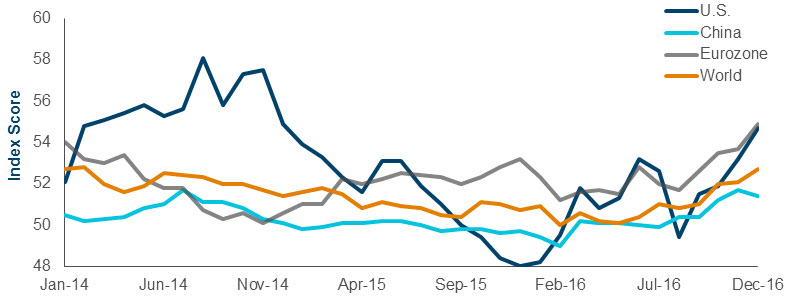
While many attribute the current pro-growth environment almost solely to the election of Donald Trump, it is important to understand that this is not the case. Mr. Trump’s election did not cause the shift toward fiscal policy, the move away from monetary accommodation, or the market rotation out of yield/bond proxies and high price/earnings (P/E) stocks (i.e., the beneficiaries of the previous low-growth, low interest rate world). Indeed, the shift in the landscape was already well underway. The improvement in global growth, led by China, was already evident in strong commodity prices. Global purchasing managers’ indices (PMIs) were already in a synchronized upswing, and inflation had similarly already started to rise (Figure 1). Mr. Trump’s victory and subsequent pro-growth statements, simply added to this mix.
Figure 1: Global Manufacturing PMIs—Synchronized Improvement
As of December 2016
Past performance is not a reliable indicator of future performance.
Source: FactSet.
A significant part of the sharp rotation in stock and sector performance from 2015 to 2016, both in Australia and globally, reflected the extreme positioning that had developed over an extended five- to six-year period. More economically sensitive sectors like materials, energy, and financials were significantly underinvested, while defensive yield sectors like consumer staples, telecommunications, and utilities, as well as high-growth areas such as technology, were massively overweighted by investors. This made for a particularly savage snapback as the landscape turned more positive and growth oriented. Earnings upgrades in mining stocks have reappeared for the first time in years and further upside seems likely. Similarly, the financials sector has also seen a marked turnaround, encouraged by rising bond yields, the likely end of ever greater capital impost by global regulators, and a potentially more lenient U.S. regulatory regime under the new Republican administration.
In contrast, more defensive areas, such as real estate investment trusts, infrastructure, and utilities, have experienced steep declines as the crowded defensive trade has started to unwind. Stocks with high P/E valuations have also come under significant pressure in recent months. Valuations of those companies able to deliver consistent and reliable, above-market earnings growth had become stretched in recent years, particularly among smaller-capitalization growth stocks and certain areas such as the health care sector. However, with the cost of capital starting to rise in line with bond yields, investors are not as comfortable paying the kind of high premiums for companies that they have been in recent years, when very low interest rates meant that the price of capital was effectively anchored at 0%.
The coming year looks set to be a tussle between those who believe that the previous low-growth, low-inflation, low-yield secular stagnation world will reassert itself and those who believe that the current higher-growth, higher-inflation environment, driven by pro-growth policies and accelerating corporate earnings—i.e., a return of the business cycle—is here to stay.
We remain firmly positioned in the second camp, believing that the regime change in financial markets has already occurred. Growth is clearly accelerating in most major countries, and industrial production is growing in a synchronized fashion for the first time in years. Monetary policy is exhausted, and the trend toward greater use of fiscal policy is growing. Inflation is also rising. The evidence to date supports the pro-growth view, though the magnitude and duration are uncertain. We do not expect a particularly smooth path ahead, and stock and sector performance is likely to come in fits and starts. There are also a number of potential risks to the current environment, the emergence of which will inevitably lead to volatility. However, we believe that, after years of secular stagnation, the future is looking very different, and decidedly more constructive, than the recent past.
2017-GL-5515
重要資訊
本文件(包括其中所載的任何陳述、資訊、數據和內容)以及與本文件一併提供的任何資料、資訊、圖像、連結、聲音、圖像或視頻(統稱為「資料」)乃由普信提供,並僅作一般資訊用途。本資料並不擬供在禁止或限制分發本資料的司法管轄區和在本資料須按特定要求提供的若干國家之人士使用。本資料不擬派發予任何司法管轄區的散戶投資者。在任何情況下,本資料的全部或部分內容均不得在未經普信同意下複製或再分發或出示予任何人士。本資料並不構成於任何司法管轄區分銷、要約、邀請、建議或徵求發售或購買任何證券。本資料並未經由任何司法管轄區的任何監管機關審閱。本資料並不構成任何投資意見,不得加以依賴。投資者務請在作出任何投資決策前先尋求獨立法律和財務意見(包括有關稅務後果的意見)。

