

Australian Equities: The Return of the Business Cycle
Executive Summary
The outlook for Australian equities in 2017 appears increasingly positive in our view, underpinned by improving global growth prospects and the generally healthy domestic economy.
Over the last five years, macro factors and sector positioning have been the way to make money in the Australian market. However, these look like lesser influences going forward. We believe that valuation and strong stock selection will reemerge as key drivers of equity market returns.
This new environment is very different from the low-growth, low-yield, low-inflation backdrop of recent years, and it will be interesting to see how investors adjust.
Say goodbye to secular stagnation, and please welcome the return of the
business cycle.
The outlook for the Australian equity market in 2017 appears increasingly positive in our view, due, in large part, to two main reasons. First, we are starting to see pro-growth policies being initiated in a number of countries, not least the U.S., and Australia stands as a major beneficiary should this growth eventuate in any reasonably meaningful way. Positive signs are already emerging, with prices of commodities like coking coal and iron ore, for example—Australia’s two largest exports—up 300% and 100%, respectively, this year.1 This is in direct contrast to the weakness in commodity prices seen in recent years, leading to a sharp contraction in the metals and mining sector. And it is not only export dollars that this improvement brings into the country, but also the flow through to employment and capital spending. These have been in decline in the mining sector for the past three years, so we anticipate something of a commodities-driven mini-stimulus coming through, providing a boost for the economy.
The improvement in commodity prices is also important in helping to repair Australia’s fiscal position. Efforts by the federal government to achieve this through Parliament have generally ended in stalemate. However, if commodity prices are sustained around current levels for the next six to 12 months, this represents a potential USD $6bn‒$8bn windfall for the Australian economy. With Australia on negative credit watch with ratings agencies, this kind of fiscal improvement is most welcome.
DOMESTIC ECONOMY IN RELATIVELY GOOD HEALTH
The second reason relates to the generally healthy state of the domestic economy. Gross domestic product (GDP) growth is still 3%+ per annum; the labor market remains solid, with unemployment at 5.6%; and the Australian dollar has also proved reasonably robust in 2016, trading in a low- to high-$0.70 range versus the U.S. dollar.2 The only slight concern is inflation, which remains below the Reserve Bank of Australia’s (RBA) target range. However, there are some early signs that this might be improving.
Our expectation is for monetary policy to remain stable in the near term. Australia is currently in the midst of a housing boom, and the new governor of the RBA, Philip Lowe, appears reluctant to cut interest rates further for fear of fanning that fire and also due to concerns about financial stability risk. Meanwhile, the current government would like to initiate fiscal spending, particularly on infrastructure; however, getting this ratified by Parliament will be difficult.
INTERNATIONAL INFLUENCES ARE NOT EXPECTED TO WEIGH ON THE MARKET
Internationally, the protectionist policies broached by U.S. President-elect Donald Trump have grabbed the world’s attention, with suggestions that the Trans-Pacific Partnership could be dismantled. However, even if Mr. Trump were to follow through on these statements, there is every possibility that such a move would prompt a strong stimulative response from China. So, in a counterintuitive way, if the U.S. were to adopt a protectionist stance, this might actually provoke a response that is ultimately favorable for the Australian economy. With that said, we are not convinced that Mr. Trump will follow such a path as it effectively becomes a tax on the American consumer.
From a market perspective, the extended rally in global bond markets looks to be ending, with the low point in yields most likely behind us. U.S. 10-year yields have risen by roughly 100 basis points (bps) in recent weeks, with a similar increase in Australian 10-year yields.3 This reflects the more upbeat growth outlook in the U.S. following Mr. Trump’s victory; however, in truth, inflation was starting to emerge in some major economies even before the U.S. election.
EXPECT MARKET ROTATION
We envisage the Australian equity market appreciating by 3%‒8% over the next six months, and it will be particularly interesting to see how the expected rotation within the market plays out. The big losers in this rotation are likely to be the bond proxy and defensive yield stocks, as well as stocks with high price/earnings (P/E) ratios. With the cost of capital rising, investors are unlikely to be as comfortable paying high premiums than when capital was effectively priced at 0%. In contrast, the parts of the market that stand to benefit from the improving outlook are more cyclical areas, such as commodity producers, mining companies, and financials.
We believe we are well positioned for such an environment. We are overweight the metals and mining sector, for example (excluding gold, where we have no exposure), and we have also moved overweight the banking sector, beginning to build our exposure prior to the U.S. election and accelerating the move since.
One question that continues to hang over the banking sector is: Are we done with the impost of additional capital requirements on the sector? From all that we are hearing at home and internationally, we are not anticipating further capital demands being made on Australian banks. Historically, the local regulator, Australian Prudential Regulation Authority (APRA), has taken a very conservative stance, which has meant that Australian banks have had to hold a lot more capital than most other banks around the world. This should provide APRA with a degree of comfort around current capital levels, and as a result, we do not see much of a drag coming from additional demands. We are keen to increase our financials exposure further, however, having seen some big moves in the sector recently, we prefer to wait and build our exposure in a more price-sensitive way.
Having been overweight health care for some time, we have recently pared this back as valuations had become stretched. While the Trump election victory is broadly positive for the sector, we took some profits on stocks that had done very well. While still overweight, it has been the lowest position for some time.
A RICH OPPORTUNITY SET IS EMERGING
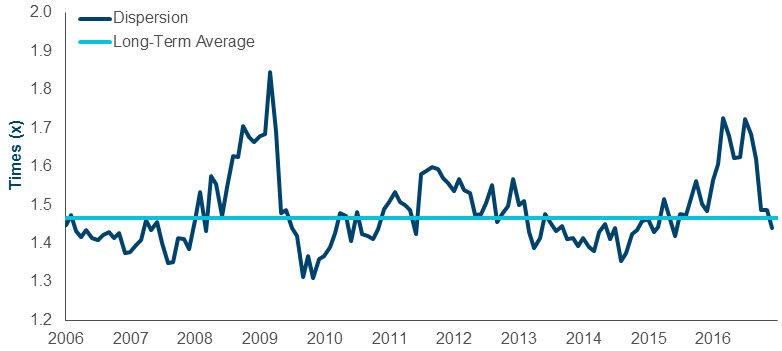
More broadly, we are also starting to look at some of the high P/E stocks that have recently come under pressure, underperforming the market. The next three to six months could potentially provide some of the best opportunities to buy these good-quality growth companies than at any time in recent years. The dispersion between the most expensive and least expensive stocks in the Australian market has fallen below the long-term average, meaning that broadly similar valuation multiples are being applied to companies with very different growth profiles.
Figure 1: Price/Earnings Dispersion of ASX 100 ex Resources Index
As of November 30, 2016
Past performance cannot guarantee future results.
Source: UBS. ASX 100 ex Resources Index—dispersion between cheapest and most expensive stocks—80th percentile P/E
divided by 20th percentile P/E.
Over the last five years, macro factors and sector positioning have been the way to make money in the Australian market. However, these look like lesser influences going forward. While certain sectors will still obviously outperform others, we believe that valuation and strong stock selection will be more important drivers of returns. Valuations have been less relevant over the past five years; however, as the cost of capital starts to rise, investors will be increasingly mindful of the prices and multiples they are prepared to pay for companies. This new environment is very different from the low-growth, low-yield, low-inflation backdrop of recent years, and it will be interesting to see how investors adjust. Say goodbye to secular stagnation, and please welcome the return of the business cycle.
1 Source: Thomson Reuters, as of October 31, 2016.
2Source: Trading Economics, as of Q3 2016.
3Source: Thomson Reuters, as of November 2016.
2016-GCC-86665
重要資訊
本文件(包括其中所載的任何陳述、資訊、數據和內容)以及與本文件一併提供的任何資料、資訊、圖像、連結、聲音、圖像或視頻(統稱為「資料」)乃由普信提供,並僅作一般資訊用途。本資料並不擬供在禁止或限制分發本資料的司法管轄區和在本資料須按特定要求提供的若干國家之人士使用。本資料不擬派發予任何司法管轄區的散戶投資者。在任何情況下,本資料的全部或部分內容均不得在未經普信同意下複製或再分發或出示予任何人士。本資料並不構成於任何司法管轄區分銷、要約、邀請、建議或徵求發售或購買任何證券。本資料並未經由任何司法管轄區的任何監管機關審閱。本資料並不構成任何投資意見,不得加以依賴。投資者務請在作出任何投資決策前先尋求獨立法律和財務意見(包括有關稅務後果的意見)。


