

Global Fixed Income: In a Muted Return Environment, Looking to Capitalize on Volatility
Executive Summary
- After a strong—albeit volatile—first half of 2016, fixed income markets appea fully priced, offering more downside risk than upside potential.
- While the conditions supporting firmer valuations could persist in the coming months, investors should be prepared for additional bouts of volatility.
- With yields low across major sovereign markets, investors should look for countries with healthier yields and the potential for rate cuts while being careful with currency exposures.
- Security selection will be key in credit markets given unexciting sector valuations and the potential for risk appetite to weaken.
Global fixed income markets took investors on a wild ride in the first half of 2016. Safe-haven sovereign yields dropped, and risk premiums initially spiked amid concerns over the speed of China’s economic deceleration, collapsing oil prices, and the Federal Reserve tightening policy in the face of fragile global economic conditions. Risk appetite abruptly returned in mid-February, however, as China shifted its focus from restructuring the economy to supporting growth, commodity prices rebounded, and major central banks assumed a more dovish stance.
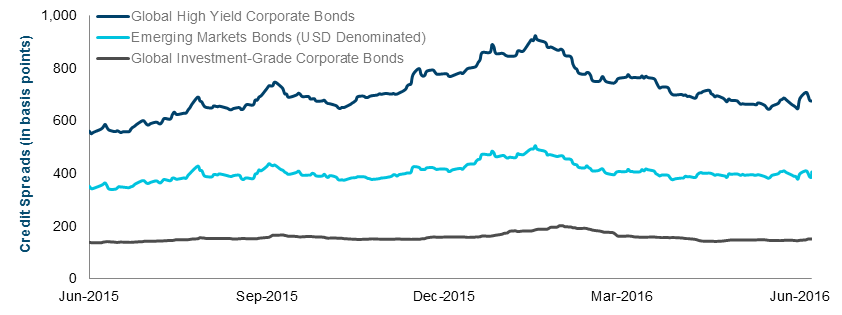
This momentum continued until late June, when Britain’s vote to leave the European Union (Brexit) shocked global markets and drove U.S. Treasury and German bund yields to new lows. Demand for riskier assets weakened, but valuations remain less attractive than early in the year (Figure 1). In the coming months, fixed income markets seem likely to generate coupon returns but have less potential for additional price gains. Skittish investor sentiment, divergent central bank policies, and conflicting macroeconomic signals leave markets susceptible to bouts of risk aversion and subsequent relief rallies. These episodes will provide nimble investors with opportunities to profit from volatility, but strong macro and credit research will be critical.
Figure 1: Sharp turnaround in risk appetite across credit markets in early 2016
As of June 30, 2016
Sources: Barclays, J.P. Morgan, and T. Rowe Price.
LOW GLOBAL RATES KEEPING YIELD CURVES ANCHORED
Amid a tightening U.S. labor market, the Fed aspires to move policy rates higher, if only to create room to cut again if global weakness undermines the U.S. expansion. But Fed officials are also concerned about risks to the U.S. economy from abroad. With the fallout from Brexit adding to worries about sluggish global growth, the Fed will be very cautious about tighter policy, with no more than one rate hike likely this year, if that. An unusually gradual path to policy renormalization should keep Treasury yields relatively restrained, barring an unexpected surge in global inflation.
Moreover, Treasuries are arguably cheap in comparison with other major sovereign markets. Yields in Europe and Japan are much lower, as European and Japanese growth remains muted, inflation is absent, and policy rates are below 0%. Negative yields across a large swath of the developed world are suppressing yields globally as investors seek higher-yielding alternatives.
SEARCHING THE GLOBE FOR SOVEREIGN OPPORTUNITIES
In this prolonged low-yield environment, our global portfolio managers are looking to our sovereign analysts to identify countries where yields are relatively high and may have potential to decline due to disinflation and subdued growth.
The Reserve Bank of Australia, for example, reduced rates in May following a surprisingly soft inflation report and could do so again before year-end. Although another cut has largely been priced in, intermediate-term Australian bonds should remain resilient if U.S. yields rise. In Malaysia, inflation momentum has dropped sharply amid a slowing economy hurt by lower oil prices and a government corruption scandal, creating room for a rate cut if the ringgit remains stable.
Among higher-yielding markets, decelerating inflation in Indonesia affords its central bank flexibility to further
ease policy to stimulate growth. And Brazilian bonds, offering double-digit yields at the front of the curve, could generate price gains if the transition to a more fiscally responsible government allows for less restrictive
monetary policy.
If the cost appears reasonable, our managers can employ exchange rate hedges to protect against the currency depreciation that often accompanies rate cuts.
RENEWED DOLLAR STRENGTH COULD AGITATE FOREIGN EXCHANGE MARKETS
In foreign exchange markets, the U.S. dollar had weakened in 2016, reversing the trend of the past two years, until Brexit fears provided support at midyear. The yen, also considered a safe haven, has strengthened despite the Bank of Japan’s efforts to depress its value, while the euro has been range-bound. Although the rally in emerging markets currencies has subsided amid revived dollar strength, they received some much-needed support this year as the market lowered its expectations for Fed rate hikes, oil prices rebounded, and China’s economy showed signs of stabilizing (Figure 2).
While the lion’s share of U.S. dollar appreciation may have already transpired, jittery markets and the eventual resumption of Fed tightening could lead to additional gains. Negative interest rates and rising monetary bases limit the euro’s and yen’s appreciation potential. Emerging markets currencies will likely be erratic due to global growth concerns and country-specific factors. Commodity-oriented currencies, such as the Australian and Canadian dollars, look vulnerable to renewed weakness in energy and metals prices.
Expecting further volatility, our global bond managers are being careful with currency exposures, focusing on select currencies that they expect to appreciate in the long run due to positive structural reforms and stronger growth potential. Promising candidates include the Indonesian rupiah and Serbian dinar. Our managers are inclined to fund long positions by selling non-U.S. developed market currencies, as well as emerging market currencies with weaker fundamentals, such as the Hungarian forint and Turkish lira.
Figure 2: U.S. dollar weaker and emerging market currencies stronger in 2016 in 2016
As of June 30, 2016
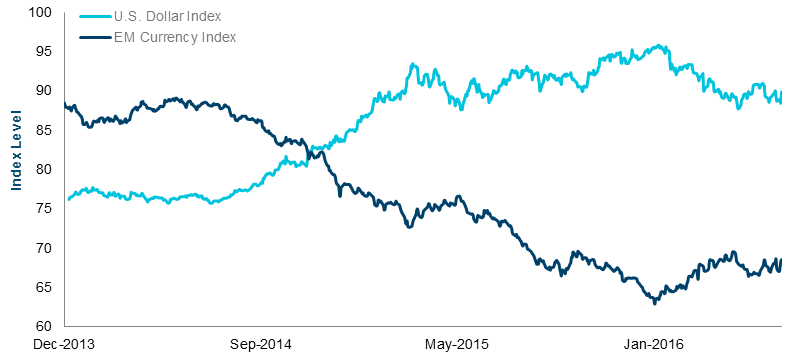
The U.S. dollar index measures the value of the dollar versus a trade-weighted basket of major currencies. The J.P. Morgan Emerging Market Currency Index measures the value of the most-traded currencies from developing countries versus the dollar.
Sources: FactSet, Federal Reserve, J.P. Morgan, and T. Rowe Price.
SELECTIVITY AGAIN IMPERATIVE IN CREDIT MARKETS
Valuations across credit markets reached compelling levels in early 2016 as risk aversion escalated. Almost all assets participated in the subsequent rally, led by lower-quality assets that had suffered the most during the sell-off. Today, with sector-level valuations less enticing and numerous risks extant, our credit-oriented portfolios are positioned more defensively, taking risk where it seems most appropriate based on our analysts’ best ideas.
Investment grade: The outlook for U.S. high-grade corporates has become less favorable. Valuations are fair, at best, and fundamentals are slowly deteriorating amid lackluster earnings reports and rising leverage ratios. Still, our investment-grade corporate team continues to find pockets of value—for instance, in lower-rated, non-commodity industrials such as airlines, cable companies, and wireless tower operators. European corporate bonds, particularly UK-domiciled issuers, will feel pressure from the unfolding Brexit drama. However, the European Central Bank’s corporate bond purchase program will provide strong offsetting technical support, and credit spread widening should create opportunities to buy bonds that have been unfairly punished due
to geography.
Within securitized markets, asset-backed and commercial mortgage-backed securities benefit from solid fundamentals and diminishing supply, although liquidity can be challenging. Valuations for agency mortgage-backed securities are not particularly compelling, but this high-quality sector is relatively insulated from global instability and provides a modest yield advantage versus Treasuries without sacrificing liquidity.
High yield: Commodity prices continue to drive performance, reflecting the meaningful weight of energy and mining companies in the U.S. high yield market. Based on research from our equity colleagues, who think the rebound in oil prices may be transitory, our high yield team took advantage of the recent sharp reversal in risk appetite, initially adding risk at cheap valuations and then trimming again as valuations richened.
Overleveraged commodity producers are driving default rates higher, but otherwise the fundamentals of high yield companies remain generally sound. Within the commodities space, we see select opportunities in short-term paper from high-quality companies that can sell assets and raise capital if needed. Bank loans offer a more defensive way to gain exposure to high yield. While high yield bond defaults are rising, we expect loan defaults to remain lower given lighter energy exposure and better overall quality.
Emerging markets: Volatility stemming from commodity price fluctuations and concerns about China’s economy and Fed policy are not only likely to generate headwinds, but they may also create opportunities to take advantage of price dislocations and attractive entry points.
Political and downgrade risks have risen in some countries—such as Poland, Russia, South Africa, and Turkey—while others are progressing along positive reform paths. We are focused on countries with positive reform momentum that supports sustainable long-term growth and reduces sensitivity to global capital market stress. Higher-conviction locales include Argentina, Indonesia, Mexico, and Serbia.
CAREFULLY TAKING RISK AMID MULTIPLE MACRO CONCERNS
At midyear, investors find themselves facing multiple risks. Markets are bracing for complex, drawn out, and disruptive Brexit negotiations. The Chinese government is walking a fine line between supporting growth and discouraging the accumulation of even more debt. The Fed also faces a difficult situation, wanting to raise rates to gain policy flexibility and keep credit growth from overheating, but also being wary of damaging emerging markets. Investors are looking for signs of growth in Europe and Japan amid concerns that central bank policy tools have lost their potency. The floor under oil prices seems flimsy given structural oversupply.
With overall valuations again at less attractive levels, risks appear to be asymmetric—offering more downside than upside. In this environment, we believe investors will benefit from long-term focus and a highly selective, risk-aware approach. Thus, our managers are taking—or hedging—risk where it appears most advantageous while maintaining sufficient liquidity in portfolios to be able to ride out turbulent markets and exploit ensuing opportunities.
2016-GL-4318
重要資訊
本文件(包括其中所載的任何陳述、資訊、數據和內容)以及與本文件一併提供的任何資料、資訊、圖像、連結、聲音、圖像或視頻(統稱為「資料」)乃由普信提供,並僅作一般資訊用途。本資料並不擬供在禁止或限制分發本資料的司法管轄區和在本資料須按特定要求提供的若干國家之人士使用。本資料不擬派發予任何司法管轄區的散戶投資者。在任何情況下,本資料的全部或部分內容均不得在未經普信同意下複製或再分發或出示予任何人士。本資料並不構成於任何司法管轄區分銷、要約、邀請、建議或徵求發售或購買任何證券。本資料並未經由任何司法管轄區的任何監管機關審閱。本資料並不構成任何投資意見,不得加以依賴。投資者務請在作出任何投資決策前先尋求獨立法律和財務意見(包括有關稅務後果的意見)。


