

Global Economy: Progress is Slow as The Global Economy Tacks Into Headwinds
Executive Summary
China’s problems are likely to return to the forefront as the recent fiscal stimulus fades and the country turns to deleveraging.
Brazil also faces fiscal challenges, but it is benefiting from stabilizing commodity prices, and the new government seems poised for real reforms.
§The Fed is likely to proceed with caution, partly because of the feedback effects of higher U.S. interest rates on emerging markets (EMs).
European growth is benefiting from monetary stimulus and low commodity prices, and peripheral markets are healing, but Brexit has added a layer of uncertainty to the global economic outlook.
The uncertainties spawned by Britain’s decision to leave the European Union (EU) have come even as economies around the globe are sailing into two primary headwinds as they enter the second half of 2016: the need for EM economies to deleverage and the end of the commodity “supercycle.” These winds are gusting most forcefully over China, Brazil, and other EMs, but given that EMs represent 40% of global gross domestic product (GDP), they are also being felt in developed economies. Meanwhile, policy levers are already pressed near their maximums. How well countries can navigate these headwinds will largely determine if the overall global economy will slow further in late 2016.
CHINA: A STRUGGLE TO BALANCE GROWTH AND DELEVERAGING
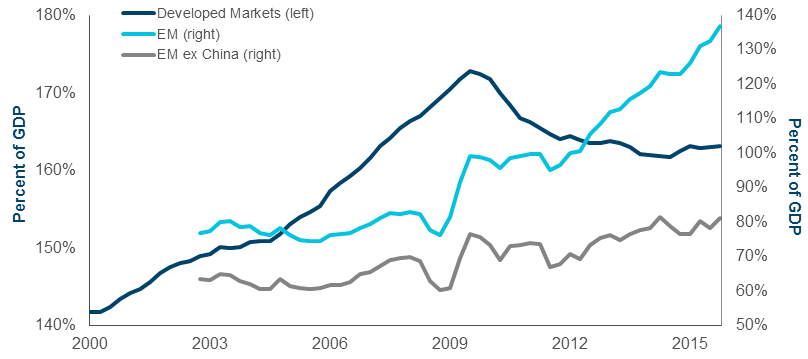
We view deleveraging in EMs as the third stage of the cleanup process after the 2008 global financial crisis. The U.S. was first in scrubbing up balance sheets, followed by the euro area. Governments, companies, and individuals in EMs will soon face their turn at the challenge of reducing debt levels even as the public becomes increasingly dissatisfied with the pace of growth.
Figure 1: Debt of Private Nonfinancial Sectors
As of December 31, 2015
Sources: Bank for International Settlements, Haver Analytics, and T. Rowe Price.
Nowhere does the deleveraging challenge carry greater implications than in China. The world cheered in early 2016 as Beijing finally intervened strongly enough to stop the downward growth spiral that has plagued the economy over the past few years. Whether the bounce that Chinese growth has experienced in recent months is more than temporary is highly questionable, however, as the improvement is largely the result of a more expansionary fiscal stance and an unsustainable acceleration in the pace of credit expansion.
At some point in the not-too-distant future, the authorities must address the imbalanced nature of the economy and bring it onto a sustainable growth path. According to the Bank for International Settlements, private nonfinancial credit outstanding has grown from 118% of GDP in 2007 to 210% in 2015. Meanwhile, according
to the International Monetary Fund (IMF), the augmented fiscal deficit has grown to roughly 10% of GDP.
A sustainable growth trajectory in China requires a much slower pace of credit growth and less reliance on massive investment projects championed by fiscal authorities.
BRAZIL: POLITICAL PICTURE BRIGHTENS, BUT DELEVERAGING CHALLENGE REMAINS
The global commodities headwind has eased, at least temporarily, as prices for oil and metals have recovered somewhat. We are suspect about the durability of recent gains, our skepticism fed in part by the research and opinions of the firm’s natural resources analysts. In addition, higher commodity prices are unlikely to feed back into growth by triggering investments in new capacity given the global supply glut and other uncertainties. Still, rising commodity prices have helped stabilize some important EM currencies and stimulate some major exporting economies. Rising commodity prices generally support incomes in EMs (with China being the notable exception).
Brazil, in particular, appears to have turned a corner. Higher metals and oil prices have helped, but local asset markets caught fire as the country moved toward removing President Dilma Rousseff and the Workers’ Party from power. Rousseff stepped aside on May 12, and the vice president from a coalition party, Michel Temer, has assumed power. Although unelected and lacking a popular mandate, Temer has indicated that he understands the country’s economic travails. He has appointed a market-friendly cabinet and announced long-overdue micro- and macroeconomic reforms, and we are encouraged that Congress seems to be coalescing around him.
While expectations are running high, so are the challenges facing the new economic team. Brazil’s fiscal deficit reached more than 10% of GDP as of the end of 2015, and gross debt stood at 74% of GDP, according to the IMF. Fiscal consolidation is sorely needed in a country that is venturing into its second year of a very serious recession. The ongoing corruption investigation involving national oil firm Petrobras presents an additional challenge as local media have reported that Temer may also be subject to corruption charges. Nevertheless, we expect the new government to achieve significant steps toward structural reform, particularly the adoption of budget reforms that will provide it the flexibility for needed fiscal consolidation. We also anticipate progress in breaking the link between pensions and the minimum wage, which has drained government finances.
U.S.: HEADWINDS TAKE A LESSER TOLL BUT STILL INFLUENCE FED POLICY
While the U.S. economy has not been sheltered from the global headwinds, it has suffered a much smaller toll from them. The weakness in commodities has led U.S. energy and mining firms to cut back investment in plant and equipment spending, which we calculate has reduced the annual rate of real GDP growth by 0.5% since the end of 2014. That drag appears to be fading at midyear, however, and solid employment growth continues to support consumer spending. Following a weak first quarter, we expect a return to around 2% annual growth over the balance of the year.
MMeanwhile, inflation pressures are rising, with the unemployment rate under 5% and import price deflation easing with the dollar below its January peak. Nonetheless, we expect the Fed to take advantage of below-target inflation and proceed with unprecedented caution, taking time to assess the impact of each step in the process of normalizing the stance of monetary policy. The Fed is also aware of the economy’s increasing vulnerability as underlying resilience fades in the latter stages of the business cycle. Corporate profit margins are peaking as the economy nears full employment and slack in the labor market disappears.
Figure 2: The Fed Is Lagging the Taylor Rule
As of June 15, 2016 (before British EU exit vote)
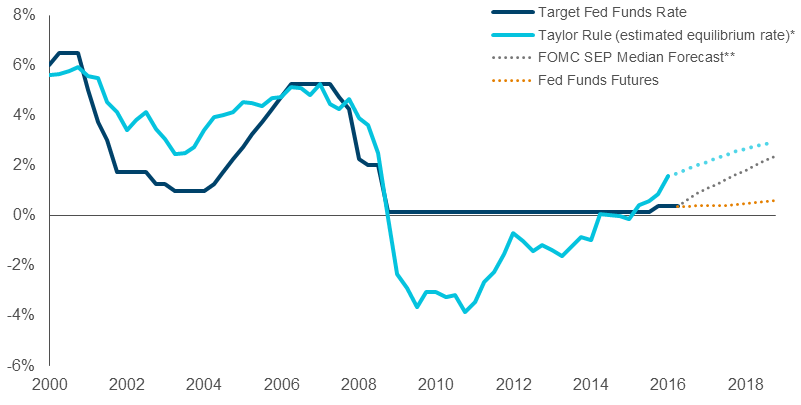
*Forecast based on March 16, 2016, Federal Open Market Committee (FOMC) Summary of Economic Projections (SEP) using midpoints of ranges for growth and inflation projections. Taylor Rule assumes neutral real fed funds rate rises from -0.1% currently to +1.0% at the end of 2018.**Median of FOMC participants' forecasts as presented in the SEP.Sources: Federal Reserve, Haver Analytics, and T. Rowe Price.
EM headwinds are also influencing U.S. interest rates. Because global capital flows often have more influence on financial conditions in EMs than do local policymakers, the Fed has to tread lightly in order to avoid stressing EM financial markets and economies. Over the past year, we have seen episodes of strong feedback from Fed action to EM reaction to U.S. financial conditions—in the form of currency movements, credit conditions, and stock market performance. Tightening financial conditions in EMs in late 2015 choked off growth and spilled over powerfully into the developed world. With EMs now representing 40% of global GDP, the Fed will be careful to avoid a repeat this year.
EUROPE: BOOSTED BY LOW COMMODITY PRICES AND EASY MONETARY POLICY
Although Britain’s decision to leave the EU will have longer-term impacts on the Continent, domestic demand growth in Europe appears buoyant—at least relative to its recent history. The downturn in oil, gas, and metals prices in 2014 and 2015 acted as a fiscal subsidy to Europe given its heavy import balance in commodities. Very loose monetary policy and marginally freer fiscal policy—due in part to expenditures to cope with the influx of refugees—should also be supportive. EM headwinds are being felt more strongly in Europe than in the U.S., but these are being overcome by the domestic policy tailwinds. The recent gain in both the euro and oil prices should moderate growth in the second half of the year, however, to an annual rate of roughly 1.5%.
The threat of domestic sources of contagion, particularly from the Continent’s periphery, has also diminished. Indeed, the peripheral countries have made slow progress on needed reforms as they have recovered from the eurozone debt crisis. In particular, we expect that Greece will see continued debt relief and Spain will eventually form a majority government, although this may take several elections.
BREXIT ADDS ANOTHER HEADWIND
The UK's vote to leave the EU (Brexit) has further complicated the global outlook. Although the UK accounts for only 4% of global GDP, the decision will affect other economies through a number of channels. Clearly, it will result in increased friction in global trade, particularly in financial services. More important, it will increase the level of global uncertainty, leading firms to delay irreversible investment decisions until clarity emerges—at a time when capital spending is already weak.
While Brexit has also raised questions about the stability of the global financial system, measures put in place by central banks since the financial crisis of 2008 should guarantee liquidity—and in any case, financial institutions had hedged themselves in preparation for such an outcome. Indeed, the promise of central bank intervention and looser monetary policy as a result of Brexit caused interest rates to decline in the wake of the vote. This may stem the risk that investors will pull assets from emerging markets and other riskier segments of the financial system.
2016-GL-4091
重要資訊
本文件(包括其中所載的任何陳述、資訊、數據和內容)以及與本文件一併提供的任何資料、資訊、圖像、連結、聲音、圖像或視頻(統稱為「資料」)乃由普信提供,並僅作一般資訊用途。本資料並不擬供在禁止或限制分發本資料的司法管轄區和在本資料須按特定要求提供的若干國家之人士使用。本資料不擬派發予任何司法管轄區的散戶投資者。在任何情況下,本資料的全部或部分內容均不得在未經普信同意下複製或再分發或出示予任何人士。本資料並不構成於任何司法管轄區分銷、要約、邀請、建議或徵求發售或購買任何證券。本資料並未經由任何司法管轄區的任何監管機關審閱。本資料並不構成任何投資意見,不得加以依賴。投資者務請在作出任何投資決策前先尋求獨立法律和財務意見(包括有關稅務後果的意見)。


