

Global Equity: Second-Half Outlook Will Depend on Financial and Economic Stabilization
Executive Summary
Hopes for a more stable equity environment in the second half of 2016 rest on greater political clarity in Europe, energy price stability, and continued global economic growth.
The uncertainty associated with the British vote to exit the European Union
(Brexit) has undermined the earnings outlook, which had appeared to stabilize
earlier in 2016.
Abrupt swings in market volatility present a difficult environment for buy and hold investors but also create opportunities for active equity managers to add to their best ideas. We believe skilled stock picking can continue to add value if it is backed by careful fundamental research.
The earnings outlook should stabilize as we move into 2017, assuming greater political clarity supports financial stabilization and economic growth.
The volatility associated with the Brexit referendum has darkened the equity outlook for the second half of 2016. How the market environment develops from here will depend heavily on three factors:
- A Brexit settlement: Markets are looking for clarity on the relationship between the UK and the European Union (EU) and on the future of the EU itself. Compromise is possible, but it will be some time before the outlines of the new political and economic order are visible. Uncertainty will weigh on investor sentiment and economic activity, although the scope of these effects is hard to estimate.
- Energy price stability: After plunging in the fourth quarter of 2015 and the opening weeks of 2016, oil prices rebounded to around $45 a barrel as of early July.1 A sharp reversal of that recovery could trigger renewed financial volatility, while further large gains would be negative for global consumers. Oil prices in roughly the $40 to $60 range would be supportive for equities.
- Global economic growth: Despite Brexit uncertainties, the U.S. economic expansion appears intact, although still subdued. Monetary policy should remain supportive, and U.S. consumers are in strong shape. However, the presidential election presents risks to investor sentiment. In China, growth continues to muddle down, but reduced pressure on the U.S. Federal Reserve to raise rates should support China's currency, the renminbi.
In our view, the uncertainties surrounding these factors create risks, but also opportunities, for long-term investors. Selectivity and caution will be critical for navigating in troubled waters, as investors will need to distinguish between the short-term price effects of market volatility and underlying fundamental values.
In this environment, we believe skilled stock picking can add value if it is backed by careful research and analysis at the company and industry levels. More than ever, we are focused on individual stock selection, as opposed to broad country or sector tilts, and are looking to add opportunistically to existing positions if and when short-term market movements create attractive valuation entry points.
EARNINGS AND VALUATIONS
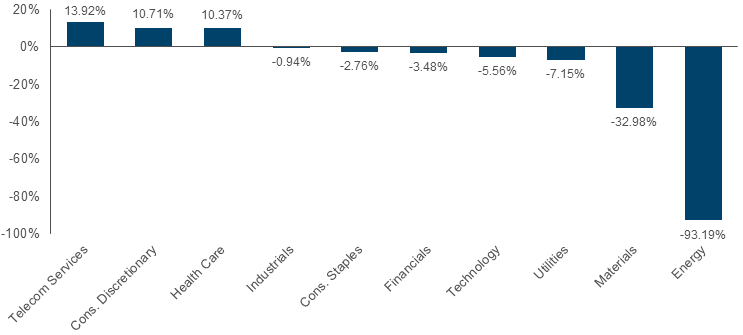
The energy and materials sectors both posted steep year-over-year earnings declines through June (Figure 1). The rebound in oil and other commodity prices seen in the first half slowed the downward pressure on earnings in those two sectors (also easing energy-related pressure on the high yield debt market). However, Brexit and the uncertainty in Europe almost certainly will place downward pressure on earnings in the second half of 2016. The extent of this damage is still uncertain, and much will depend on how quickly the British government clarifies its intentions regarding the timing of Brexit and enters into formal negotiations with the EU.
While the negotiation and exit process will take years, relatively speedy movement toward a compromise could set the stage for earnings stabilization and recovery in 2017. However, renewed strength in the U.S. dollar and potential weakness in energy and commodity prices will remain downside risks for the earnings outlook.
Figure 1: Economic Sector Earnings in the MSCI All Country World Index
Year-Over-Year Change in Trailing 12-Month Earnings Per Share (EPS)
June 30, 2015, Through June 30, 2016
Past performance is not a reliable indicator of future performance.
Sources: FactSet and MSCI.
In terms of equity valuations, aggregate market multiples may not tell a useful story given the dispersion in regions and sectors and the distortions introduced by the slump in oil and commodity prices and the sector rotations seen in the first half.
Defensive sectors, such as utilities and consumer staples, appear fully valued both in historical terms and relative to the broad market. By contrast, information technology, health care, and financials appear undervalued. Multiples in the energy sector are extremely high on an absolute (i.e., not normalized) basis, reflecting the brutal contraction in earnings over the past year. This presents a risk for energy stocks if oil prices stay in a narrow low range instead of continuing to rebound.
Although some cyclical sectors and depressed emerging markets (EMs) may have modest room for valuation recoveries, opportunities for multiple expansion appear limited overall. We believe that earnings growth will remain at a premium, supporting valuations for companies positioned to benefit from new technologies or business models.
Defensive sectors, such as utilities and consumer staples, appear fully valued, both in historical terms and relative to the broad market. By contrast, technology, health care, and financials appear undervalued. Multiples in the energy sector are extremely high on an absolute (i.e., not normalized) basis, reflecting the brutal contraction in earnings over the past year.
Although some cyclical sectors and depressed emerging markets (EMs) may have modest room for valuation recoveries, opportunities for multiple expansion appear limited overall. We believe that earnings growth will remain at a premium, supporting valuations for companies positioned to benefit from new technologies or business models.
REGIONAL OUTLOOKS
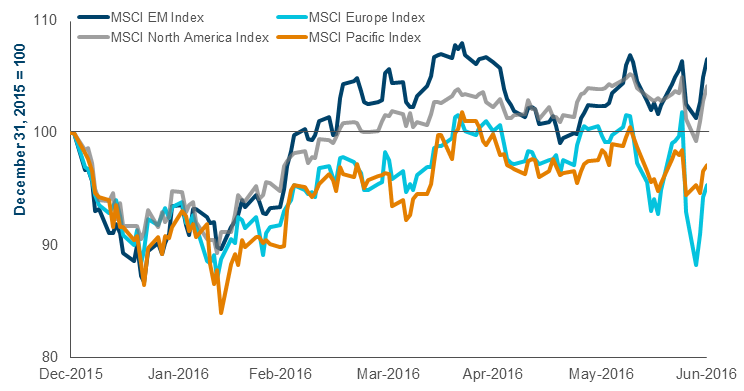
Regional performance in the first half of 2016 was dominated by the same risk-on/risk-off response from equity investors that drove sector returns. A number of EMs staged a modest recovery from their 2015 declines, while Europe—not surprisingly—was hardest hit by uncertainty before and after the Brexit vote (Figure 2).
Figure 2: Cumulative Total Returns on MSCI Regional Indexes
Year to Date Through April 30, 2016
Past performance is not a reliable indicator of future performance.
Source: MSCI.
Looking forward, relative regional performance will depend heavily on outcomes in Europe and their global effects, which are difficult to predict:
- United States: Despite industrial weakness, continued economic growth driven by consumer spending should be supportive for equities, although Brexit aftershocks, election uncertainty, and changing expectations for Fed policy could trigger renewed volatility.
- Europe: Although we believe further disintegration of the EU remains unlikely, Brexit will force European leaders to devote more attention to fending off populist pressures at home. These political risks have clear negative connotations for structural economic reform and, thus, for corporate profitability.
- Japan: We continue to see only selective equity opportunities in Japan, reflecting persistently sluggish growth and stubborn deflationary pressures. Monetary policy is supportive, but the yen appreciation seen so far in 2016 suggests that the reflationary policies pursued by the Shinzo Abe government may have run out of steam.
- China: Financial volatility, including possible currency moves, remains a downside risk. Chinese equity markets are still fragile, and concerns about credit risk exposure in the so-called shadow banking system remain widespread. However, we believe these financial risks are manageable in the short to medium term given that China’s capital account is still tightly regulated and the country has virtually no external debt. A slower upward path for U.S. interest rates should support a more stable renminbi.
- Other emerging markets: The rebound in energy prices has taken some pressure off of commodity-centered markets (Russia, Brazil, and the Middle East oil producers) and negatively impacted the commodity-importing markets (India and China), but the effects so far have been relatively modest on both ends. India continues to have a good midterm tailwind for economic growth, and Brazil is an interesting turnaround opportunity.
A POSITIVE ENVIRONMENT FOR STOCK PICKING
The uncertainty associated with Brexit has undermined the outlook for economic growth and earnings, which had appeared to stabilize earlier in 2016. Investors are faced with the task of assessing these effects and adjusting to them, a process that will take time. While market volatility is creating selective opportunities for bottom-up stock pickers and bargain hunters, careful research and thorough analysis will be especially critical going forward.
Assuming relatively positive outcomes for the key factors in our outlook—a speedy move toward a post-Brexit settlement, continued global economic growth, and stable energy prices—we believe equity markets can move toward a broad recovery in 2017. However, it is likely to be a bumpy ride, creating opportunities for active management to add value.
2016-GL-4330
重要資訊
本文件(包括其中所載的任何陳述、資訊、數據和內容)以及與本文件一併提供的任何資料、資訊、圖像、連結、聲音、圖像或視頻(統稱為「資料」)乃由普信提供,並僅作一般資訊用途。本資料並不擬供在禁止或限制分發本資料的司法管轄區和在本資料須按特定要求提供的若干國家之人士使用。本資料不擬派發予任何司法管轄區的散戶投資者。在任何情況下,本資料的全部或部分內容均不得在未經普信同意下複製或再分發或出示予任何人士。本資料並不構成於任何司法管轄區分銷、要約、邀請、建議或徵求發售或購買任何證券。本資料並未經由任何司法管轄區的任何監管機關審閱。本資料並不構成任何投資意見,不得加以依賴。投資者務請在作出任何投資決策前先尋求獨立法律和財務意見(包括有關稅務後果的意見)。


