

High yield: Cast your net wider
EXECUTIVE SUMMARY
- With high yield valuations looking stretched, investors need to look beyond the US to find value.
- We believe Europe offers a good environment for high yield – and the number of opportunities is growing.
- We prefer to invest in B rated issuers in European high yield where the premium is more attractive.
- Having the research capabilities to study the value of first-time issues is key to success in our view.
- Emerging market corporate high yield bonds issuing in Euro also offers attractive premiums. The bestopportunities are often in those companies benefiting from positive demographic trends and stronggrowth potential.
The past five years have been the most rewarding cycle in the history of the high yield bond market and there’s no denying that valuations are stretched. So what strategy should investors consider today in an area that has become such a crowded trade?
For investors who want to build a more robust income stream without taking undue credit risk, it’s time to cast the net wider. Global high yield investors should be considering emerging market corporates and really start taking Europe seriously given this market’s size and its superior prospects to the US.
Despite its monetary and political challenges, Europe’s high yield market has outperformed the US in 2012, 2013 and again year to date.1 However, it still has more room for growth than the US – but it’s more important than ever be to be creative and explore the full scope of opportunities.
MORE FISH IN THE EUROPEAN SEA…
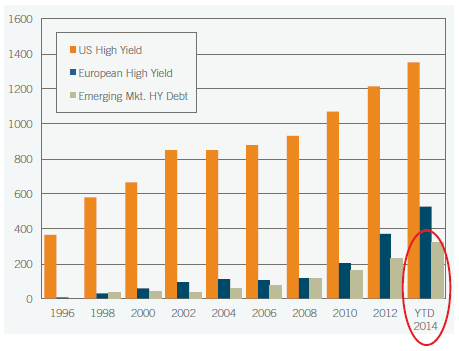
The good news is, the European high yield market has tripled in size since 2008 – and offers more depth, diversity and liquidity. Since the financial crisis, public bond markets have been the main source of debt capital for European companies as banks have been either less inclined or less able to lend.
The European high yield market is now over €400 billion, with 560 issues – 40% of the size of the US market, and growing faster. This is not a temporary fad: there is a real change in how European sub-investment grade companies are being financed.
We believe the European high yield market will continue to outperform the US for the foreseeable future. Interest rates and inflation are likely to stay low in Europe over the medium term, in contrast to the Federal Reserve reducing market liquidity. Europe’s economic recovery remains tempered enough to restrain companies from engaging in risky re-leveraging practices. Meanwhile, healthier economic conditions should improve corporate profitability, which should feed through to better balance sheet liquidity. Default rates are near historically low levels and expected to edge below 2% by the end of 2014.2
However, in Europe too valuations in many cases are stretched and discriminating investors will be the best-rewarded. 2013 was the first year post the crisis where managers were rewarded for bond selection, as opposed to just being ’risk on’ or ‘risk off’, depending on that day’s news headlines.
European High Yield and Emerging Markets High Yield Represent Growing Markets with Scale
As of March 31, 2014
Sources: Credit Suisse, and BofA Merrill Lynch.
BE SELECTIVE
Some bonds in the BB category are now giving less than 3% yield – and you have to ask whether they are actually compensating you for the risk. Many of the ‘fallen angels’ – companies that have dropped out of the investment-grade sector – are in fact value traps, in our opinion.
In contrast, we believe the single B rated sector has many attractive opportunities, where there is still a premium on offer. It’s also the fastest-growing sector of the market. In 2012, single B names made up only 21% of market, but by mid June 2014 this stood at 29%.3
We also see value in many of the new issuers coming to the market; new issues carry a small premium. Last year, nearly 40% of the issuance came from first time issuers, offering opportunities that can be captured with thorough research. We’ve seen more than €80 billion of new issues so far this year – getting close to the level that many pundits had forecast for the entire year.4
EMERGING MARKET CORPORATE HIGH YIELD
This market is still in the early stages of growth and, like the European market, it is growing rapidly. With a history of high inflation, long-term credit is a scarce resource for emerging market companies.
We think companies with a high proportion of revenues derived from domestic demand offer the best potential here, benefiting as they are from the strong demographic trends of fast-growing younger populations and the growth of the middle class.
In terms of valuations, emerging market corporate high yield offers 60-70% additional credit spread to US high yield, which is a post-crisis wide. In terms of sectors, this breaks down to 250 basis points more spread on single Bs and 150 basis points on BBs.
So, for those investors who are willing to cast their nets wider, and into the European and emerging markets, there are still plenty more fish in the sea.
重要資訊
本文件(包括其中所載的任何陳述、資訊、數據和內容)以及與本文件一併提供的任何資料、資訊、圖像、連結、聲音、圖像或視頻(統稱為「資料」)乃由普信提供,並僅作一般資訊用途。本資料並不擬供在禁止或限制分發本資料的司法管轄區和在本資料須按特定要求提供的若干國家之人士使用。本資料不擬派發予任何司法管轄區的散戶投資者。在任何情況下,本資料的全部或部分內容均不得在未經普信同意下複製或再分發或出示予任何人士。本資料並不構成於任何司法管轄區分銷、要約、邀請、建議或徵求發售或購買任何證券。本資料並未經由任何司法管轄區的任何監管機關審閱。本資料並不構成任何投資意見,不得加以依賴。投資者務請在作出任何投資決策前先尋求獨立法律和財務意見(包括有關稅務後果的意見)。
