

Frontier Markets: The next emerging story?
EXECUTIVE SUMMARY
- As the emerging market (EM) universe matures, investors are increasingly exploring opportunities in previously untapped markets outside the emerging mainstream. In many ways, frontier markets (FMs) today are similar to mainstream EMs 15 or 20 years ago.
- Frontier regions have made large economic strides in recent years as economies and capital markets have liberalized. The asset class remains undercapitalized and underowned, with strong growth potential. The potential magnitude of their economies and growth prospects are not reflected in the scale of their stock market capitalization.
- A large opportunity set, along with diversification benefits compared with other asset classes, creates potential with smooth portfolio returns. With sufficient resources, a manager can identify and exploit market inefficiencies with the aim of providing compelling risk-adjusted returns.
- FMs have outperformed both emerging and developed markets in recent years. However, with valuations continuing to look attractive, this fledgling asset class may offer opportunities for the experienced investor and could provide the final piece of the investment puzzle for global investors.
- However, with differing prospects for each FM and challenges to be navigated, active management will prove important in navigating this nascent asset class.
Call of the frontier
EMs have evolved in terms of their size, pace of growth and importance to the global economy. Greater political stability, improvements in infrastructure, financial deepening and a rapid expansion in trade have driven dramatic changes in the fabric of EM countries. As EMs have matured and become less risky places, the expected excess returns from investing in them have almost certainly converged downward.
Replicating the higher returns of the EM group of the past may require investors to look to new geographies. Despite some challenges, this brings us to the FMs. As we argue in the following pages, FMs offer many of the features that made yesterday’s EMs successful in the past.
Following the same path
Economic growth—Accelerating at same pace as EMs in the past
There is almost universal acceptance that emerging economies have taken over as the engine of world growth. In recent times, though, economic growth has slowed in some EMs, and this has caused a narrowing of the EM growth premium over developed markets. Indeed, if you strip out growth in China and India, growth rates look poor in comparison with years gone by. By contrast, economic growth in FMs has largely accelerated, driven by some of the factors we discuss in more detail below. Encouragingly, many of these positive drivers are set to remain enduring themes. Figure 1 reflects the similarities between EM and FM growth.
Figure 1: Following the EM economic growth path
As of 31 Aug 2013
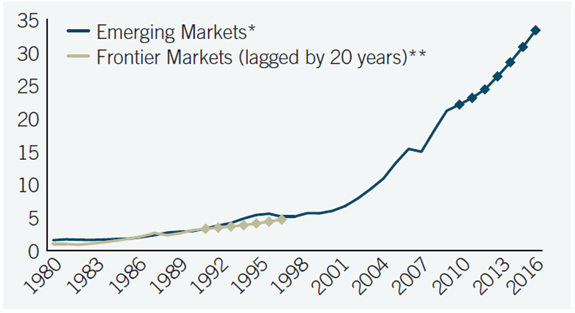
* EM includes: Brazil, Chile, China, Colombia, Czech Republic, Egypt, Hungary, India, Indonesia, Korea, Malaysia, Mexico, Morocco, Peru, Philippines, Poland, Russia, South Africa, Taiwan, Thailand and Turkey.
**FM includes: Argentina, Bahrain, Bangladesh, Bosnia-Herzegovina, Botswana, Bulgaria, Croatia, Estonia, Ghana, Jamaica, Jordan, Kazakhstan, Kenya, Kuwait, Lebanon, Lithuania, Mauritius, Nigeria, Oman, Pakistan, Qatar, Romania, Serbia, Slovenia, Sri Lanka, Trinidad and Tobago, Tunisia, UAE, Ukraine, Vietnam and Zimbabwe.
Sources: HSBC and World Bank.
Demographics—A working population
Economic growth is additionally underpinned by a young population in most frontier countries at a time when the developed world and some parts of the EM world (e.g., China) are aging rapidly. Currently, around 60% of Africa’s population and 50% of the Middle East’s population are under 24 years old. Africa will have the world’s largest working population by 2040 (Figure 2).
Figure 2: Consumer—Comparable with the BRIC countries
As of 31 Dec 2012
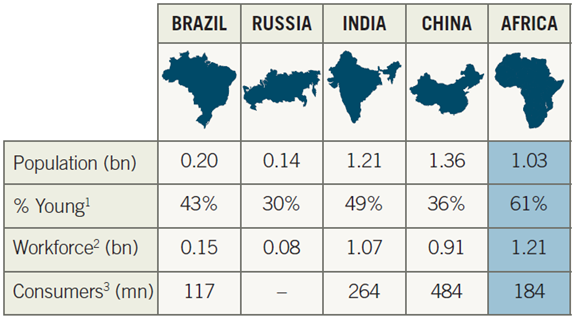
1Percent of population under the age of 24.
2Size of workforce (15–64) by 2040 in USDbn.
3Size of population earning above $2,700 p.a.
Sources: World Bank, CGIDD and Boston Consulting Group Analysis.
UN World Population Prospects 2012 Revision.
Productivity and wages—Competitive advantage coming to the fore
Currently, the output of workers in FMs is considerably less—in terms of gross domestic product (GDP) output per employed adult—than in EMs or in the developed world. In principle, becoming more productive should be easier in FMs, where workers are less productive to start with and the capital stock is lower; in other words, there is more “low hanging fruit.”
Commensurate with this lower productivity are lower wages. Although standardized data on wage rates is difficult to come by, it is clear that wages are lower than their EM counterparts. With many EMs moving up the value chain, wages have risen accordingly, no more so than in China where they have experienced around 15% year-over-year wage growth for a number of years now. By contrast, wages have remained low and wage growth has been slower, especially in places such as Vietnam and Sri Lanka. This has increasingly seen companies based in FMs beginning to win orders from western companies where once those orders were being given to China and other EM countries.
Natural resources—Commodity wealth attracts investment and growth
The majority of the world’s natural resources are found outside the developed economies. Although many of these are found in parts of the EM world (especially Brazil, Chile, Russia and South Africa), many FMs have substantial commodity reserves. Leading among these are Iraq, Kazakhstan, Mongolia, Nigeria, Ukraine and Venezuela. While an ample commodity endowment is not always a guarantee of economic success, it is the case that, if managed correctly, commodity wealth can lend significant support to a country’s economic growth.
While oil is the most abundant commodity in FMs, iron ore, uranium, bauxite and coal are also relatively important. Iraq, Nigeria, Kazakhstan and Venezuela all have the potential to raise production in the future. Currently, Ukraine has the world’s highest iron ore reserves. Kazakhstan and, to a lesser degree, Venezuela also have notable reserves. Bauxite (refined into alumina and smelted into aluminum metal) is abundant in Vietnam and present in Kazakhstan and Venezuela.
Urbanization and infrastructure—Building BRICs of growth
As with the BRIC countries before them, urbanization and infrastructure are themes that will help support long-term investment. Infrastructure is very much the backbone of an economy and helps to provide the framework for both economic growth and modernization. At its simplest, infrastructure spending is deemed necessary to reduce or avoid bottlenecks—for example, in transportation—which would otherwise occur as a consequence of rapid growth or urbanization. More generally, economists have long recognized that the provision of “public goods,” such as clean water, sanitation, education and health services, can have positive effects on productivity throughout an economy. Additionally, the globalization of trade has also magnified the importance of infrastructure with respect to economic growth and development.
Why focus so largely on infrastructure? Well, it has been proven that investment in a country’s infrastructure can yield large economic gains. Building roads or railways immediately boosts output and jobs, but it also helps to spur future growth. The World Bank estimates that a 1% increase in a country’s infrastructure stock is associated with a 1% increase in the level of GDP. Infrastructure investment in both the EMs and FMs has, in the past, been largely neglected, to the detriment of their economies. Governments have now realized, however, that infrastructure is one of the keys to a strong and sustainable growth cycle. This realization has caused a marked increase in investment in recent years, with currently over half of the world’s infrastructure investment now taking place in these regions.
Deepening financial markets: Investor appetite is strong, but there remain hurdles to clear
While the economic backdrop is important to the financial market outlook, there are other important considerations for investors (liquidity, valuations, regulation, the competitive environment and corporate governance).
Equity markets in FMs are small, but they are unlikely to remain that way forever. As mentioned, a key reason to pay more attention to the FMs now is that there is every reason to expect them to follow the same path charted by EMs over the past couple of decades. This path has brought growth in the breadth and depth of the financial markets, leading to greater liquidity and easier access for international investors.
Liquidity, however, can still be a barrier for public investment. Liquidity remains much lower than in emerging and developed markets, and for some institutional investors, there are still very few companies of sufficient size and liquidity outside the main markets. For example, Uganda, Zambia and Mauritius have very good and well-run companies but currently, due to the lack of liquidity, are not attractive investment destinations.
Going forward, the process of improvement will involve a number of steps: fewer restrictions on foreign investments, more liquid equity and foreign exchange markets, a solid legal and operational framework for investing, better custodial and settlement arrangements, greater disclosure from companies and more analyst coverage. All of these factors should help play a role in broadening the investor base and lowering the cost of capital for equity market investing.
Market capitalization—Room for catch-up
Encouragingly, though, there is real room for catch-up in terms of capitalization. Today, FMs represent just over 1% of world market capitalization1 and, as a share of their own GDP, have ample room to catch up with both their developed and EM counterparts (Figure 3). (There is a small caveat to this. By including only MSCI-listed stocks, and given that MSCI tends to exclude stocks that are not listed on its local index, for markets where a significant number of stocks are listed on foreign markets—Kazakhstan and Ukraine, for example, where some large stocks are listed in London, Toronto and Warsaw—the figure is understated.) Nevertheless, none of these adjustments would push the overall FM ratio above 5%, implying that there is still a great scope for the deepening of these equity markets in line with the sizes of their economies.
However, the fact that equity markets will get larger does not necessarily mean investors will benefit. More market capitalization can be achieved either through an increase in share prices or from the issuance of new shares (of either new or existing companies). A portion of the increase in the capitalization of Ems over the past decade has come from new issuance rather than equity market performance (with China a particularly striking example). Nevertheless, most EM investors have done well even in an environment of heavy stock issuance, and we see no reason why the same pattern would not apply to FMs.
Figure 3: Total market capitalization at similar levels as emerging markets in mid-90s
As of 31 Aug 2013
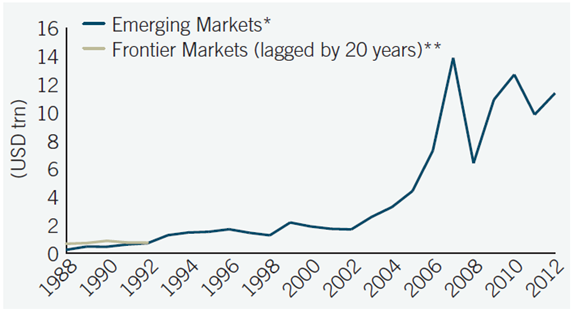
* EM includes: Brazil, Chile, China, Colombia, Czech Republic, Egypt, Hungary, India, Indonesia, Korea, Malaysia, Mexico, Morocco, Peru, Philippines, Poland, Russia, South Africa, Taiwan, Thailand and Turkey.
** FM includes: Argentina, Bahrain, Bangladesh, Bosnia-Herzegovina, Botswana, Bulgaria, Croatia, Estonia, Ghana, Jamaica, Jordan, Kazakhstan, Kenya, Kuwait, Lebanon, Lithuania, Mauritius, Nigeria, Oman, Pakistan, Qatar, Romania, Serbia, Slovenia, Sri Lanka, Trinidad and Tobago, Tunisia, UAE, Ukraine, Vietnam and Zimbabwe. Data are based on total market cap of all listed companies as calculated by World Bank. Market capitalization data are not free-float adjusted.
Sources: HSBC and World Bank.
AFRICA: A FERTILE LAND FOR MANY COMPANIES
Robust top-down fundamentals and more positive political backdrop...
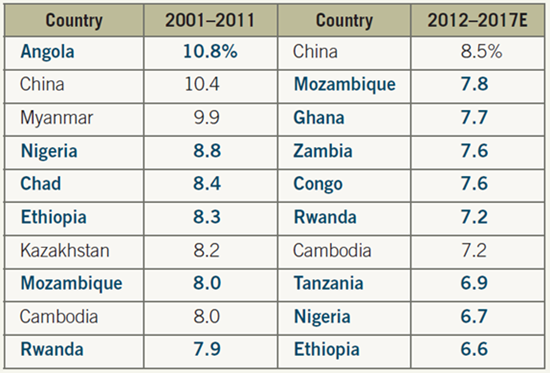
Africa has made huge economic strides in recent years as economies and capital markets have liberalized. The impressive reforms many countries have undertaken over the last two decades have resulted in smaller public and private deficits, more prudent use of commodity windfalls, lower inflation, lower levels of debt and higher international reserves. The region now offers access to one of fastest-growing areas of the global economy (Figure 4). Most tellingly, foreign investment is pouring into the region, with China contributing US$100 billion from 2005 to 2010, one-third of its entire foreign direct investment during that period.
The uncertain political environment within the region has long been used as a reason to limit investment. However, we have seen greater political stability in recent years from a number of countries. Between 2011 and the end of 2013, 50 of the 65 countries in the Africa and Middle East region conducted a democratic election. Within the region, we are also increasingly seeing a new generation of political and business leaders focused on economic growth and building conditions under which their businesses and economies can flourish. Policies are now being increasingly targeted to encourage growth, and foreign investment is being harnessed to help build sustainable conditions for that growth.
Of course, there will remain troubled countries (e.g., Libya and Syria), but they have little, if any, impact on the growth prospects of the region overall. Additionally, with 65 countries within the investable universe, there are many other opportunities. Still, news of unrest anywhere can be hard to shake. Therefore, the greatest challenge is to work out how much of the noise we see and hear in the media is relevant. Even more of a challenge is bridging the gap between the trouble spots and the opportunities.
…Feeding into superior earnings growth for companies
The robust top-down credentials and the broad structural changes across the region have created enormous opportunities for investors. Currently, there are many companies that have the ability to grow their compounded earnings 100% over the next three years. Additionally, at this stage, they are not valued correctly given the opportunities these companies possess and given the structural changes and tailwinds they are likely to have for a number of years as countries continue to reform.
Financials: Key area of opportunity
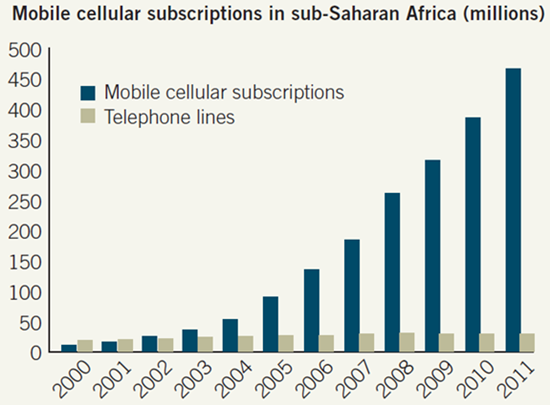
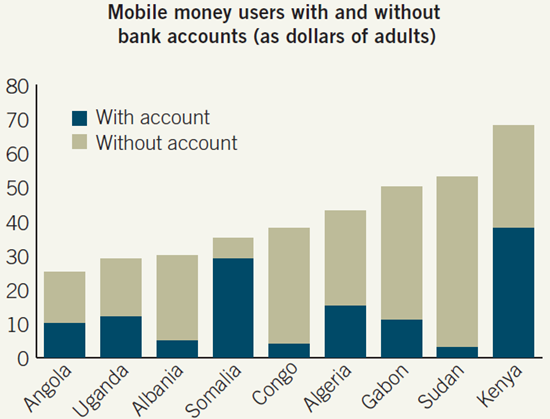
Financials can, in some respects, be considered as a “levered” investment linked to an underlying economy. A banking system operating within a growing economy with controlled nonperforming loans is likely to be a good starting point if you wish to identify growing, profitable banks—we see many such examples in the frontier world today. The return on equity for many financial stocks in Africa is very large, while tier 1 capital ratios are also high. Africa also has one of the lowest banking penetration levels globally. Currently, only 24% of adults in sub-Saharan Africa have bank accounts.2 African financials are also a great example of restructuring and innovation and, in many ways, are leading the world in terms of how money can be moved by consumers.
Figure 4: World’s 10-fastest-growing economies (gross domestic product)
As of 30 Sep 2013
Sources: IMF and McKinsey Global Institute.
Africa leading the world in mobile banking
The growth in mobile cellular subscriptions is well known in Africa, but perhaps not as well known is the fact that Africans have been at the vanguard of financial transactions via mobile technology (Figure 5). Much of this has come about through the lack of proper infrastructure and poor traditional banking systems, but this is a great example of how companies and consumers have adapted to structural problems to their own benefit. Safaricom, the leading mobile network operator in Kenya, is one such example. Currently, it conducts monthly financial transactions that equate to 27% of the country’s gross domestic product.3
Figure 5: Financials—Innovation through mobile is leading the way
As of 31 Dec 2012
Sources: Demirguc-Kunt and Klapper (2012) and World Bank (2011).
FRONTIER MARKETS SHINE BRIGHT WITHIN THE EMERGING MARKET UNIVERSE
As many are aware, EMs have suffered poor performance over the last couple of years as a deceleration of economic growth and aggregate weakness in EM corporate earnings has caused sentiment to weaken. There also remain concerns over the implications of tapering upon the EM world. In short, the growth thesis of the emerging world has come under intensifying scrutiny causing underperformance. However, we do not believe that the long-term case for EM investing is broken, but it is currently going through a meaningful period of change. We maintain a belief that many EM stocks retain sensitivity toward a recovery in global growth, and given this, we remain optimistic on a bottom-up basis that earnings growth will recover and this will be rewarded by markets.
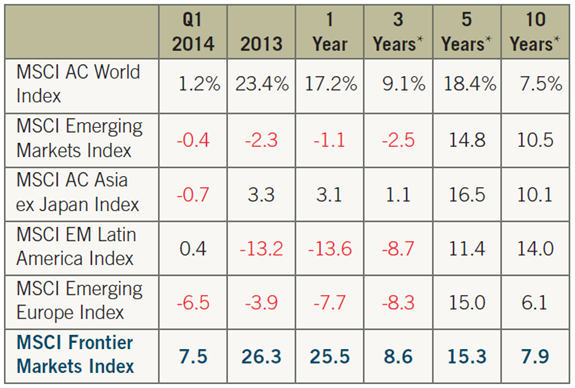
In contrast to the poor performance, however, from EM stocks, FMs have performed strongly (Figure 6). In fact, FMs have actually outperformed global and regional EMs in three of the last five years. The main reasons for this have been that economic growth has remained robust in most parts of the frontier world, especially Africa and the Middle East. Investors have also recognized that robust domestic economic growth can be translated into strong earnings growth at a company level. There are a number of companies within the frontier space that are currently delivering 20% per annum earnings growth, and they are predicted to deliver this for a number of years going forward. This is a very compelling story.
Figure 6: Frontier markets have performed strongly in a tough environment
As of 31 Mar 2014
*Annualized returns to 31 Mar 2014.
Sources: MSCI and Factset.
Looking for diversification within a risk framework?
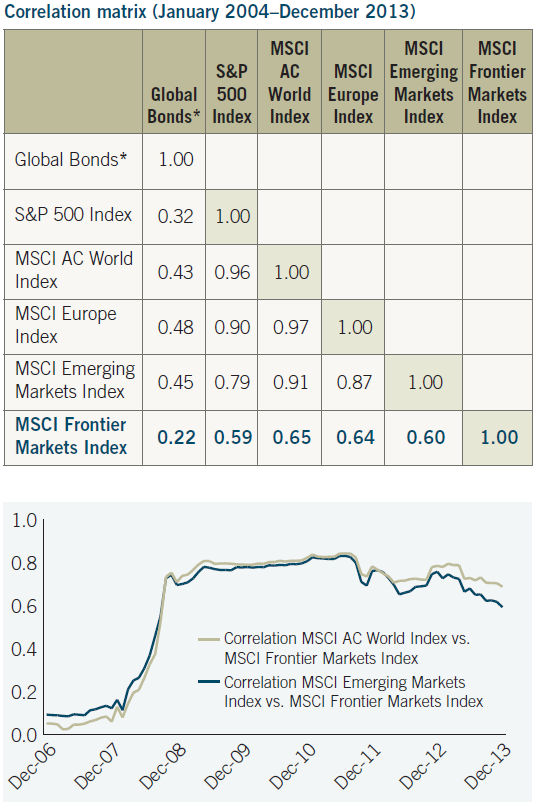
One of the challenges for investors in recent years has been the rising correlation among asset classes that has reduced diversification. Even rising correlations among the more mature EMs have required investors to look farther afield for diversification opportunities. Of course, while the financial crisis emphasized how strongly the world becomes correlated when we encounter a protracted slowdown, and a subsequent bear market, FMs do continue to harbor greater diversification benefits compared with their emerging counterparts. As Figure 7 illustrates, not only have FMs tended to have much lower correlations to world equities than their more mature EM brethren, but they also provide additional diversification within the EM space itself.
Figure 7: Frontier markets offer real diversification benefits
As of 31 Dec 2013
*Barclays Global Aggregate Bond Index.
Sources: Zephyr Style Adviser and T. Rowe Price.
There are a number of reasons for this low correlation. FMs remain quite local in character, driven by their own internal economic and political dynamics. Foreign investors also tend to play a less important role in these markets. Moreover, the small number of securities in many of these markets means company-specific factors play a far more important role.
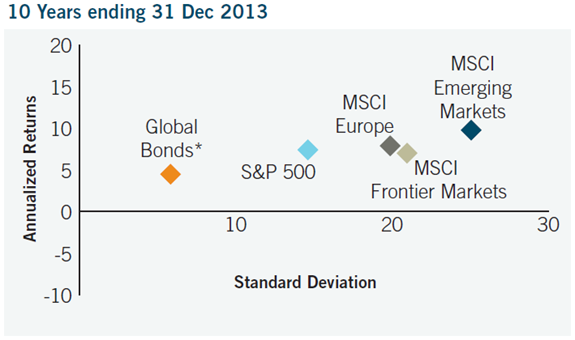
More surprisingly, frontier countries appear to be less volatile than other emerging equity markets when analysing the standard deviation of indices (Figure 8). This largely reflects lower liquidity and lower efficiency within the frontier space. Admittedly, individual FMs can have high volatility. However, when amalgamated together into an index or portfolio, volatility is dramatically reduced, primarily due to the very low correlation between individual countries.
Figure 8: Volatility is lower compared with other emerging markets
As of 31 Dec 2013
*Barclays Global Aggregate Bond Index.
Sources: Zephyr Style Adviser and T. Rowe Price.
VALUATIONS AND THE SEARCH FOR HIGHER RISK-ADJUSTED RETURNS
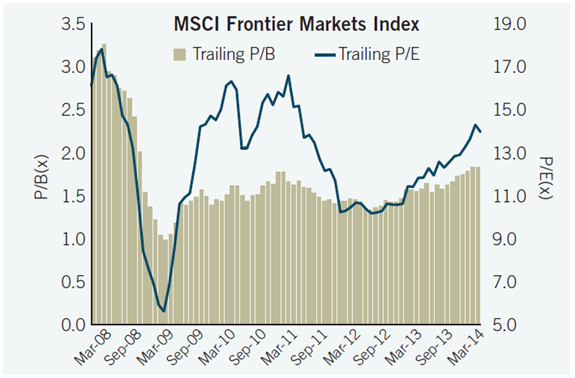
Due to their nature, it is more difficult to evaluate valuation metrics compared with other asset classes. Investors are hampered by a lack of reliable consensus earnings forecasts for most markets, while even historical valuation data can prove difficult to retrieve. Since January 2008, MSCI has calculated trailing price/earnings (P/E), price/book, dividend yield and return on equity data for each market; however, these multiples, while useful, can give a distorted view given that (1) most country indices have only a handful of stocks and are thus heavily affected by company-specific anomalies and (2) earnings visibility is generally low in these markets. It is clear, however, from the MSCI data now available that FMs still remain attractive, even despite recent outperformance. The region’s trailing P/E was 14.0x as of March 2014 (Figure 9).
Figure 9: Valuation metrics have become more attractive
As of 31 Mar 2014
Source: MSCI and Factset.
APPROACHING INVESTMENT IN THIS DISTINCTIVE AREA
Against this positive backdrop, however, investors still have to remember that FMs carry higher individual risk. These are markets that are at the beginning of their evolution, and this brings with it its own inherent challenges. A key consideration for investors is the difficulty of generalizing across a widely dispersed set of economies facing very different levels of development, economic conditions and structural constraints. FMs are not homogeneous. There is considerable variation in political stability, economic performance, openness to foreign investors, corporate governance practices and exposure to exchange rate risk.
A FOCUS ON FUNDAMENTAL BOTTOM-UP RESEARCH IS CRUCIAL
FMs also operate in a much less efficient space in terms of analytical coverage. This lack of broad research coverage can often lead to price anomalies. Within each region, there can be quite polarized underlying returns. As such, there is a pressing need for active management.
Approaching investment can be tackled in a number of ways, and it is sensible for potential investors to investigate their existing global, emerging or regional managers to ascertain what capabilities they have in this area and whether they need to augment their exposure. However, it is important that any manager who invests in frontier countries has the resources and ability to delve deeper into the opportunity set. It is also prudent to recognize that regional and sector risk concentration can exist, certainly when you consider that MSCI has such a high concentration in Middle East markets and the financial sector. Importantly, regardless of how one accesses FMs, their investment potential is apparent. However, there are risks associated with investment, and on an individual basis, some countries will continue to remain high risk. Therefore, the evergreen theme of bottom-up fundamental research is imperative to understanding both the opportunities and risks associated with this nascent asset class.
FRONTIER MARKETS CAN PROVIDE THE FINAL PIECE OF THE GLOBAL EQUITY INVESTMENT PUZZLE
As the EMs of today eventually progress to become part of the developed world, investors will begin looking for the next emerging story. While available information is often sparse, local regulations are varied and complex and research coverage by analysts and brokerage firms is limited, these were also obstacles that EMs encountered 20 years ago. Challenges such as these create opportunities for investors to uncover neglected companies with healthy or improving operations and to identify stocks that have been ignored by the mainstream investment community. With a focus on quality, FMs may prove rewarding and can make a significant contribution to portfolio returns.
How to gain exposure to FMs is up for debate, and investors should question how deep down the opportunity set managers or plans explore. There are also higher risks associated with investment, and therefore, active management is crucial. Importantly, the long-term fundamental reasons for investing remain largely intact, and with the flexibility of a broad range of investments across a large opportunity set, the asset class offers opportunities to generate alpha. Over time, the FMs are likely to adopt many of the changes implemented by their more successful peers, the EMs, while doing their best to avoid their own more egregious mistakes of the past. Given their starting point, even modest improvements can yield significant results. Such has been the story with EMs, and indeed the developed markets before them. For global investors, FMs can potentially provide the last piece in the investment puzzle.
1 1.3% of total market cap as at January 31, 2014 as measured by MSCI (free float adjusted)
2 Sources: Demirguc-Kunt and Klapper (2012) and World Bank (2011).
3 Sources: Safaricom and Central Bank of Kenya.
重要資訊
本文件(包括其中所載的任何陳述、資訊、數據和內容)以及與本文件一併提供的任何資料、資訊、圖像、連結、聲音、圖像或視頻(統稱為「資料」)乃由普信提供,並僅作一般資訊用途。本資料並不擬供在禁止或限制分發本資料的司法管轄區和在本資料須按特定要求提供的若干國家之人士使用。本資料不擬派發予任何司法管轄區的散戶投資者。在任何情況下,本資料的全部或部分內容均不得在未經普信同意下複製或再分發或出示予任何人士。本資料並不構成於任何司法管轄區分銷、要約、邀請、建議或徵求發售或購買任何證券。本資料並未經由任何司法管轄區的任何監管機關審閱。本資料並不構成任何投資意見,不得加以依賴。投資者務請在作出任何投資決策前先尋求獨立法律和財務意見(包括有關稅務後果的意見)。
