
Midyear financial planning: How to stay true to your money goals
June 2025, Personal Finance
- Key Insights
-
- Review spending habits and identify ways to cut back or reallocate dollars to match your goals.
- Revisit savings, investment allocations, and tax-advantaged accounts to keep progress on track.
- Life changes? Update your insurance coverage, estate plan, and cybersecurity protections.
Midyear presents a useful checkpoint to pause and take stock of your financial progress. A quick check‑in can help you recognize what’s working, make thoughtful adjustments, and stay aligned with your long‑term goals. Consider these steps:
1. Review your budget and expenses
Budgets made in January can look very different several months later—whether due to inflation, unexpected expenses, or shifts in income. And for many investors, taking on some debt along the way is unavoidable. The key is making sure that changes don’t derail your long‑term financial goals.
- Check your budget: Are you sticking to your spending plan? Our T. Rowe Price Budget Worksheet can help you get organized and stay on track. Make sure to account for any price increases in essential expenses, such as groceries, utilities, and transportation.
- Identify cost‑cutting opportunities: Midyear is a great time to reassess your spending. Cancel unused subscriptions and reduce discretionary spending. Whether it’s $50 or $1,000 per month, every dollar you can invest matters.
- Review outstanding debt: Prioritize paying off high‑interest debt like credit cards. If you’re regularly running a balance on a credit card, consider ways to cut expenses.
2. Evaluate your savings goals
Now is the time to review your progress on both short‑term savings and retirement contributions.
- Build up your emergency fund: Aim for three to six months of expenses saved in an accessible account. If your household has only one income, or your income is less predictable—such as with freelance or commission‑based work—you may want to set aside enough for more than six months.
- Maximize retirement contributions: Increase your individual retirement account (IRA) and 401(k) contributions if you can—up to the annual contribution limits. Use this opportunity to review your progress and see if you are on track for your age using our retirement savings benchmarks.
- Balance short‑term and long‑term savings: Assess your progress toward near‑term goals—such as vacations, home improvements, or a down payment—by checking your savings balances and monthly contributions. At the same time, make sure short‑term spending doesn’t come at the expense of long‑term goals such as retirement. If you’re behind on one priority, adjust your monthly contributions accordingly or look for areas in your budget where you can cut back to reallocate funds to the appropriate investments and accounts.
(Fig. 1) Savings benchmarks by age—As a multiple of income
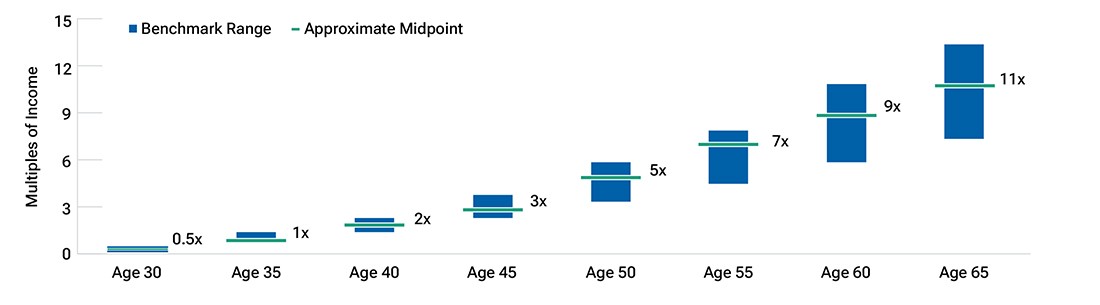
Key assumptions: Household income grows at 5% until age 45 and 3% (the assumed inflation rate) thereafter. Investment returns before retirement are 7% before taxes, and savings grow tax-deferred. The person retires at age 65 and begins withdrawing 4% of assets (a rate intended to support steady inflation-adjusted spending over a 30-year retirement). Savings benchmark ranges are based on household income levels described in the Additional Disclosures section. Target multiples at retirement reflect estimated spending needs in retirement (including a 5% reduction from preretirement levels), taxes, and Social Security benefits based on the SSA.gov Quick Calculator.
close
| Investor’s Age | Savings Benchmarks |
| 30 | 0.5x of salary saved today |
| 35 | 1x to 1.5x salary saved today |
| 40 | 1.5x to 2.5x salary saved today |
| 45 | 2.5x to 4x salary saved today |
| 50 | 3.5x to 5.5x salary saved today |
| 55 | 4.5x to 8x salary saved today |
| 60 | 6x to 11x salary saved today |
| 65 | 7.5x to 13.5x salary saved today |
3. Strengthen your investment strategy
Investing in a variety of asset classes—such as stocks, bonds, and cash—can help you achieve your long‑term goals.
- Reassess your asset allocation: Asset allocation is a primary driver of your portfolio’s performance over time. You’ll want to ensure your mix is aligned with your time horizon, risk tolerance, and goals.
- Check portfolio diversification: Avoid over‑concentration in any single asset class. You might have higher‑than‑expected exposure to a single company, sector, or geographic region—either within a fund or when there is overlap in the holdings of various funds. If your employer‑based retirement plan includes company stock, you might want to make sure it doesn’t make up more than 5% to 10% of your portfolio.
- Rebalance if necessary: Adjust allocations to maintain your target mix. Consider investing in asset allocation funds, which provide a diversified portfolio in one investment. These all‑in‑one funds are overseen by experienced investment professionals and rebalanced regularly. You can also work with a financial advisor to help determine the right allocation for your goals and risk tolerance—and to make adjustments as your needs evolve.
4. Adjust tax payments
With last year’s tax return now filed, check that your withholding is on target and review additional ways to save with tax‑advantaged accounts.
- Review withholding: Update your withholding if necessary to avoid underpayment (and surprise tax bills later), as well as overpayment.
- Maximize tax‑advantaged accounts: Retirement accounts aren’t the only investment accounts that offer tax advantages. Consider contributing to Health Savings Accounts (HSAs), Flexible Spending Accounts (FSAs), or 529 plans, each of which offers tax advantages that can add up over time.
- Organize tax documents: Keep records of deductions, receipts, and other important financial paperwork.
5. Assess insurance and estate planning
Life changes can affect your insurance needs and estate plan. Ensure your plans reflect your current situation.
- Update insurance coverage: Ensure your policies for health, life, home, and auto are adequate.
- Check beneficiaries: Review designations on retirement accounts and insurance policies, particularly if you recently have married or divorced, had children, or experienced other major life changes.
- Update estate documents: Make necessary changes to wills, trusts, and powers of attorney. Our Family Records Worksheet (PDF) can help you stay organized.
6. Secure your financial future
Take steps to protect your savings and make the most of your investments.
- Automate saving and investing: An automated approach helps take the emotion out of investing. The result is a disciplined saving process that reduces the chance that you’ll make impulsive changes.
- Protect against fraud: Use strong passwords, monitor account activity, and stay alert to scams. If you become a victim of cybercrime, immediately file a report with the FBI’s Internet Crime Complaint Center.
- Continue your financial education: The economy is ever evolving—markets go up and down, tax rules change, and shifting policies can impact everything from prices to employment. Stay informed by reading, listening to podcasts, and following financial news. Our Insights articles can help you learn more about financial topics that interest you.
Is your time aligned with your goals?
Between work, family, and everyday responsibilities, it’s easy to lose sight of what truly matters. But how you spend your time often shapes how you spend your money—and it may have an even greater impact on your overall well-being. Both should reflect your values and priorities.
Use this simple exercise to assess your current time allocation and whether it supports the life you want to lead.
Instructions: For each category, rank how much time you currently spend (1–10, where 1 = most time). Then, rank how much time you wish you could spend in each area based on your personal goals and values.
What do you notice? If there’s a gap between your current and ideal rankings, consider small shifts that could help you better align your time with your intentions.
| Activity | Current (1–10) | Ideal (1–10) |
| Working | ||
| Commuting | ||
| Household management (chores, schedules) | ||
| Traveling | ||
| Relaxing/TV/social media | ||
| Exercising | ||
| Enjoying the outdoors | ||
| Spending time with family | ||
| Helping with children/grandchildren | ||
| Caring for parents/grandparents | ||
| Caring for pets | ||
| Social activities (dining out, shows) | ||
| Pursuing education or new skills | ||
| Hobbies (art, music, building) | ||
| Religious or spiritual activities | ||
| Volunteering |

Confidence runs deeper with a trusted advisor by your side
Get expert advice on investing, retirement, and tax-smart approaches, so you can have greater clarity and confidence in your financial future.
Additional Disclosures
Benchmarks are based on a target multiple at retirement age and a savings trajectory over time consistent with that target and the savings rate needed to achieve it. Household income grows at 5% until age 45 and 3% (the assumed inflation rate) thereafter. Investment returns before retirement are 7% before taxes, and savings grow tax-deferred. The person retires at age 65 and begins withdrawing 4% of assets (a rate intended to support steady inflation-adjusted spending over a 30-year retirement). Savings benchmark ranges are based on individuals with current household income approximately between $75,000 and $300,000 and couples with income between $100,000 and $400,000. Target multiples at retirement reflect estimated spending needs in retirement (including a 5% reduction from preretirement levels); Social Security benefits (using the SSA.gov Quick Calculator, assuming claiming at full retirement ages, and the Social Security Administration’s assumed earnings history pattern); state taxes (4% of income, excluding Social Security benefits); and federal taxes. We assume the household starts saving 6% at age 25 and increases the savings rate by 1% annually until reaching the necessary savings rate. Benchmark ranges reflect federal tax rates as of January 1, 2025. Approximate midpoints for age 35 and older are rounded up to a whole number within the range.
Important Information
Consider the investment objectives, risks, and charges and expenses carefully before investing. For a prospectus or, if available, a summary prospectus containing this and other information, call 1-800-225-5132 or visit troweprice.com/prospectus. Read it carefully.
This material is provided for informational purposes only and is not intended to be investment advice or a recommendation to take any particular investment action.
Risks: Stock prices can fall because of weakness in the broad market, a particular industry, or specific holdings. Bonds may decline in response to rising interest rates, a credit rating downgrade or failure of the issue to make timely payments of interest or principal. Diversification and dollar cost averaging cannot assure a profit or protect against loss in a declining market.
The views contained herein are those of the authors as of June 2025 and are subject to change without notice; these views may differ from those of other T. Rowe Price associates.
This information is not intended to reflect a current or past recommendation concerning investments, investment strategies, or account types; advice of any kind; or a solicitation of an offer to buy or sell any securities or investment services. The opinions and commentary provided do not take into account the investment objectives or financial situation of any particular investor or class of investor. Please consider your own circumstances before making an investment decision.
Information contained herein is based upon sources we consider to be reliable; we do not, however, guarantee its accuracy. Actual future outcomes may differ materially from any estimates or forward-looking statements provided.
Past performance is not a guarantee or a reliable indicator of future results. All investments are subject to market risk, including the possible loss of principal. All charts and tables are shown for illustrative purposes only.
T. Rowe Price Investment Services, Inc., distributor.
© 2025 T. Rowe Price. All Rights Reserved. T. ROWE PRICE, INVEST WITH CONFIDENCE, the Bighorn Sheep design, and related indicators (see troweprice.com/ip) are trademarks of T. Rowe Price Group, Inc. All other trademarks are the property of their respective owners.
- 202506-4541242