

Australian Equities: Did the Yield Trade Just End?
Executive Summary
The demand for yield has been one of the major driving forces in equity markets over recent years. With bond yields having fallen to all-time lows, “bond proxy” stocks have enjoyed a sustained period of outperformance. However, this demand seems to be waning, as reflected in the underperformance of defensive, high-yielding areas of the Australian equity market in recent months.
Yield stocks have benefited from the ultra-accommodative monetary policy action of global central banks. Many of these, however, are now trading at very expensive levels and look susceptible to a change in the current environment. While it is difficult to predict such a change, we have seen a shift in market fundamentals recently, with bond yields rising as the ongoing effectiveness of monetary policy alone has come under scrutiny.
Additionally, the prospect of fiscal stimulus being introduced by governments is growing nearer. The implementation of this Keynesian economic approach—advocating increased government expenditure and lower taxes in order to stimulate demand—has significant ramifications for markets, with the likely rotation out of previously supported areas into those that are currently out of favor.
Over recent years, noncyclical defensive stocks have outperformed, while more economically sensitive and secular growth names have lagged. This trend is likely to reverse with the introduction of fiscal support. This would not only see yields potentially rise, as monetary stimulus is scaled back, but we would likely see the beginnings of a new industrial cycle globally, with potentially more capital expenditure, fewer share buybacks, and lower dividends.
Having been out of favor for some time, with investors preferring “safer” bond proxy names, many of the secular growth stocks that we favor, in sectors such as health care, technology, and consumer discretionary, now appear undervalued. Given their ability to perform throughout the cycle, these secular growth stocks are well positioned to outperform if fiscal stimulus is introduced.
The world’s financial markets are going through an extraordinary period. The unprecedented monetary action initiated by major central banks in the wake of the global financial crisis has altered the financial market landscape. The sheer scale of policy stimulus has distorted global asset prices. Government bond yields have been artificially pressured to all-time lows to the extent that roughly one-quarter of the world’s total government debt—in excess of USD $10 trillion—is now mired in negative yield territory. Moreover, the knock-on impact is also being felt on global equity markets. With bond yields at desperately low levels, investors have been forced to take on risk in search of alternative yield sources. This has seen money pour into more defensive, higher-dividend-paying areas of the equity market such as utilities, REITs, telecoms, and infrastructure. This is particularly relevant to the Australian equity market given that, including banks and insurance companies, nearly half of the local index is made up of these defensive-yield or bond proxy stocks.
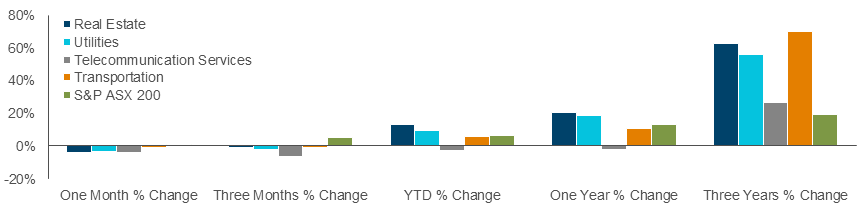
Indeed, the incredible demand for yield income has, for some time, been one of the major driving forces in equity markets. However, this demand seems to be waning, as reflected in the underperformance of high-yielding areas of the Australian equity market in recent months (Figure 1).
Figure 1: Demand for bond proxies is waning
As of September 30, 2016
Source: FactSet.
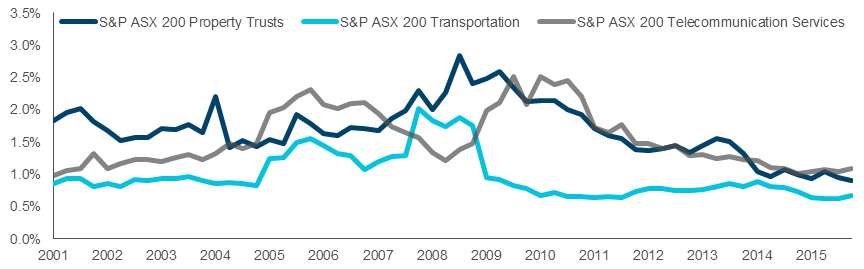
For investors, this begs the question: Is the extended run of high-yielding equity outperformance coming to an end? Companies in sectors that provide reliable, even rising dividends have seen their share prices driven sharply higher, regardless of any commensurate improvement in profitability. Accordingly, valuations in these defensive sectors are trading at very high levels, putting downward pressure on dividend yields (Figure 2) and lower yields suggest less support for current elevated valuations. The crowded nature of this trade means that investors are exposed to considerable risk in the event of a material change in the yield environment. The consequences for Australian—and global—investors sheltering in these perceived “low risk” assets could be severe.
Figure 2: Falling dividend yield suggests lower level of support for high valuations
As of June 30, 2016
Source: FactSet. Dividend yield change relative to S&P ASX 200 Index.
Of course, it is very difficult to predict exactly when such a change in the environment might occur. What is interesting to note, however, is the shift in sentiment among market participants regarding the ongoing effectiveness of monetary policy. Almost a decade after central banks successfully steered the global economy out of crisis, faith in their powers, and the mechanism of monetary policy in isolation, is waning. With the U.S. being the possible exception, growth in almost all major advanced economies remains anemic and inflation low. Indeed, all major central banks have failed to achieve their mandate—be it explicit or implicit—of 2% inflation. Increasingly, what we are seeing is central banks venturing deeper into uncharted and unorthodox policy territory, heightening the risks of unintended consequences. The experiment into negative interest rates, for example, has been unsuccessful in its objective to stimulate demand and inflation, while delivering a largely unanticipated blow to the already beleaguered financial/banking sector. Accordingly, persistently weak gross domestic product and monetary policy that is becoming increasingly more extreme, as evident in the implementation of negative interest rates, has set the stage for the introduction of fiscal stimulus. The International Monetary Fund and the Organisation for Economic Co-operation and Development, for example, have argued with increasing force for governments to provide stimulus support in the form of fiscal expansion.
A SHIFT TOWARD KEYNESIAN ECONOMICS
All of this is to say that the prospect of fiscal stimulus being introduced by governments is growing nearer. Canada and Japan have already introduced fiscal measures to varying degrees, while it remains a topic high on the agenda of governments in the UK and Europe. The implementation of this Keynesian economic approach, advocating increased government expenditure and lower taxes to stimulate demand, has significant ramifications for markets, with the likely rotation out of previously supported areas into those that are currently out of favor. The implementation of widespread fiscal stimulus has the potential to spark a market environment similar to that experienced during the early stages of an economic recovery. Over the past few years, noncyclical bond proxy names have outperformed, while more economically sensitive and secular growth names have lagged. This trend is likely to reverse with the introduction of fiscal support. Not only would bond yields potentially rise, given the move away from monetary policy, but we would likely see the beginnings of a new industrial cycle globally, with potentially more capital expenditure, fewer share buybacks, and lower dividends. This environment would almost certainly prompt a derating of defensive yield stocks. Conversely, secular growth stocks should attract solid support in such an environment. And having been out of favor for some time, many of these secular growth stocks, in sectors such as health care, technology, and consumer discretionary, now appear quite undervalued. Given their ability to perform throughout the cycle, these secular growth stocks are well positioned to outperform in the event of fiscal stimulus being introduced.
Meanwhile, in the U.S., the outlook for rising bond yields appears high. Inflation remains below target, but growth and employment data are robust, leading some to predict that the Federal Reserve may raise official rates before year-end. With this in mind, and given expectations of fiscal stimulus being introduced by a number of governments around the world, it is not surprising to see that defensive, higher-yielding areas of the Australian equity market have underperformed recently. The question investors need to be asking now is: How should I be positioned moving forward?
THERE IS NO SUBSTITUTE FOR QUALITY
Our principal investment focus is on high-quality, structural growth stories—companies that are in control of their own destinies and so offer the prospect of outperformance throughout the economic cycle. Ultimately, the best long-term-yield stocks are quality growth companies offering something unique (for example, products, services, business model, or market position, etc.)—that enables them to grow their earnings and profitability faster than other areas of the market.
Our definition of “quality” starts from the premise that stock prices essentially follow earnings, free cash flow growth, and returns on capital over time. With this in mind, we look to identify companies that can deliver sustainable, durable growth in earnings and free cash flow and strong and/or improving returns on capital.
However, while certain stocks may appear high quality on paper, they may face secular pressures that have
the effect of lowering their quality, for example, if the company faces a high level of competition.
Where our investment process differs from many other managers is in making effective qualitative assessments of company business models to determine a company’s quality over time. This qualitative judgement, made by our investment team, is a function of rigorous analysis and debate, deep sector experience and knowledge, and input from our global research teams. To this end, we look for companies operating in rich growth areas and that occupy leading competitive positions. We focus on sectors/industries where the margin structure is stable or improving, where barriers to entry are high and substitute product potential is low, and where companies have a degree of pricing power, both in relation to customers as well as suppliers. Meeting with company management is also central to our calculation of quality. We view experienced and committed management as critical to a company’s ability to deliver durable earnings growth. Strong managements are adept at appropriately allocating capital, reinvesting cash flows, and managing expenses effectively.
With attributes that allow them to perform throughout the economic cycle, we believe that investors should again be focusing on higher-quality growth companies. In comparison, the strong run enjoyed by defensive-yield stocks in recent years, pushing valuations to expensive levels, appears to be waning. Given the outlook for Keynesian economic policy being implemented in a number of countries, and the prospect of a new industrial cycle being triggered, quality growth stocks look well placed to outperform, particularly from their current, undervalued levels.
2016-GL-5048
重要資訊
本文件(包括其中所載的任何陳述、資訊、數據和內容)以及與本文件一併提供的任何資料、資訊、圖像、連結、聲音、圖像或視頻(統稱為「資料」)乃由普信提供,並僅作一般資訊用途。本資料並不擬供在禁止或限制分發本資料的司法管轄區和在本資料須按特定要求提供的若干國家之人士使用。本資料不擬派發予任何司法管轄區的散戶投資者。在任何情況下,本資料的全部或部分內容均不得在未經普信同意下複製或再分發或出示予任何人士。本資料並不構成於任何司法管轄區分銷、要約、邀請、建議或徵求發售或購買任何證券。本資料並未經由任何司法管轄區的任何監管機關審閱。本資料並不構成任何投資意見,不得加以依賴。投資者務請在作出任何投資決策前先尋求獨立法律和財務意見(包括有關稅務後果的意見)。
