

Volatility, Uncertainty, and the Aging Bull Market
Executive Summary
Top-down macroeconomic and political news is dominating markets like
never before.
The uneven nature of global economic health and a now more uncertain investing environment has raised questions over whether the equity cycle is coming to an end, or are we merely entering a new phase?
For patient long-term investors, such uncertainty typically creates buying opportunities in durable growth stocks, especially those with perceived cyclicality. Importantly, although profits growth and earnings have been poor at an aggregate level, there remain compelling pockets of growth in the world, and this remains a perennial opportunity throughout a cycle.
While the rally in oil and commodity prices has brought about a debate on the potential for a value cycle to form, we believe that long-term growth stocks are likely to continue to command a sustainable premium in a challenging macroeconomic environment.
MACROECONOMIC HEADLINES DOMINATE IN 2016
Macro and top-down events are dominating markets like never before in 2016.
Rising uncertainty is to be expected when you combine the fact that we are eight
years into the second longest bull market in history, in a U.S. election year, and in an environment where so many of the pillars of past return are evolving. The result of the UK referendum on European Union (EU) membership has added to the list of macroeconomic and political risks facing markets.
Realistically, the Brexit result will impact the UK economy in the near term as companies hold back investment in the face of uncertainty surrounding the UK’s relationship with Europe. Continental Europe may suffer a similar fate, an unwelcome outcome for a region that is growing slowly and still at the beginning of its economic recovery. Ongoing stimulus from the European Central Bank to support the European economy is highly likely and affirms the view that interest rates are likely to remain low for a prolonged period of time, both in Europe and globally. Meanwhile, we have the upcoming U.S. elections in November, which will continue to dominate the headlines.
This adds to investor concerns over an equity bull market, which has become increasingly more complex. This complexity centers on the question of whether global corporates can deliver better earnings in a more modest growth world. As further bottom-up improvement has been called into question, top-down factors—including the outlook for China, concerns over Europe, and volatility in energy and commodity prices—have taken center stage in driving stock prices. On the other hand, those fearful of an aggressive U.S. Federal Reserve tightening cycle may at least have their concerns allayed given rate increases are now likely to be more measured based on Brexit and global growth concerns. Regardless, macroeconomic concerns will persist in the near term, as investors put more weight on these issues rather than the underlying fundamentals of individual companies.
EARNINGS IMPROVEMENT PRESENTS OPPORTUNITY
While the economic picture remains confusing for many, one comforting factor is that we continue to find numerous companies displaying better fundamentals, even in a modest-growth world. In addition, this perspective is set against a starting point where valuations remain reasonable, especially when considering free cash flow-based metrics. The broadening out of the perspective on valuations to include cash-based metrics is important because changes in cash flow trends will help us judge the evolution of the equity cycle over the near and medium terms. It will also help support the return of capital to investors in the form of share buybacks and dividends.
With monetary policy remaining accommodative and inflation still low (although with the potential to turn upward), we believe this is a solid starting point to generate attractive returns from global equities. In particular, it will support stocks with compelling and unrecognized growth characteristics, given the ongoing scarcity of broad-based macroeconomic growth trends.
While the near-term rally in oil and commodities has caused much debate on whether we are seeing the beginning of a value cycle, we do not think this is likely outside of a scenario of a strong upturn in global growth. In fact, the backdrop has created some unusual partnerships including the positive correlation of Value and Growth over the summer. Specifically, Growth and Value seem to have put their historic differences aside, as investors either stay on the sidelines or pile into defensive stocks.
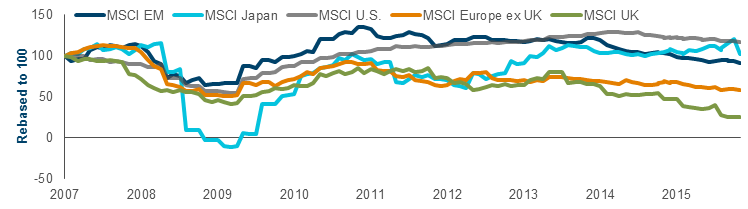
When considering the equity cycle, however, the absence of profit delivery over the past few years remains a legitimate concern (Figure 1). That is important for us when we invest, that we continue to ask ourselves whether we can see clear signs that stocks will begin to deliver on profits after a period of distinctly narrow growth signals.
Figure 1: A Reality Check on Profits Growth—Regional Profits (EPS in USD)
In USD Since Last Cycle Peak (October 2007). As of August 31, 2016.
Sources: FactSet, Citi Research, and MSCI.
MSCI makes no express or implied warranties or representations and shall have no liability whatsoever with respect to any MSCI data contained herein. The MSCI data may not be further redistributed or used as a basis for other indices or any securities or financial products. This report is not approved, reviewed or produced by MSCI.
POTENTIAL POCKETS OF GROWTH
Although earnings have been poor at an aggregate level, there remain very interesting pockets of growth. We have identified many stocks that have earnings improvement potential in the next stage of the economic cycle. At the same time, we do not believe that we are headed for a severe contraction of global growth in the near term.
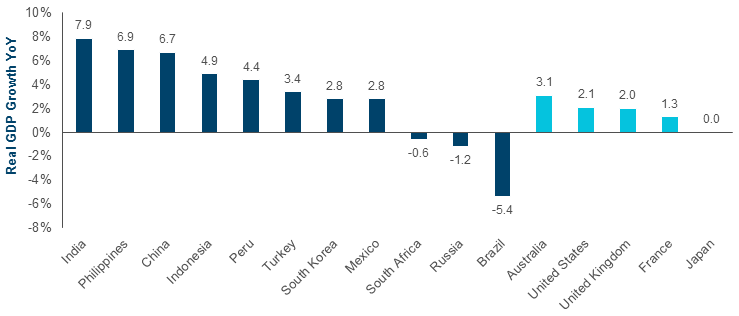
Within the emerging world, there is still huge potential for change and market share gains in particular. Emerging Asia continues to demonstrate strong domestic growth potential, given that many economies remain advantaged by long-term consumption and demographic drivers (Figure 2). Elsewhere, while the developed world growth outlook is subdued, building exposure to select contrarian and cyclical segments of the market, when the opportunity is afforded, can be a sensible approach in our view. This requires a long-term time horizon (as well as a contrarian instinct) in an environment where short-term volatility is inevitable. However, the rewards are real for those willing to buy durable companies with long runways for growth.
Figure 2: Emerging Markets Continue to Drive Global Growth
As of June 30, 2016
Sources: FactSet and Economics.
VALUATIONS ARE REASONABLE BUT WILL NOT DRIVE FUTURE RETURNS
With global equities (including emerging market equities) trading around 15 times 2017 earnings,1 the days of extremely cheap valuations are clearly over, but valuations remain reasonable in the context of the economic cycle and especially given alternative avenues for capital.
While valuations will not drive aggregate returns moving forward to the extent that they did in the early part of this equity cycle, at the same time, they should not be a barrier to equity markets delivering solid returns over the medium to long terms. Importantly, the lack of bullishness in the world has continued to keep broad-based bubbles at bay, and valuations have, therefore, remained at sensible levels. This provides a generally favorable backdrop for investors and, with all else being equal, likely extends this particular equity cycle.
The environment for equity investing, however, is more nuanced than in previous years. Investors have been cautious of stocks with cyclical characteristics through much of this equity cycle, while continuing to treasure stocks with defensive qualities and lower-volatility profiles. However, as markets have been shaken by growth concerns, a key opportunity has arisen: the chance to buy high-quality growth and improvement stocks on weakness.
WHERE DO WE GO FROM HERE?
Challenging data points will continue to lie ahead for the global economy, but this will inevitably lead to opportunities in certain areas—including industrials, consumer discretionary and emerging markets—to purchase on weakness. We are still cautious on the commodity price outlook, however, given the long-term changes occurring in China, and this informs much of our positioning in the more cyclical areas.
The major cycle-ending risks are always hard to call, and we should acknowledge that cycles rarely come to an end due to mirror images of previous crises. In short, the world evolves, and so should an investor’s perspective on today’s risks versus those that have caused significant pain in the past.
Rising political tensions and the impact on economic growth, a prospective deterioration in the credit cycle stemming from lower oil prices, and the likelihood of corporate defaults in China stand out as the most prevalent risks. However, further rate increases are now less likely, and monetary policy around the world remains generally accommodative. Bull markets usually end with a broad-based recession or due to valuation bubbles bursting—we see no signs of either.
Given these factors, we remain constructive, but market returns are likely to be more modest. As we have witnessed during the past few years, sentiment is likely to ebb and flow. This will provide opportunities to invest through periods of stock-specific volatility. But while the outlook is more stock-specific and complex than it has been for some time, patient investors should continue to be rewarded over the long term.
1 As of August 31, 2016. Source: FactSet
2016-GL-4939
重要資訊
本文件(包括其中所載的任何陳述、資訊、數據和內容)以及與本文件一併提供的任何資料、資訊、圖像、連結、聲音、圖像或視頻(統稱為「資料」)乃由普信提供,並僅作一般資訊用途。本資料並不擬供在禁止或限制分發本資料的司法管轄區和在本資料須按特定要求提供的若干國家之人士使用。本資料不擬派發予任何司法管轄區的散戶投資者。在任何情況下,本資料的全部或部分內容均不得在未經普信同意下複製或再分發或出示予任何人士。本資料並不構成於任何司法管轄區分銷、要約、邀請、建議或徵求發售或購買任何證券。本資料並未經由任何司法管轄區的任何監管機關審閱。本資料並不構成任何投資意見,不得加以依賴。投資者務請在作出任何投資決策前先尋求獨立法律和財務意見(包括有關稅務後果的意見)。


