November 2026, Retirement
Artificial intelligence (AI) is changing not just how Hong Kong people work, but how they think about retirement itself. T. Rowe Price’s 2026 Hong Kong Retirement Survey1 finds that 55% of respondents believe AI will make their path to retirement more unpredictable than it was for the previous generation. Yet only 21% feel fully or substantially financially prepared if AI changes their work, income or retirement path.
That gap matters. Our 2026 survey suggests that retirement for Hong Kong savers is becoming less a single point in time and more a journey, so an effective investment plan must be flexible enough to adapt as a saver’s circumstances change. The retirement glide path, an investment framework that adjusts a portfolio’s strategic asset allocation between stocks and bonds as an investor’s risk tolerance and time horizon change, could help meet the challenge.
Three findings in particular stand out from the 2026 survey. Together, they show how AI is reshaping retirement paths and underscore the importance of a comprehensive, flexible approach to retirement investing.
Retirement in Hong Kong is becoming less linear, and AI is compounding the trend.
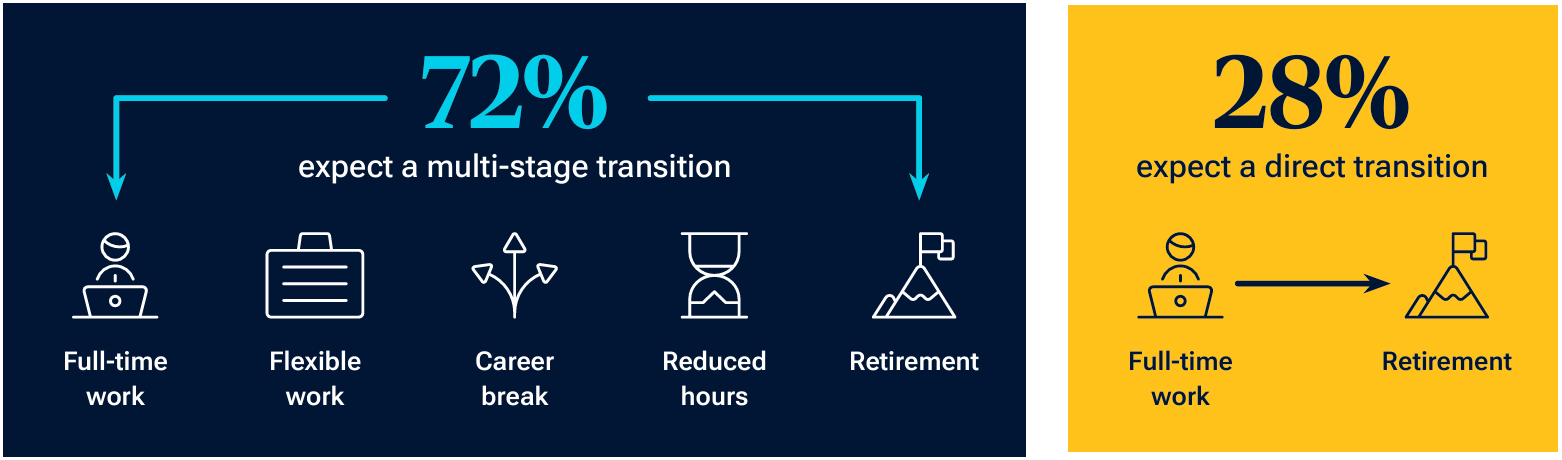
Retirement in Hong Kong is becoming less linear, and AI is compounding the trend. Among respondents with a clear view of how they expect to retire, nearly three‑quarters (72%) expect to move towards retirement through multiple stages—shifting between full‑time work, flexible work, career breaks and reduced hours—rather than transitioning from full‑time work directly into retirement. Just 28% expect a single, direct transition (Figure 1).
Flexible retirement approaches are already mainstream: 71% of respondents favour a flexible or non‑conventional approach to retirement, such as micro‑retirement with reduced employment hours or unretirement/return to work after an initial retirement. At the same time, 63% believe the growing use of AI in the workplace will increase the need for flexible retirement arrangements. Uncertainty is particularly pronounced among younger workers: 61% of respondents aged 30 to 39 say AI is making their path to retirement more unpredictable, suggesting that those with the longest careers ahead may need to plan for the widest range of possible outcomes.
Respondents expect AI to reshape their working lives in both positive and disruptive ways. Over half (56%) think AI is likely to enable more flexible ways of working, while 43% see the potential for new career, business or income opportunities. At the same time, 70% expect to need new skills to adapt to AI‑related changes, and 49% expect AI to disrupt their employment or business income.
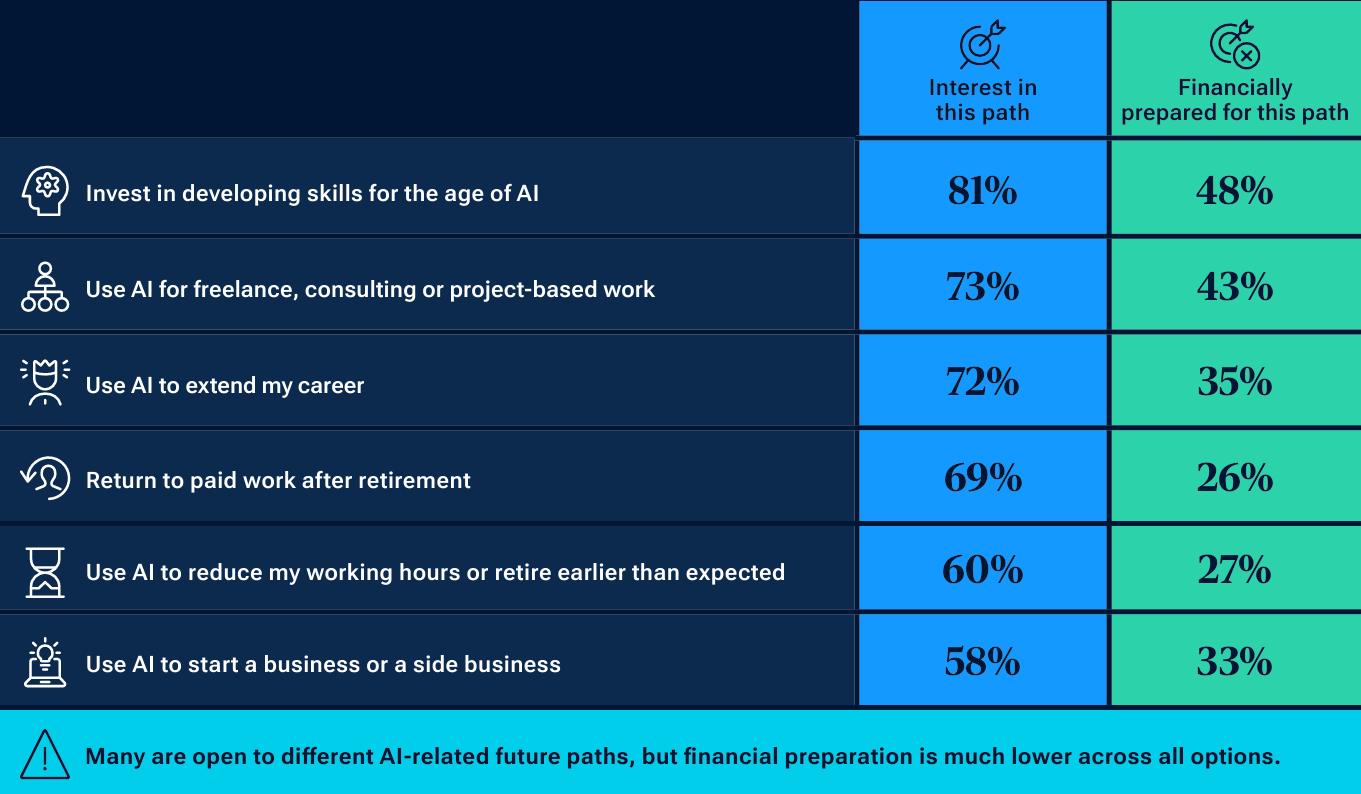
This mix of opportunity and disruption cuts both ways on retirement timing. Some 72% are already using, or would consider using, AI to work more efficiently so they can extend their careers, while 60% have already started or would consider using AI to reduce their working hours or move towards retirement earlier than expected—suggesting AI could shift retirement timing earlier or later, rather than in a single direction.
AI could also make retirement less of a one‑way exit:
However, financial preparation for these possibilities lags well behind interest (Figure 2). Among those considering each path, only 35% have prepared financially for extending their careers, 27% for reducing hours or retiring earlier and 26% for returning to paid work after retirement.
Nearly 60% of respondents believe they will need more than HK$5 million in savings and investments to retire with peace of mind, including 22% who believe they will need more than HK$10 million. AI is raising that bar further: 44% say the potential impact of AI on their work, income and retirement journey means they will need more money for retirement. Yet, just 15% have a comprehensive retirement plan that they review regularly.
The most common financial response to AI‑related uncertainty is short‑term in nature: 43% have built or increased an emergency savings buffer, compared with only 28% who have reviewed or changed their retirement investment mix. This contrasts with what respondents say they want from their retirement investments: 40% cite inflation protection as one of the most important features of a retirement investment approach, and a similar proportion (39%) cite long‑term growth.
Taken together, these findings reveal a gap between what savers want from their investments and the steps many have taken so far. Closing the gap calls for an approach that can evolve along with the retirement journey itself. This is where a glide path investment solution could help.
For illustrative purposes only.
Our retirement surveys show that uncertainty around retirement planning is increasing, driven by the growing preference for flexible retirement arrangements and the perceived impact of AI in the workplace.
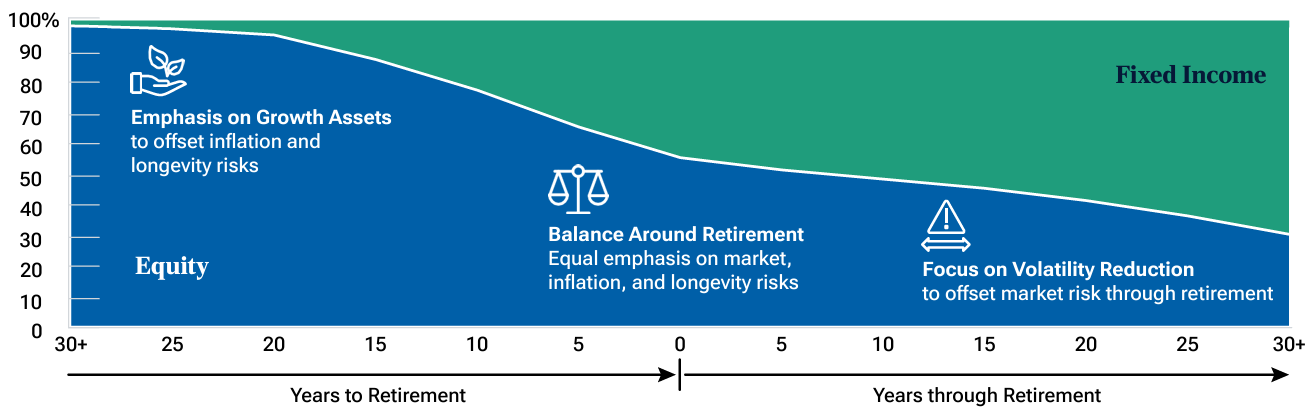
A glide path investment approach provides a consistent and disciplined investment framework that can accommodate evolving retirement plans. By aligning investors’ equity and fixed income allocations with their investment time horizon to or through retirement, the glide path can help ensure their investment strategy remains appropriate as circumstances change. For example, if an investor decides to retire significantly earlier than originally planned, they may consider moving to a later point along the glide path, adopting a more conservative asset allocation that better reflects their shortened accumulation horizon and new stage in their retirement journey.
This glide path typically unfolds in three broad stages, as illustrated in Figure 3.
Because it is built for retirement, a glide path can help address a wide range of risks by gradually reducing equity exposure as an investor moves towards or through retirement:
Together, these features translate into several key advantages for retirement investors:
For Hong Kong savers, the stakes are clear. AI is widening the journeys people may take into and through retirement, while compressing the time available to plan. Interest in those paths is high, but preparation lags. That is why how savers invest matters as much as the amount they save. A glide path offers a disciplined, adaptable framework that seeks to build wealth early, protect it as retirement nears and keep it working through a retirement that may last decades.
We encourage Hong Kong savers to seek independent expert financial advice to build a strategy resilient enough to adapt to changing circumstances over time. With more than USD $1.8 trillion in client assets under management (AUM) as of 30 September 2026— about two‑thirds of which are retirement‑related2 —and over 85 years of investment experience, T. Rowe Price is a longstanding leader in the global retirement industry.
Jan 2026
Retirement
Article
Dec 2025
Retirement
Article
1 2026 T. Rowe Price Hong Kong Retirement Survey, T. Rowe Price, October 2026. Survey conducted in August 2026 among 1,004 Hong Kong residents age 30 or older who were undertaking paid work and earning at least HK$15,000 per month.
2 Firmwide assets under management include assets managed by T. Rowe Price Associates, Inc. and its investment advisory affiliates, in addition to SMA Model Delivery.
Important Information
This material is being furnished for general informational purposes only. The material does not constitute or undertake to give advice of any nature, including fiduciary investment advice. Prospective investors are recommended to seek independent legal, financial and tax advice before making any investment decision. T. Rowe Price group of companies including T. Rowe Price Associates, Inc. and/or its affiliates receive revenue from T. Rowe Price investment products and services. Past performance is not a guarantee or a reliable indicator of future results. Investment involves risks. The value of an investment and any income from it can go down as well as up. Investors may get back less than the amount invested.
The material does not constitute a distribution, an offer, an invitation, a personal or general recommendation or solicitation to sell or buy any securities in any jurisdiction or to conduct any particular investment activity. The material has not been reviewed by any regulatory authority in any jurisdiction.
Information and opinions presented have been obtained or derived from sources believed to be reliable and current; however, we cannot guarantee the sources’ accuracy or completeness. There is no guarantee that any forecasts made will come to pass. The views contained herein are as of the date written and are subject to change without notice; these views may differ from those of other T. Rowe Price group companies and/or associates. Under no circumstances should the material, in whole or in part, be copied or redistributed without consent from T. Rowe Price
The material is not intended for use by persons in jurisdictions which prohibit or restrict the distribution of the material and in certain countries the material is provided upon specific request.
Hong Kong—Issued by T. Rowe Price Hong Kong Limited, 6/F, Chater House, 8 Connaught Road Central, Hong Kong. T. Rowe Price Hong Kong Limited is licensed and regulated by the Securities & Futures Commission (“SFC”). This material has not been reviewed by the SFC.
© 2026 T. Rowe Price. All Rights Reserved. T. ROWE PRICE, INVEST WITH CONFIDENCE, the Bighorn Sheep design and related indicators (see troweprice.com/ip) are trademarks of T. Rowe Price Group, Inc. All other trademarks are the property of their respective owners. Use does not imply endorsement, sponsorship, or affiliation of T. Rowe Price with any of the trademark owners.