

PRICE POINT - IN BRIEF
Global Fixed Income: Navigating Through Uncertain Waters
June 2015
EXECUTIVE SUMMARY
There is a high level of uncertainty in global fixed income markets at midyear, highlighted by recent turbulence in many sovereign markets. Amid divergent and less predictable central bank policy, the range of potential outcomes is wide, and higher volatility seems certain.In this challenging environment, T. Rowe Price Head of International Fixed Income Arif Husain believes that investors need to be nimble. By utilizing the full global opportunity set and maintaining some defensive positions, investors will be better equipped to manage risks and take advantage of available opportunities in global rates, currencies, and credit markets.
The predominant theme in global fixed income markets at midyear is a high degree of uncertainty. Major central banks had coordinated monetary easing in response to the global economic downturn. But today, policy has become more divergent, and central banks are providing less guidance around their future plans. Against this backdrop, the range of potential outcomes for sovereign, credit, and currency markets is wide. It seems the only certainty is higher volatility.
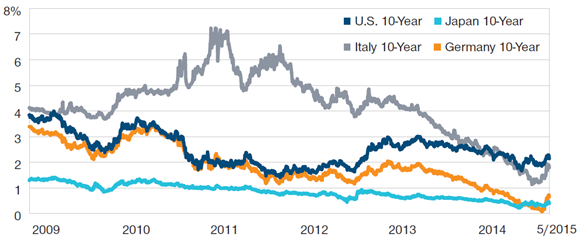
Fixed income markets have been unsettled recently, with sharp corrections in many government bond markets. The epicenter has been Germany, where yields on 10-year notes spiked from near 0% in mid-April to more than 0.70% in mid-May. Investors had crowded into eurozone sovereigns, hoping to sell to the European Central Bank (ECB) at higher prices, but retreated as valuations began to look unjustifiably rich and Europe’s economic outlook improved.
U.S. Treasury yields simultaneously climbed to their highest level of the year. Treasuries had enjoyed strong demand from foreign investors due to a strengthening dollar and attractive yields relative to Europe and Japan (see Figure 1). But rising global yields caused Treasuries to lose some of their luster. Higher oil prices, a reprieve in rampant dollar strength, and continued improvement in the labor market contributed to the sell-off.
The recent market turbulence has drawn comparisons with the “taper tantrum” of 2013, when investors unloaded Treasuries and other interest rate-sensitive assets after Federal Reserve officials signaled their intent to taper asset purchases. Volatility in the Treasury market spiked from low levels, and credit spreads rapidly widened amid a drought of market liquidity.
FIGURE 1: Sovereign yields have followed divergent paths
31 December 2009–15 May 2015
Source: Barclays.
A lesson from that episode is that there is considerable pent-up demand for bonds at higher yields. Institutional investors stepped in to stem the rout, becalming markets in relatively short order. We could be in store for a similar pattern of sharp sell-offs followed by gradual rallies as Fed rate hikes come into closer view. In this environment, investors will need to be nimble to manage risks and take advantage of opportunities.
Seeking shelter from interest rate volatility
As demonstrated by recent events, volatility can quickly spread across global financial markets due to their interconnectedness. No country will be completely immune to volatility in large markets, such as the U.S. and Europe. But some may be less vulnerable because their interest rate cycles are at different stages.
Asian markets are one potential refuge from interest rate volatility. While European and U.S. rates rose sharply in April and May, sovereign yields held relatively steady across much of Asia. Although return potential is limited, some of these defensive countries include:
- China: Central bank policy is biased toward easing to support growth, which should keep yields well anchored. And policymakers have signaled their intent to keep the exchange rate stable, reducing currency risk.
- South Korea: The performance of Korean bonds has become less correlated with U.S. Treasuries. With slow growth, low inflation, and aging demographics, Korea’s sovereign market behaves more like Japan than an emerging market. Its central bank may cut rates again, which would be positive for local bonds.
- Thailand: Like South Korea, sluggish growth and subdued inflation are keeping downward pressure on rates. Thailand’s bonds also have low foreign ownership, making them less vulnerable to capital flight as the Fed begins tightening.
Elsewhere, Brazil offers a substantial yield cushion should global rates rise. Brazil’s central bank has been raising rates since early 2013. It may be nearing the end of its cycle, and the government’s commitment to fiscal thrift should eventually permit easier monetary policy. However, inflation remains high, and yields could move higher in this more volatile market. Inflation-linked Brazilian debt affords some downside protection.
A formidable environment for currencies
Currency volatility has been elevated amid pervasive U.S. dollar strength (see Figure 2). The dollar has recently given back some of its significant gains amid a spell of weak U.S. economic data. But this is likely only a pause given the divergent paths of central banks and expected acceleration in U.S. growth. That said, the dollar’s earlier rise was intense, and further appreciation may occur at a slower velocity. With the ECB and Bank of Japan pursuing aggressive policy while the Fed pares back stimulus, there is scope for some additional weakness in the euro and yen. But the moves appear to have largely run their course.
FIGURE 2: Recent dollar strength intense but not unprecedented
4 January 1971–15 May 2015
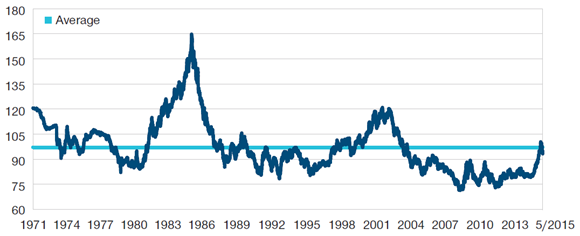
U.S. dollar index (DXY) versus a trade-weighted basket of major currencies.
Sources: Thomson Reuters and T. Rowe Price.
In emerging markets, currency valuations have become more attractive, and some countries have seen improvements in terms of trade. But caution is warranted given the threat of dollar strength. Our highest-conviction positions are in countries that possess traits that should attract capital flows, such as strong growth, high yields, and positive economic reforms. Prime examples include:
- Indian rupee: Prime Minister Modi is slowly implementing promised reforms that include phasing out subsidies, removing barriers to foreign investment, and restructuring a complex tax system that discourages business investment. Relatively robust growth and an improved trade balance are also positive for the currency.
- Mexican peso: The Peña Nieto administration has instituted important reforms, most notably in the energy and telecommunication sectors. While growth remains modest, it should pick up over the medium term as these efforts take hold and the economy becomes more competitive.
A bond-picker’s market in global credit
Valuations are generally unexciting at the sector level, but there are still compelling individual credit stories. As such, we expect security selection to be a larger driver of performance than broad sector exposures. We recommend taking full advantage of an expanding global opportunity set, which provides opportunities to exploit pricing discrepancies and unsynchronized credit cycles.
- Investment grade: The corporate credit cycle has entered its late stages in the U.S. amid rising merger and acquisition and shareholder-friendly activities. Shorter-maturity, lower-beta industrials and European banks hold potential, and high-quality Asian corporates are a source of higher yields and lower expected volatility.
- High yield: With the exception of commodities producers, fundamentals are mostly solid for below investment-grade firms. Valuations remain decent but are less attractive than earlier in the year, and sustained low oil prices remain a risk given the size of the U.S. high yield energy sector. We see value in energy names that can withstand low oil prices, as well as in shorter-maturity debt trading at a discount. In Europe, an improving economy and ECB easing are supportive of its burgeoning high yield credit market.
- Emerging markets: Valuations are compelling relative to comparable U.S. credit, and the oil price rebound has reduced near-term default risk. However, certain markets—such as Russia and Venezuela—face challenges, and the relatively young emerging market corporate sector is untested in a rising-rate environment. Poor liquidity is a risk, but it could also create opportunities to buy at wider spread levels.
Recent volatility likely to persist
Risks to the outlook include how effectively China responds to a slowing economy and the rapidly evolving situation in Greece. A collapse of the Greek government or the installation of capital controls would likely benefit “safe haven” securities, such as U.S. Treasuries and German bunds, while hurting peripheral eurozone sovereigns and the euro.
But the most glaring risk is the Fed given that the central bank is no longer “patient” with regard to renormalizing policy. After six years with a virtually 0% fed funds rate, any increase will be a paradigm shift for the investment environment. Of more importance than the timing of the first move, however, is the subsequent path and ending level. The Treasury market is pricing in a slower and shallower tightening cycle than Fed officials are projecting, which skews risk to the downside if an inflation surprise forces the Fed to move more rapidly. This implies higher volatility and bond yields.
Accommodative Fed policy has buoyed asset prices across the risk spectrum. There is a risk that the withdrawal of monetary support could lead to a scenario where stocks and bonds fall simultaneously. Within fixed income, markets that attracted large investor inflows in search of yield look most vulnerable to rising rates.
However, experience demonstrates that demand for duration is robust when yields climb to enticing levels. And the many countries that will not be raising rates should be less sensitive to rising U.S. yields. In this uncertain environment, maintaining a balanced portfolio that includes some defensive and liquid positions in global rates and currency markets is a prudent approach for riding out expected volatility.
2015-GL-1953
IMPORTANT INFORMATION
This material is being furnished for general informational and/or marketing purposes only. The material does not constitute or undertake to give advice of any nature, including fiduciary investment advice, nor is it intended to serve as the primary basis for an investment decision. Prospective investors are recommended to seek independent legal, financial and tax advice before making any investment decision. T. Rowe Price group of companies including T. Rowe Price Associates, Inc. and/or its affiliates receive revenue from T. Rowe Price investment products and services. Past performance is not a reliable indicator of future performance. The value of an investment and any income from it can go down as well as up. Investors may get back less than the amount invested.
The material does not constitute a distribution, an offer, an invitation, a personal or general recommendation or solicitation to sell or buy any securities in any jurisdiction or to conduct any particular investment activity. The material has not been reviewed by any regulatory authority in any jurisdiction.
Information and opinions presented have been obtained or derived from sources believed to be reliable and current; however, we cannot guarantee the sources' accuracy or completeness. There is no guarantee that any forecasts made will come to pass. The views contained herein are as of the date noted on the material and are subject to change without notice; these views may differ from those of other T. Rowe Price group companies and/or associates. Under no circumstances should the material, in whole or in part, be copied or redistributed without consent from T. Rowe Price.
The material is not intended for use by persons in jurisdictions which prohibit or restrict the distribution of the material and in certain countries the material is provided upon specific request.
It is not intended for distribution retail investors in any jurisdiction.
WARNING : REFERRED CONTENT IS DEACTIVATED. TILE MAY NOT APPEAR ON LIVE SITE.
PRICE POINT - IN BRIEF