

High yield returns
Understanding high yield bond returns
The power of the compounding coupon
Transcript
Hi, I’m Jennifer Poon from the T. Rowe Price Fixed Income team, and today I'm here to help you understand the returns on high yield bonds.
High yield has performed well over the long term. Since 1983, US high yield bonds have delivered an average annual return of around 8% - higher than government bonds but a bit lower than equities.
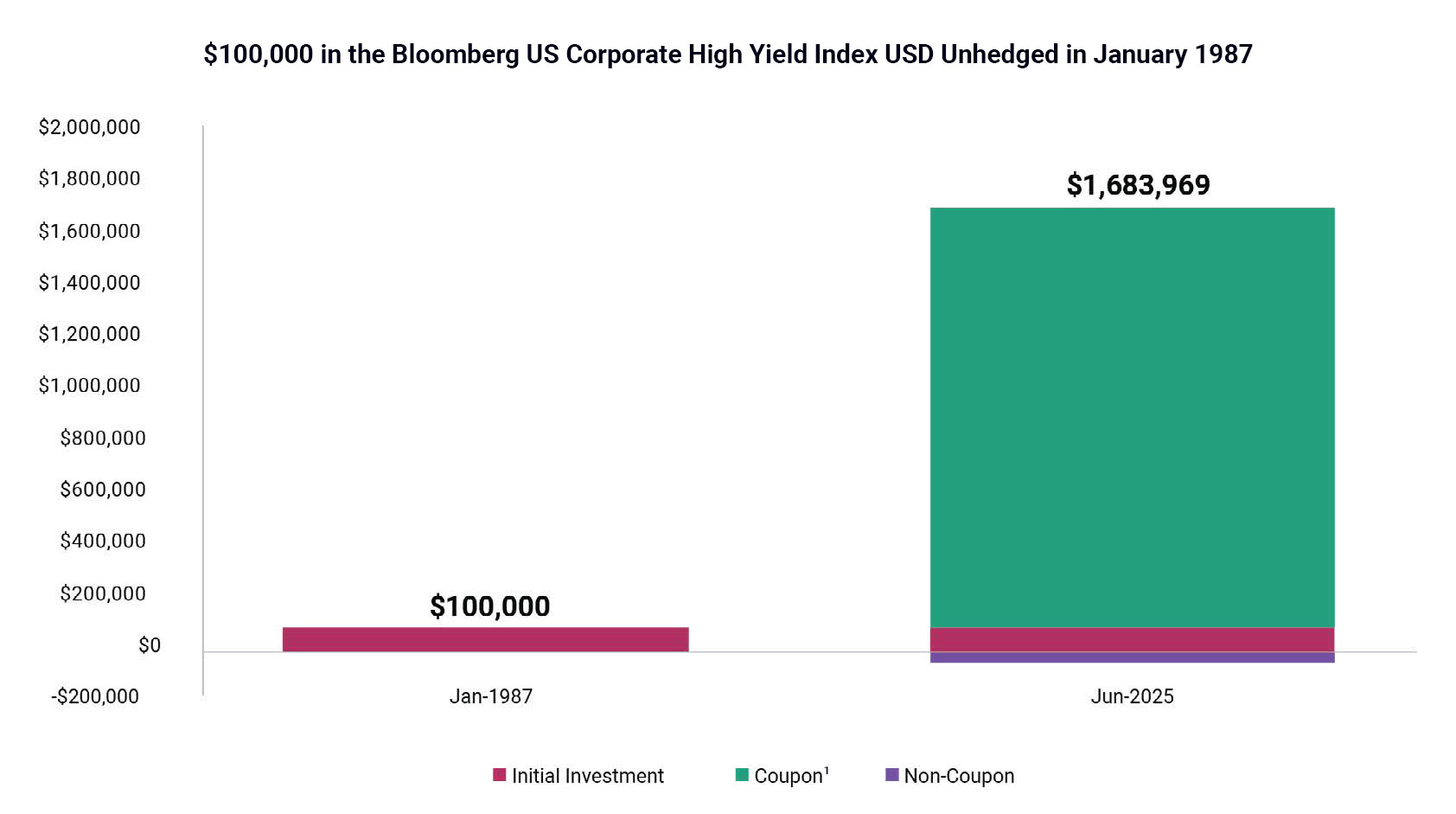
The coupon is really important in high yield because it’s the main driver of returns over time. When you invest in high yield, most of what you earn comes from those regular interest payments, not from big price moves. In fact, historically, coupon income has accounted for more than 100% of total returns, while defaults and price volatility have been a small drag. So as long as the issuer doesn’t default, you keep collecting that steady income, which is what makes high yield attractive for many investors.
High yield is about collecting the coupon, reinvesting it, and letting that income compound over time. That’s what drives the majority of long-term returns in this asset class.
High yield sits in the middle of the risk-return spectrum. It’s not as defensive as government bonds, but it’s much less volatile than equities. Because of that, it can play different roles depending on your portfolio. In a growth-focused portfolio that’s heavy in equities, adding high yield can help lower overall volatility while still contributing to returns.
And in a more defensive portfolio, it can enhance income and return potential without taking on the full risk of equities. So it helps improve the balance between risk and reward.
I hope this helps you better understand how high yield bond returns work.
For more information, please speak to your financial adviser.
Key takeaways
 Share via Email
1. Strong historical performance
US high yield has delivered over 8% annualised returns over 40+ years, with coupon income accounting for more than 100% of total returns1.
2. Potential for enhanced returns
Meaningful returns can be generated by collecting, reinvesting and compounding the coupon.
Past performance is not a guarantee or a reliable indicator of future results.
Chart shows hypothetical growth of 100,000 USD invested in the index. Index performance is for illustrative purposes only and is not indicative of any specific investment. Investors cannot invest directly in an index. Index referred to is Bloomberg US Corporate High Yield Index USD Unhedged.
Source: Bloomberg Index Services Limited. Data from Jan-1987 to Jun-2025. Returns in U.S. dollars.
3. Volatility reduction potential
High yield can help lower overall portfolio volatility compared to equities while still providing attractive returns potential.
1 Past performance is not a guarantee or a reliable indicator of future results. The US High Yield market, which has the longest track record, is represented by Bloomberg US CorporateHigh Yield Bond Index, Annualised index returns from 1 July 1983 to 30 June 2025.
Read the complete story


Complete the learning and short quiz to earn CPD points.
New to high yield terms?
Get quick definitions of key concepts to help you navigate the high yield education hub with confidence.
Continue your learning
items Introduction to high yield
Why global high yield?
Looking for income opportunities? This exciting asset class could be a compelling option
 Introduction to high yield
High yield is all around us...
You could be surprised by some familiar names
 High yield returns
It's all in the name... High yield
Breaking down a high yield bond
 Role of high yield
Comparing high yield to other asset classes
See how high yield stacks up from a risk and return, and volatility perspective
 Role of high yield
Correlations
It behaves more like equities than traditional bonds
 Role of high yield
More ups than downs
See how it's performed during times of market stress

Portfolio construction
Where does global high yield fit in your portfolio?
 Risks
Risks
The importance of avoiding defaults
How active management can make a big difference
 Risks
Risks
Risks of high yield
Things to consider before investing

T. Rowe Price Global High Income Fund
Exciting companies.
Compelling incomes.
Current yield
7.08%*
*As of 30 September 2025. Past performance is not a guarantee or a reliable indicator of future results. The current yield of the fund reflects the market-weighted average of coupon divided by price per security.
Risks
Fixed income securities are subject to credit risk, liquidity risk, call risk, and interest-rate risk. As interest rates rise, bond prices generally fall. Investments in high yield bonds involve greater risk of price volatility, illiquidity, and default than higher-rated debt securities.
Additional Disclosures
Bloomberg do not accept any liability for any errors or omissions in the indexes or data, and hereby expressly disclaim all warranties of originality, accuracy, completeness timeliness, merchantability and fitness for a particular purpose. No party may rely on any indexes or data contained in this communication. Visit https://www.troweprice.com/en/au/market-data-disclosures for additional legal notices & disclaimers.
202508-4771180