
How to make the most of your savings using a tax-efficient approach
August 2026, Personal Finance
- Key Insights
-
- Taxes should not drive your investment decisions, but they should be a factor you consider.
- For taxable account investors, exchange-traded funds can provide greater control over year-to-year tax obligations while helping improve after-tax returns.
- Account type and asset location are important components of a tax‑efficient strategy.
Taxes can create a drag on your investment performance, but through smart choices and a tax‑wise strategy, you can reduce that impact. The goal of these efforts is not to eliminate taxes but to minimize their influence on your returns.
The importance of taxes in your investment strategy will depend on your situation, including your tax rate. The higher your marginal tax rate, the more value there is in pursuing an investment strategy that factors taxes into your decision‑making process. Even so, many of the strategies described below could be options for investors in most tax brackets. That is particularly true when it comes to saving in tax‑advantaged accounts and diversifying your account types.
Contributing to tax‑advantaged accounts
Contributing to tax‑advantaged accounts is one of the simplest and most accessible ways investors can be more tax savvy. Retirement savings accounts allow your investments to grow without the annual drag of taxes on interest, dividends, or realized capital gains. Making tax‑deferred contributions to some retirement accounts, including Traditional individual retirement accounts (IRAs) and 401(k) plans, reduces your taxable income. Roth contributions are not deductible, but qualified distributions are tax‑free.
Since tax rates on both ordinary income and long‑term capital gains have decreased in recent years, investors might wonder if a taxable account would be preferable to a tax‑advantaged account. Over a long time horizon, the short answer is no. A Roth account is almost always preferable to a taxable account, given the former’s qualified tax‑free withdrawals. A Roth account is also generally preferable to a tax‑deferred account if your tax rate will be higher in retirement. If your tax rate will stay the same or decrease in retirement, a tax‑deferred account works out better than a taxable account. (See Scenarios 1 and 2.)
The advantage of tax-deferred accounts
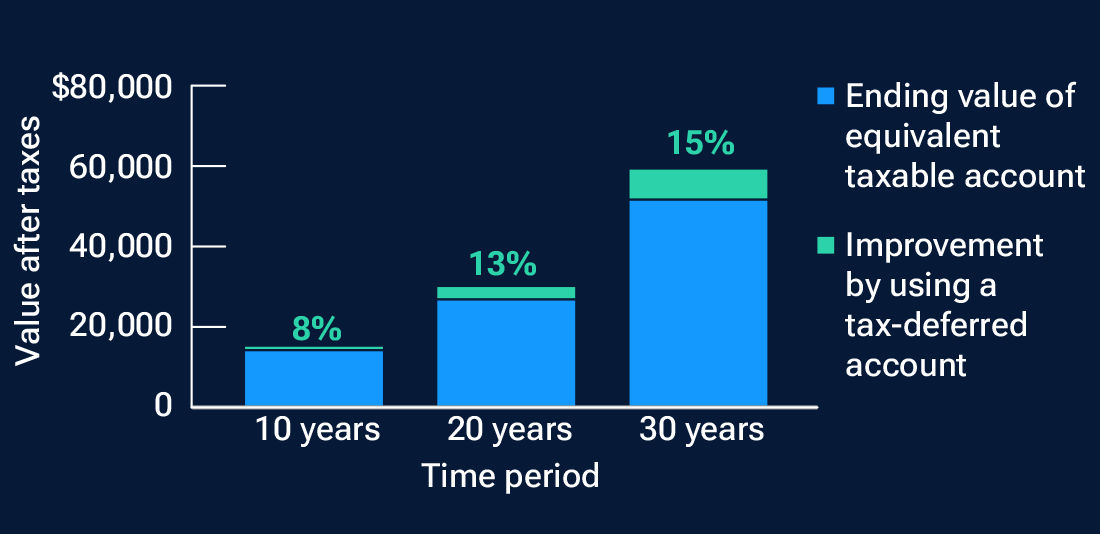
Tax‑deferred accounts provide an important foundation for many individuals’ retirement savings plans. The examples below compare the ending after‑tax value of a $10,000 tax‑deferred contribution and an equivalent investment in a taxable account. In both scenarios, tax‑deferred is better for growing savings over time—and the longer the time horizon, the bigger the improvement.
Scenario 1
(Fig. 1) This scenario reflects assumptions that are relatively favorable to the taxable account: All gains taxed are at capital gains tax rates at the end of the period (rather than each year), and the investor’s tax bracket doesn’t change in retirement. A tax‑deferred account still comes out on top.
Scenario 2
(Fig. 2) This scenario shows a larger difference if the situation isn’t quite so favorable to the taxable account: Half of that account’s gains are taxed each year (though still at capital gains tax rates), and the investor drops one tax bracket lower in retirement.
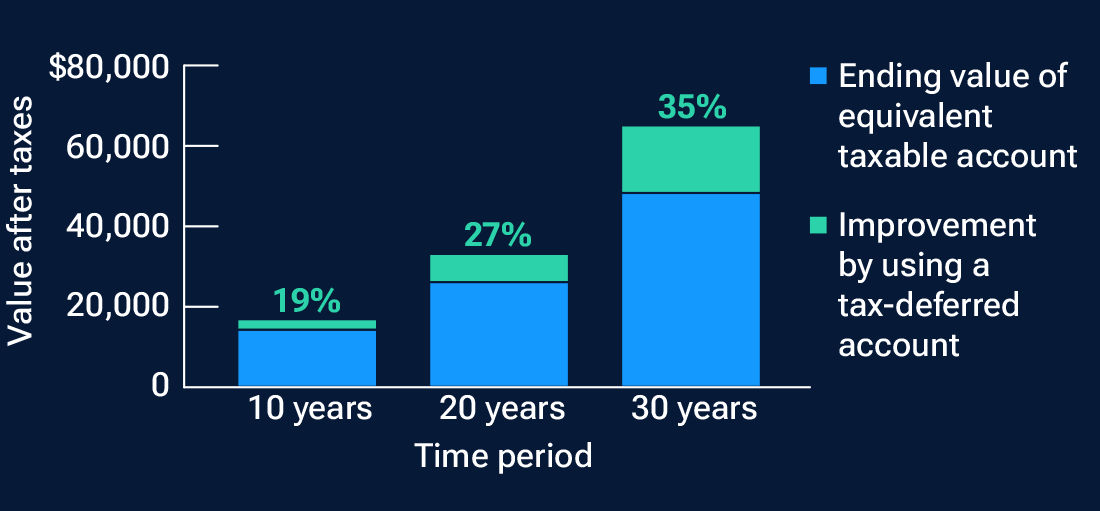
Assumptions: Both scenarios assume a 7% annual rate of return and a 22% initial marginal tax rate; in Scenario 2, the marginal tax rate drops to 15% at the end. The initial tax‑deferred investment in both scenarios is $10,000, while the initial investment in the taxable account is $7,800, which is the equivalent in after‑tax income. All returns in the taxable account are taxed at a 15% capital gains tax rate (either each year or at the end of the period), and ending values are after all relevant taxes are deducted. Values are not adjusted for inflation.
Diversifying your account types
Tax‑advantaged accounts form an important foundation for your retirement savings, but taxable accounts can provide flexibility for other goals and for savings above annual retirement plan contribution limits. Setting aside money in different types of accounts offers flexibility for your withdrawals in retirement, allowing you to better manage your tax liability.
The different account types can include taxable accounts, tax‑deferred accounts, and Roth accounts. Health Savings Accounts (HSAs) are also an investment option for those with high‑deductible health plans (HDHPs) who have the ability to set that money aside over a longer time horizon to cover future medical expenses. Each account type has different tax treatments and, thus, different ways it can fit into an income plan for retirement. (See “Tax treatments of different accounts.”)
Choosing tax‑efficient investments
Some investments carry their own intrinsic tax benefits. For example, interest income from certain municipal bonds is tax‑free at the federal level and potentially at the state and local levels as well. Similarly, investing in exchange-traded funds (ETFs) can help reduce taxable distributions and improve after-tax returns.
When comparing investments, it’s important to focus on after-tax returns rather than pretax performance alone. For example, a lower yield on a tax-free municipal bond may be preferable to the yield of a comparable taxable bond because more of that income stays in your pocket. In fact, the higher your marginal tax rate, the higher the pretax yield on a taxable bond would need to be to match the after-tax yield on a municipal bond. (See “A look at tax-equivalent yields.”)
The same principle applies when evaluating stock funds. Both mutual funds and ETFs may distribute net realized capital gains to shareholders. However, because ETFs generally minimize sales within the portfolio, capital gain distributions tend to be lower, allowing investors greater control over when they realize taxable gains. While ETFs can provide distinct tax advantages in taxable accounts, those benefits generally apply only to capital gains. Dividends from stock ETFs and interest from bond ETFs are still distributed to shareholders and are generally taxable. (See “Consider the tax efficiency of ETFs.”)
Consider the tax efficiency of ETFs
Exchange-traded funds (ETFs) can offer an important tax advantage for long-term investors in taxable accounts. Because ETFs generally use an in-kind creation and redemption process, they historically have distributed few or no capital gains to shareholders who remain invested.1 This can provide peace of mind for investors who would prefer that their year‑to‑year tax liabilities are driven less by the trading activity of other shareholders and more by when they choose to sell and realize their gains. While no investment can eliminate taxes, ETFs can be an attractive option for taxable investors seeking diversification, long-term growth, and greater control over capital gain realization.
Pay attention to asset location
Where you hold your securities is also an important component of a tax‑savvy strategy. Generally, investors should aim to hold investments that generate significant ordinary income in tax‑advantaged accounts. For instance, high‑yielding taxable bonds and bond funds, as well as real estate investment trusts, should generally be held in tax‑deferred accounts. Depending on your situation, even stocks or stock funds that generate qualified dividends might be better in those accounts than in taxable accounts.
Tax treatments of different accounts
(Fig. 3) Consider the tax treatments of each account type and how each may fit into your retirement income plan
| Contribution type | Income tax on earnings | Income tax on distribution or liquidation | Tax treatment for heirs | |
|---|---|---|---|---|
| Tax‑advantaged accounts | ||||
| Traditional IRA or 401(k) | Tax‑deferred or pretax | Deferred | Ordinary rate | Beneficiary’s required minimum distributions (RMDs): ordinary rate |
| Roth IRA or 401(k) | After tax | Deferred | Tax‑free for contributions and qualified earnings1 | Beneficiary’s RMDs: tax‑free if qualified |
| Health Savings Accounts2 | Tax‑deferred or pretax | Deferred | Tax‑free if for qualified medical expenses | Spousal beneficiary maintains tax advantage; full value taxable at ordinary rate for non‑spousal beneficiaries |
| Taxable accounts | ||||
| Appreciation | None until liquidated | Return of cost basis tax‑free; gains at rates applicable to short‑term or long‑term capital gains | Step‑up in basis, so gains during life of original owner are tax‑free | |
| Ordinary income‑generating (e.g., interest) | Ordinary rate | |||
| Qualified dividend | Qualified dividend rate |
1Generally, a qualified owner is over age 59½ and the Roth account has been open for at least 5 years.
2HSAs are only available for those with HDHPs; health care plans should be selected primarily based on insurance coverage needs. Some HSA tax benefits only accrue if assets are invested in the account over the longer term.
Additionally, consider the benefits of using Roth accounts to hold securities that have potential for significant long‑term growth. It could make sense to put very high‑growth‑potential securities in Roth accounts if you plan to hold on to them for a long time, since that growth will be tax‑free. A Roth account can be a particularly good choice for high‑turnover growth strategies in your portfolio, since those could generate short‑term capital gains in a taxable account.
By comparison, more tax‑efficient or tax‑advantaged investments should be held in taxable accounts. Municipal bonds, for instance, should only go in taxable accounts, as their tax benefits are wasted when held in a tax‑advantaged account. Stocks, stock ETFs, and low-turnover equity funds held longer than one year currently receive preferential capital gains tax treatment compared with short‑term gains or ordinary income, so these, too, can be appropriate for taxable accounts.
A look at tax‑equivalent yields
(Fig. 4) Select your federal tax bracket below to see the pretax yield you would have toearn on a taxable bond to equal a 3.5% tax‑free yield on a municipal bond.
* Does not include the 3.8% net investment income tax (NIIT); see irs.gov for more information.Chart also does not reflect any potential state or local tax benefit. Note that factoring in the NIITand state and local income taxes, where applicable, would result in higher tax‑equivalent yields.
For office use only: 202608-5846644
In any event, keep in mind that if you have assets in a taxable account, you should focus on their after-tax returns and the level of control you have over capital gains realization. Implementing the specifics of a location strategy will depend on your mix of accounts and asset allocation. In addition, exceptions to these general rules are appropriate when taking your time horizon into consideration. (See “Balancing tax efficiency and time horizon.”)
Balancing tax efficiency and time horizon
There are times when holding less tax‑efficient securities in a taxable account makes sense. When it comes to short‑term goals, such as saving for a down payment on a home, it can make sense to hold more conservative investments, such as short‑term bond funds, in a taxable account. Doing so ensures that those assets are available to you, penalty‑free, when it’s time to withdraw them. Holding those assets in a tax‑advantaged fund might lead to withdrawal penalties if your goal arrives before you reach the age of 59½. Don’t let the taxes play the dominant role in your decision about where to hold various investments. To the extent that you have short‑term goals, it’s ok to hold conservative interest‑generating investments in a taxable account to have those assets accessible when you need them.
Stay focused on what’s important
Ultimately, the most important elements of your retirement savings plan involve how much you save and how early you can start saving. Seeking tax efficiency should never get in the way of maximizing your savings, but a few relatively easy steps can go a long way toward tax efficiency. While avoiding all taxes is virtually impossible, investors can make some important portfolio decisions and adjustments to adopt a more tax‑efficient investing strategy.
 Roger Young, CFP®
Thought Leadership Director
Roger Young, CFP®
Thought Leadership Director

- Sep 2026
- Personal Finance
- Article
How HSAs can help you unlock tax savings and manage health care costs
1 Source: Morningstar, “Few ETFs Project Capital Gains Distributions in 2025: Key Takeaways for Investors,” December 2025. morningstar.com/funds/few-etfs-project-capital-gains-distributions-2025-key-takeaways-investors
Important Information
ETFs are bought and sold at market prices, not NAV. Investors generally incur the cost of the spread between the prices at which shares are bought and sold. Buying and selling shares may result in brokerage commissions which will reduce returns.
This material is provided for informational purposes only and is not intended to be investment advice or a recommendation to take any particular investment action.
The views contained herein are those of the authors as of June 2026 and are subject to change without notice; these views may differ from those of other T. Rowe Price associates.
This information is not intended to reflect a current or past recommendation concerning investments, investment strategies, or account types, advice of any kind, or a solicitation of an offer to buy or sell any securities or investment services. The opinions and commentary provided do not take into account the investment objectives or financial situation of any particular investor or class of investor. Please consider your own circumstances before making an investment decision.
Information contained herein is based upon sources we consider to be reliable; we do not, however, guarantee its accuracy. Actual future outcomes may differ materially from any estimates or forward‑looking statements provided.
Performance quoted represents past performance which is not a guarantee or a reliable indicator of future results. All investments are subject to market risk, including the possible loss of principal. Fixed income securities are subject to credit risk, liquidity risk, call risk, and interest rate risk. As interest rates rise, bond prices generally fall. Some municipal bond income may be subject to state and local taxes and the federal alternative minimum tax. All charts and tables are shown for illustrative purposes only.
T. Rowe Price Investment Services, Inc., distributor.
© 2026 T. Rowe Price. All Rights Reserved. T. ROWE PRICE, INVEST WITH CONFIDENCE, the Bighorn Sheep design, and related indicators (see troweprice.com/ip) are trademarks of T. Rowe Price Group, Inc. All other trademarks are the property of their respective owners. Use does not imply endorsement, sponsorship, or affiliation of T. Rowe Price with any of the trademark owners.
- 202608‑5747632