 Active investing approach
Designed to perform
Our active investing approach is powered by experts with the curiosity to ask better questions and uncover deeper insights—helping our clients thrive in an evolving world.
What is active management?
Active management involves making informed decisions based on extensive research, expert insights, and market analysis with the ultimate goal of beating the index returns. Passive management is focused on matching, not beating, the returns of the index.
Our active management strives for better results for our clients

Experts equipped with a world of information
Experienced professionals operating around the world are supported by broad and innovative sources of information, giving them an information edge as they seek out opportunities wherever they may be.

Curiosity driving better questions
Curiosity powers us to dig deeper and uncover insights that others might miss. Our culture demands we challenge each other’s thinking and drives a deep understanding of the companies, economies, markets, and trends to help make better decisions.

Dynamic, holistic view
We push past common narratives and develop differentiated ideas by synthesizing insights and identifying patterns. Rigorous research intersects with creative thinking to provide a more comprehensive view of the investable universe and position portfolios for long-term success.
More return. More often. That’s the T. Rowe Price difference.
Ten-year periods, rolled monthly, over the 20 years ended December 31, 2025

T. Rowe Price funds beat comparable passive funds more frequently—and with higher returns—than the average of all active managers, including the largest ones.
Past performance is no guarantee of future results. To learn more about T. Rowe Price funds, view our Standardized Returns (PDF). For additional insights and disclosures, read our Analysis Details and Disclosures. For institutional investors, explore T. Rowe Price’s Strategy Outperformance.
Ten-year periods, rolled monthly, over the 20 years ended December 31, 2025

This outperformance stemmed from our experience and commitment to rigorous global research, which allowed us to uncover equity investment opportunities with long-term growth potential.
Past performance is no guarantee of future results. To learn more about T. Rowe Price funds, view our Standardized Returns (PDF). For additional insights and disclosures, read our Analysis Details and Disclosures. For institutional investors, explore T. Rowe Price’s Strategy Outperformance.
Ten-year periods, rolled monthly, over the 20 years ended December 31, 2025
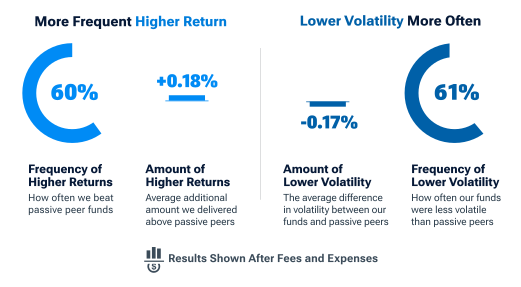
Our fixed income funds had 0.2% less volatility than comparable passive funds. Our active management approach provided clients with a smoother ride—and a 0.2% better return—even after considering expenses.
Past performance is no guarantee of future results. To learn more about T. Rowe Price funds, view our Standardized Returns (PDF). For additional insights and disclosures, read our Analysis Details and Disclosures. For institutional investors, explore T. Rowe Price’s Strategy Outperformance.
Ten-year periods, rolled monthly, over the 20 years ended December 31, 2025

These Retirement Funds have delivered higher returns than comparable passive funds in every 10-year monthly rolling period over the last twenty years. This kind of extra return can compound over time and may lead to higher retirement balances.
Analysis compared T. Rowe Price funds at or near retirement (2020–2040 vintages) with combined portfolios of passive target date funds over 10-year rolling monthly periods over the last twenty years through 12/31/25.
Past performance is no guarantee of future results. To learn more about T. Rowe Price funds, view our Standardized Returns (PDF). For additional insights and disclosures, read our Analysis Details and Disclosures. For institutional investors, explore T. Rowe Price’s Strategy Outperformance.
A long-term approach built on rigorous research and independent thinking can lead to powerful insights and better decisions. In this video, see how this enables us to deliver more for clients—and what makes our approach different.
To learn more about T. Rowe Price funds, view our Standardized Returns (PDF). For additional insights and disclosures, read our Analysis Details and Disclosures.
More return. More often.
In volatile markets and economic uncertainty, you need a trustworthy partner in the markets that seeks consistent results.
At T. Rowe Price, our active management approach is founded on
- A Long-Term Approach
- Rigorous Research
- Independent Thinking
- Experienced Risk Management
Our investment professionals are independent thinkers operating in a deeply embedded culture of collaboration.
The rigor of our research—and the dynamic exchange of perspectives through our collaborative investing culture—lead to powerful insights and better decisions.
360+ sector & regional experts
520+ investment professionals traveling the world to visit companies
15k+ meetings annually between our investment teams & firms we invest in
Daily partnership between portfolio managers & analysts around the globe
As of 12/31/2024
This partnership leads to:
- Active debate,
- More differentiated opinions,
- And synthesis of information,
Helping us understand risks and opportunities through a multifaceted lens.
Our recent study of 115 actively managed T. Rowe Price funds revealed that, on average, they delivered a higher return than passive peer funds – and at a higher level – than other active managers – net of fees and expenses.
T. Rowe Price funds across asset classes came out on top compared with passive peers and their competitors.
More return. More often. That’s the T. Rowe Price Difference.
Why our active investing approach is different
Our expert investment analysts test and retest the case for, or against, a security. Watch how their curiosity and rigorous approach informs the analysis of future opportunities.
At T. Rowe Price, investment analysts are curious, independent thinkers with a passion for investing.
With diverse backgrounds—from medicine to geology—they bring unique perspectives to their work and our active management approach.
And today these insights drive their global search for investment opportunities.
They decide which ideas are worth a firsthand look by examining company and security valuations, the competitive environment, industry growth, and much more.
In the field, equity and fixed income analysts often travel together, to study companies, industry sectors, and entire economies from every angle.
They meet with senior executives, front-line employees, and industry leaders. Asking better questions. Getting a deeper understanding of worker productivity, the quality of facilities and products, and the way business gets done.
They measure a company’s effectiveness by talking with suppliers and customers.
And they sit down with legislative, regulatory and other public officials, looking for answers to seek information that could affect the future of a potential investment.
Back at the office, our analysts turn findings from site visits into actionable insights—sharing ideas and debating them, collaborating to identify opportunities that can help give clients an investment edge.
Their insights help us decide what to invest in. But the work doesn’t end there. Analysts keep a long-term view, constantly asking better questions and re-evaluating the case for, or against, an investment.
The analyst’s journey is one of the many ways we help clients reach their most important financial goals. And thrive in an evolving world.
Active investing is suited to the challenging markets ahead
We believe skilled active managers with global scale and deep research platforms can thrive in the new world of higher rates, greater dispersion, and heightened volatility.

Learn how active management can help your investments thrive in an evolving market landscape

- Oct 2026
- Personal Finance
- Article
How active ETFs can help reduce a portfolio’s tax liability

- Sep 2026
- Fixed Income
- Article
Why fixed income is critical for the AI supercycle

- Aug 2026
- Equity
- Article
Why investors should prioritize durable growth when the market does not
Putting our active management approach to work for you
Personal Investing
I want to explore mutual funds, roll over a 401(k), save for college, get investment advice or open a new account.
Financial Advisors / Intermediaries
I'm a broker-dealer, registered investment advisor, DC–focused advisor, or trust or bank financial professional and want to explore T. Rowe Price's investment offering.
Institutional Investors / Consultants
I'm an institutional investor or consultant who wants to learn more about each of T. Rowe Price's investment capabilities.
Read Form CRS for important information on our fees and services.
The performance data shown is past performance and is no guarantee or reliable indicator of future results.
All investments are subject to risk, including the possible loss of principal. Results from other time periods may differ. Active investing may have higher costs than passive investing and may underperform the broad market or passive peers with similar objectives. Passive investing may lag the performance of actively managed peers as holdings are not reallocated based on changes in market conditions or outlooks on specific securities.
For more information on the methodology of this analysis, please visit troweprice.com/complete-performance-study.
Analysis by T. Rowe Price. Comparable passive funds are (1) mutual funds and exchange-traded funds (ETFs) classified as an “index fund” in the Morningstar Direct database and (2) in the same Morningstar category as the active funds being analyzed. All Active Managers represents the actively managed (non-index fund) mutual funds and ETFs in the Morningstar Direct database, excluding those managed by T. Rowe Price. The performance of the T. Rowe Price active funds and the All Active Managers funds were compared against the comparable passive funds using 10-year rolling monthly periods from 1/1/06 to 12/31/25. The analysis was conducted at the Morningstar category level, analyzing all open-end funds and ETFs within U.S. Morningstar categories where passive funds are present. Oldest share class returns are used for analysis. Money market funds are excluded from the analysis.
All Funds
1 116 funds covering 9,844 rolling 10-year periods.
2 602 funds covering 49,475 rolling 10-year periods. The active assets under management (AUM) as of 12/31/25 across all funds considered in the analysis are aggregated, and those funds offered at any point in the analysis period by the largest five active fund managers by AUM, identified by Morningstar, other than T. Rowe Price are grouped together here. Source: Morningstar.
3 5,672 funds covering 394,997 rolling 10-year periods, excluding T. Rowe Price.
Equity Funds
1 55 funds covering 5,568 rolling 10-year periods.
2 324 funds covering 32,237 rolling 10-year periods. The active assets under management (AUM) as of 12/31/25 across all funds considered in the analysis are aggregated, and those funds offered at any point in the analysis period by the largest five active fund managers by AUM, identified by Morningstar, other than T. Rowe Price are grouped together here. Source: Morningstar.
3 3,050 funds covering 260,725 rolling 10-year periods, excluding T. Rowe Price.
Fixed Income Funds
Fixed income securities are subject to credit risk, liquidity risk, call risk, and interest rate risk. As interest rates rise, bond prices generally fall.
Volatility is measured via standard deviation, annualized and net of fees, over 10-year rolling periods from 1/1/06 to 12/31/25.
33 T. Rowe Price funds are analyzed over 2,443 rolling 10-year periods.
Target Date Funds
For more information on the methodology of this analysis, the full study can be accessed at troweprice.com/TDPassiveStudy.
The performance data shown is past performance and is no guarantee or reliable indicator of future results. Investment return and principal value will fluctuate so that an investor’s shares, when redeemed, may be worth more or less than their original cost. Current performance may be lower or higher than the performance data quoted. To obtain the most recent month-end performance, visit troweprice.com.
Analysis by T. Rowe Price. Source: Morningstar. The target date funds included in the combined portfolios were (1) defined as passive as they were identified by as having an “Active Passive Breakdown Percent Index Funds” of 75% or greater, and (2) in the Morningstar universe sharing the same target date as each Retirement Fund. Combined portfolios were equally weighted and based on the oldest share class of each competing passive target date fund. Analysis considers vintages of T. Rowe Price Retirement Funds at or near retirement; if all vintages with a 10-year track record were analyzed, 98% of periods show outperformance of the calculated category passive average.
Although in the same category, there may be material differences among target date funds, including fees, expenses, and the portfolio mix of investments. Active investing may have higher costs than passive investing and may underperform the broad market or passive peers with similar objectives. Passive investing may lag the performance of actively managed peers as holdings are not reallocated based on changes in market conditions or outlooks on specific securities. Results for other time periods will differ.
All investments are subject to market risk, including the possible loss of principal. The principal value of the target date funds is not guaranteed at any time, including, if applicable, at or after the target date, which is the approximate year an investor plans to retire (assumed to be age 65). Investments in other funds: The fund bears the risk that its underlying funds will fail to successfully employ their investment strategies. One or more underlying fund’s underperformance or failure to meet its Investment Objective(s); as intended could cause the fund to underperform similarly managed funds. Foreign investing: Underlying funds with exposure to foreign investments carry greater risk because non-U.S. securities tend to be more volatile and have lower overall liquidity and trading volume than investments in U.S. securities and may lose value because of adverse local, political, social, or economic developments overseas, or due to changes in the exchange rates between foreign currencies and the U.S. dollar. Emerging markets: Investing in underlying funds that hold securities of issuers in emerging market countries involves greater risk and overall volatility than investing in underlying funds that hold securities of issuers in the U.S. and other developed markets. Interest rates: A rise in interest rates typically causes the price of a fixed rate debt instrument to fall and its yield to rise. Conversely, a decline in interest rates typically causes the price of a fixed rate debt instrument to rise and the yield to fall. See the prospectus for more detail on the fund’s Principal Risks.
©2026 Morningstar, Inc. All rights reserved. The information contained here in: (1) is proprietary to Morningstar and/or its content providers; (2) may not be copied or distributed; and (3) is not warranted to be accurate, complete, or timely. Neither Morningstar nor its content providers are responsible for any damages or losses arising from any use of this information.
5256701