

Should I Stay or Should I Go?
Executive Summary
- Bond investors face a very difficult investment environment: Yields are near record lows, central bank actions have caused widespread volatility, and concerns persist over the prospects for the global economy.
- Yields are likely to remain low, protecting existing portfolios against sudden declines in value, but weak U.S. corporate balance sheets could signal volatility.
- It is still possible to make money in this environment, but rising correlations between equities and certain bond assets are complicating matters.
- Ultimately, investors need to decide whether they want to access the higher yields available from emerging market, high yield, and corporate debt (which means accepting higher correlations with equities) or the greater diversification available from developed market sovereigns (which will mean accepting lower yields).
Every asset in a portfolio needs to justify its place. As investors, therefore, it is important that we frequently ask ourselves a basic question: Why am I holding this product? If we can’t provide a clear answer, then it is time to rethink our approach. Investing in a security for the wrong reasons can prove to be an expensive mistake.
The question is particularly important for fixed income investors at the moment. Yields in developed market sovereigns remain close to record lows, with some USD $13 trillion1 currently estimated to be in negative territory. Unconventional central bank actions have caused markets to be volatile and unpredictable, leaving participants in a near-permanent state of anxiety about when and where the next hike or cut may be coming from. Concerns over Chinese growth, the UK’s exit from the European Union, and an increasingly fractious Middle East are only adding to a prevailing climate of uncertainty. Faced with such difficult terrain, bond investors can be forgiven for not knowing which way to turn.
“LOWER FOR LONGER” PROJECTION HOLDS
The main argument for remaining invested in fixed income is that domestic interest rates in most developed economies are likely to remain low for some time to come, protecting existing bond portfolios from sudden declines in value as a result of rising yields. There are a number of reasons for this, including anemic economic growth, falling labor productivity, and slowing population growth (which reduces investment levels).
Also important are the structural adjustments taking place in emerging markets (EM). The end of the commodity-driven investment cycle will leave many emerging countries looking for a new business model as they can no longer rely on oil and gas exports to China. And until it is clear what those new business models are, the demand for credit from EM countries will remain low, keeping interest rates down. At the same time, China is also in the process of adjusting its business model to one that is less dependent on investment and capital formation and more focused on services—and given that China accounts for a quarter of the world’s capital formation, this adjustment will likely result in a further decline in the demand for credit.
This fall in demand for credit within emerging markets marks a third distinct phase of deleveraging since the global financial crisis. The first occurred in the U.S., when households were forced to bring down debt following the collapse of Lehman Brothers; the second took place in the eurozone, when households, corporates, and governments worked to reduce credit exposure during—and after—the most acute phase of the crisis. Both of these phases resulted in slower growth and lower interest rates in those regions. The third phase is occurring now in emerging markets as countries adjust to the end of the commodity-driven investment boom led by China. The result? Growth is slowing (albeit remaining well ahead of developed markets) and interest rates are falling.
U.S. BUSINESS CYCLE APPROACHES LATE STAGE
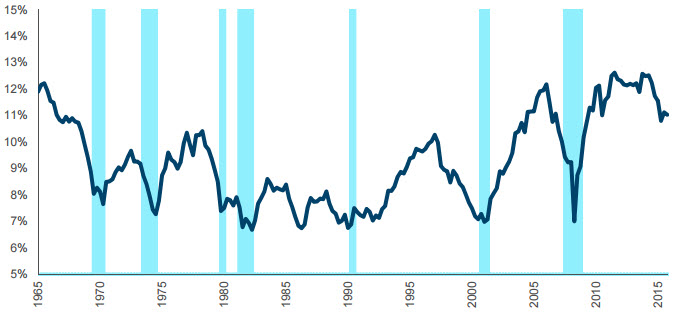
There are also growing signs that the U.S. may be in the late stage of its business cycle—and may even be on the verge of a downturn (see Figure 1). Economywide revenue growth is down to zero, profits peaked in late 2014, and retail margins are under pressure. Forward-looking guidance on margins and profitability remains weak, which is putting downward pressure on investment spending.
Figure 1: U.S. Corporate Profit Margins (Shaded Areas are Recession Periods)
Past performance is not a reliable indicator of future performance. Sources: Bureau of Economic Analysis and T. Rowe Price.
A looming downturn gives the Fed less room to raise rates. This does not mean that we should not expect further hikes—we still anticipate three to four rate rises overall—but it does mean that the Fed is unlikely to hike very much or very quickly, which is again good news for existing bondholders.
However, the fact that the U.S. is in the late stage of its business cycle also brings additional risks for bond investors. A glance at U.S. corporate balance sheets shows that debt levels have risen to highs not seen since before the crisis, driven by a combination of the shale boom, a surge in merger and acquisition activity, and a huge increase in corporates undertaking stock buybacks (over the past 12 months alone, S&P 500 companies have bought back USD $600 billion worth of stock, and 150 out of the 500 S&P-listed companies currently buy back more stock than they generate in profits). While most companies’ interest rate coverage remains relatively healthy because rates are so low, this will not last if debt levels continue to increase. The overall state of U.S. corporate balance sheets looks weak, which could signal looming volatility.
GOING GLOBAL
Fortunately, credit cycles do not move in tandem: At any given time, individual countries will be at different stages of expansion and contraction. This means there are always likely to be pockets of value within global fixed income markets for investors with the scope to invest across markets and regions and the flexibility to move into and out of positions quickly. A number of developed market bonds have performed well despite offering low yields at the beginning of the year, including Australia, Sweden, Japan, and Germany. These are not long-term buy-and-hold positions—they are short-term opportunities that can be taken advantage of by those who move quickly. But they show that, even in a low-yielding environment, it is possible to make money.
Moreover, the widely held perception that we are in a low-yield environment is also somewhat misleading. It is certainly true that domestic rates in much of the developed world are very low, but higher rates can be found in developing market countries including Brazil, Russia, and the Philippines. What’s more, rates continue to move in different directions: Last year, there were a total of 77 central bank rate cuts and 66 rate hikes; by the end of August this year, there had been 51 cuts and 30 hikes.2 Clearly, when looked at from a global perspective, the yield picture is far more mixed than it appears from a developed market-only viewpoint. Investors with global reach can benefit from these differences.
MAKE A CHOICE
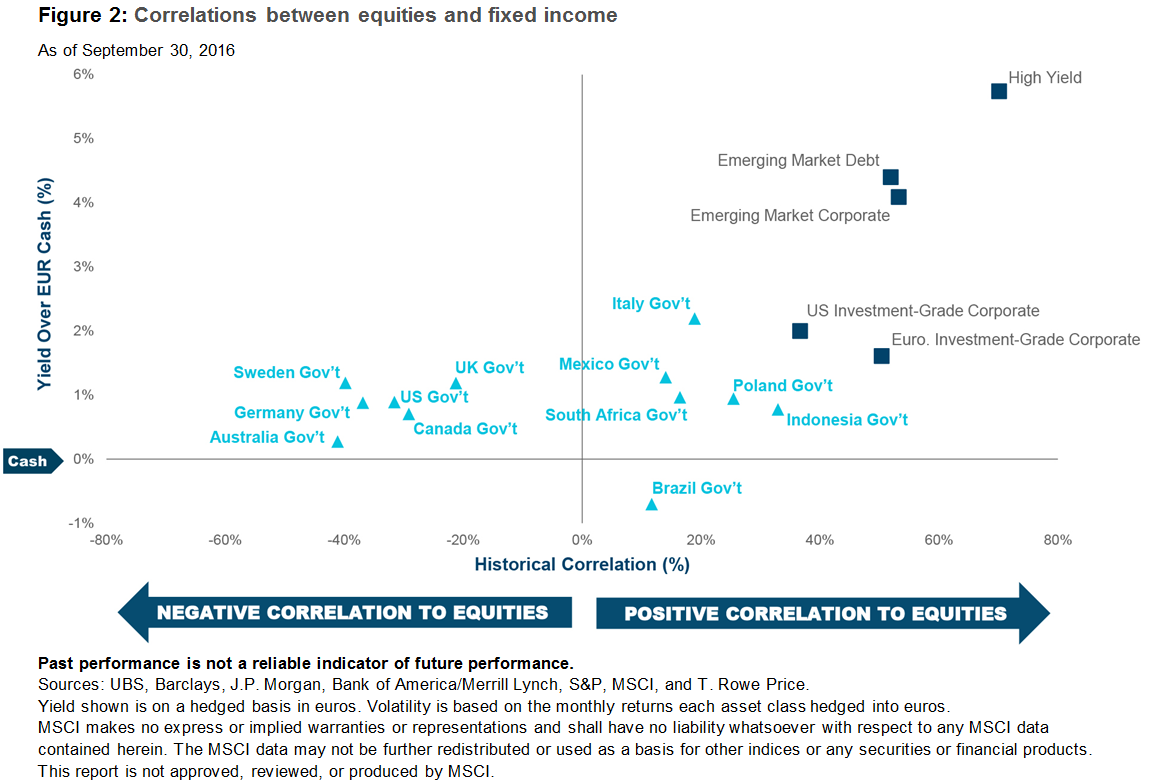
People own fixed income for two main reasons: to generate income or to diversify against equities. Achieving the latter has become increasingly difficult in recent years because correlations between equities and certain bond assets have become positive. This is not how it is supposed to be: In normal circumstances, bonds and equities move in opposite directions. But the combination of deleveraging and excess liquidity from central bank quantitative easing programs has resulted in some fixed income assets—emerging market debt and some investment-grade and high yield bonds—moving in tandem with equities. This has led to the formation of a bubble in which some ostensibly “safe” bond assets have become equity substitutes rather than equity diversifiers (see Figure 2).
This is not the case for all fixed income assets, however. As Figure 2 shows, developed world sovereign debt, while offering low and, in some cases, negative yields, continues to offer effective diversification from equities. Fixed income investors therefore have a simple choice: Do you want your bond portfolio to generate returns or provide safety? If the preference is for the former, there are plenty of pockets of value available in emerging markets and in investment-grade and high yield corporates. However, a bond portfolio constructed in this way will be correlated with equities and will therefore be highly vulnerable in the event of a downturn. If the latter option is chosen, there are options available that will provide effective diversification against equities but will almost certainly offer very low yields.
In the future, it may be possible to once again hold bonds that pay income and diversify away from equities, but for the time being, investors must choose one or the other—attempting to straddle the middle is likely to be an uncomfortable experience, with little obvious gain. The choice ultimately comes down to the role that you believe fixed income should play in your portfolio. Once that is understood, deciding which instruments to invest in becomes a much easier proposition.
1Source: Financial Times as of August 12, 2016.
2016-GL-4995
重要資訊
本文件(包括其中所載的任何陳述、資訊、數據和內容)以及與本文件一併提供的任何資料、資訊、圖像、連結、聲音、圖像或視頻(統稱為「資料」)乃由普信提供,並僅作一般資訊用途。本資料並不擬供在禁止或限制分發本資料的司法管轄區和在本資料須按特定要求提供的若干國家之人士使用。本資料不擬派發予任何司法管轄區的散戶投資者。在任何情況下,本資料的全部或部分內容均不得在未經普信同意下複製或再分發或出示予任何人士。本資料並不構成於任何司法管轄區分銷、要約、邀請、建議或徵求發售或購買任何證券。本資料並未經由任何司法管轄區的任何監管機關審閱。本資料並不構成任何投資意見,不得加以依賴。投資者務請在作出任何投資決策前先尋求獨立法律和財務意見(包括有關稅務後果的意見)。
