

Delivering Amid Market Volatility for Euro Based Investors
The Global Unconstrained Bond Fund, which reached its one-year anniversary in June, was launched during a highly challenging time for bond investors. Even before the turbulence caused by UK’s Brexit vote, the slump in commodity prices, persistent low or negative yields, China’s slowdown and intense speculation about central bank actions had made for a highly volatile and uncertain period in the markets. As unconstrained investors, however, these conditions also provided us with an opportunity to demonstrate our ability to deliver performance for our clients across different phases of the market cycle.
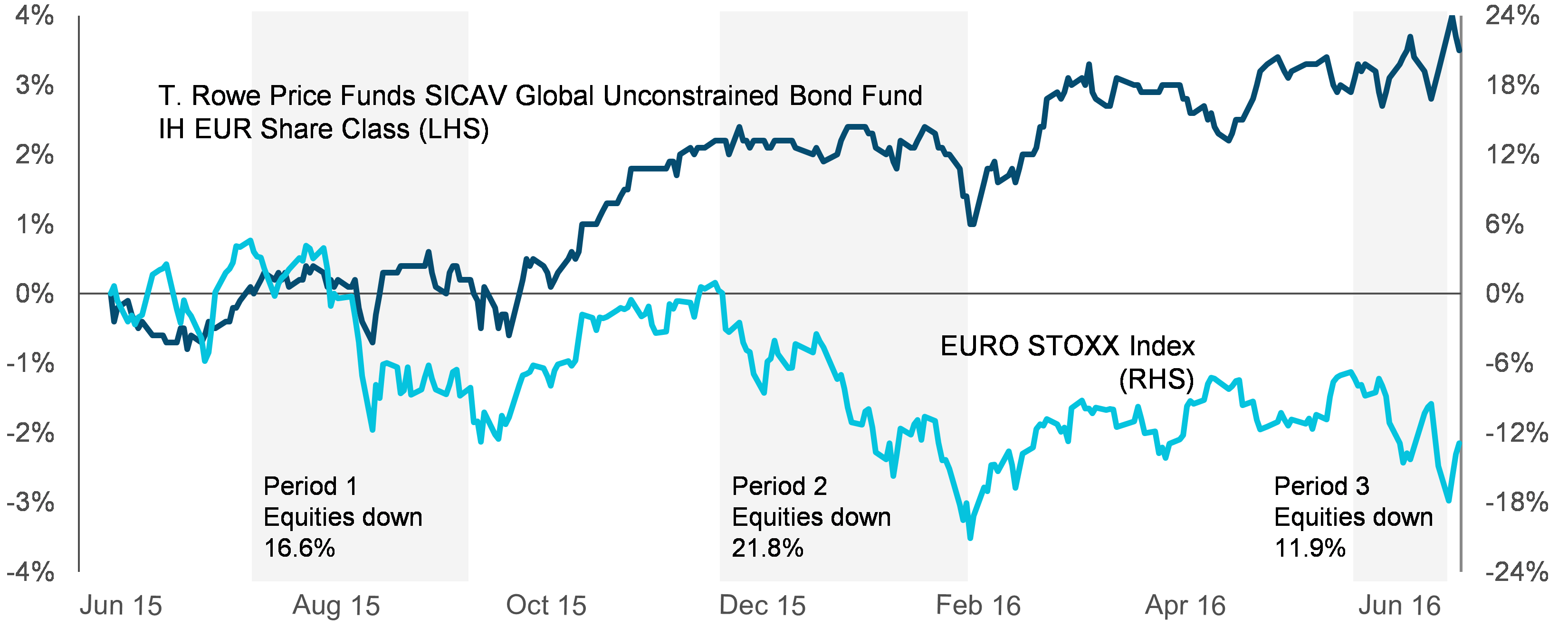
Traditional approaches to bond investing are typically constrained by benchmarks which are dominated by the largest debt issuers. This is not the optimal way to invest, particularly when interest rate cycles are turning. The ability to be agnostic and look beyond a predefined opportunity set to source both long and short ideas should, therefore, help to add value across different market environments. From inception to 30 June, the Global Unconstrained Bond Fund delivered regular performance in line with expectations while at the same time the European equity markets witnessed three periods of severe corrections (see graph below).
FIGURE 1: CUMULATIVE PERFORMANCE AT TIMES OF EQUITY CORRECTION
As of 30 June 2016
Past performance is not a reliable indicator of future performance.
The light grey area indicates period or rapid equity correction.The index shown is not a formal benchmark. It is shown only for comparison purposes.Fund performance is net of fees and is calculated using the official NAV with dividends reinvested, if any. The value of the investment will vary and is not guaranteed. It will be affected by changes in the exchange rate between the base currency of the fund and the subscription currency, if different. Sales charges, taxes and other locally applied costs have not been deducted and if applicable, they will reduce the performance figures. Where the base currency of the fund differs from the share class currency, exchange rate movements may affect returns.
Hedged share classes utilize investment techniques to mitigate currency risk between the underlying investment currency(ies) of the fund and the currency of the hedged share class. The costs of doing so will be charged to the share class and there is no guarantee that such hedging will be effective.
Sources: STOXX and T. Rowe Price
GENERATING RETURNS ACROSS THE MARKET CYCLE
The main objectives of our fund are to generate returns through high conviction positions and – more importantly – manage downside risk in periods of equity market stress. With regard to the first of these, most of the attribution of our fund in its first 12 months came from long and short duration/country bets. This differentiated us from most of our competitors, who traded more in credit markets or emerging market sovereigns. One of the advantages of an unconstrained approach is that it gives us the freedom to move quickly in and out of major short and long duration positions as the markets change.
Let’s look at how this works in practice: a major influence on markets over the past 18 months has been speculation about central bank moves, in particular the European Central Bank’s (ECB) quantitative easing (QE) measures and the timing and frequency of any Fed rate hikes. We modified our positioning during the period in line with our own expectations. For example, we saw a repricing of spreads of peripheral European sovereign bonds throughout 2015 as the ECB announced details of its QE programme, and we actively adjusted our exposure according to our own risk-return assessments. At times when the periphery was significantly outperforming the “core” countries, a benchmark-constrained strategy would have been stuck with large weightings to countries, such as Germany, which would have detracted from performance.
PROTECTING AGAINST DOWNSIDE RISK
While return-seeking trades are an essential part of what we do, even more important is how we protect our clients’ assets during periods of equity market volatility. We have seen several tests of our ability to do this. The first came in August last year, when equity markets plummeted following the People’s Bank of China’s decision to devalue the renminbi (Figure 1). In response, we quickly exited a number of long positions in Asian currencies such as the Korean won and the Malaysian ringgit. We had previously felt that these countries were relatively immune to a rise in volatility, but in reality the situation in China put pressure on local bond markets. Subsequently, we adopted short positions in a number of Asia ex-China currencies, which proved beneficial for performance.
Some of our risk-hedged positions worked well during the August/September rout, but others did not. Our short euro position, for example, did not deliver as expected and we reduced it during the month. On the other hand, our long volatility position through put options on the S&P 500 was highly effective in mitigating market impact on performance. As the cost of volatility increased during the month, we took profits on the put options. In situations like these, the ability to be nimble in order to quickly adapt and exit positions is essential.
A second test came in January 2016, when equities slumped again amid renewed fears over China and a collapse in the oil price (Figure 1). However, we had begun the year with a strong defensive stance, having added a number of hedges to the fund during November and December. These included short positions in credit derivative instruments, long duration positioning in high quality government bond markets and short positions in specific emerging market currencies versus the US dollar. Most of these defensive positions paid off in January.
Then came the Brexit vote. In the runup to the European Union referendum on 23 June, it became clear that volatility would rise and that the cost of insurance against that volatility was fairly cheap. While we did not necessarily predict a Leave vote, we saw the outcome as asymmetric: the potential downside impact of a Leave vote on the financial markets would be much greater than the upside response to a Remain. Our positioning therefore reflected this asymmetry so that in the end we benefited from the outcome. (At the same time we implemented some positions that would have benefited from a Remain scenario: a risk that the market would react more positively than expected, leading to a “melt up” in risk. This scenario never materialized, however, and the premium paid for these positions lost its value after the referendum.)
OUTLOOK FOR THE REST OF 2016
Looking ahead to the rest of this year, we remain fairly defensive. Further volatility is likely while the consequences of the Brexit vote at the Europe-wide level are still not fully understood. There is still much uncertainty about the path events will take and liquidity is likely to remain challenged. Away from Brexit, the world is still not an altogether stable place. China is still a concern. U.S. and Italian politics will gain focus as we move into the autumn, with a referendum on constitutional reform in Italy due in the second half of the year and the US election in November.
Instead, risk will be taken on a more idiosyncratic basis, in specific countries, currencies and issuers where analysts have strong conviction. Some of these opportunities are likely to be found in emerging market countries where the growth dynamic is improving, but also within specific credit securities where prices have become more attractive and where the fundamental story remains sound. So, for the time being, we are positioned to protect our clients’ assets against spikes in volatility and add idiosyncratic alpha as and when we find it.
2016-GL-4367
重要資訊
本文件(包括其中所載的任何陳述、資訊、數據和內容)以及與本文件一併提供的任何資料、資訊、圖像、連結、聲音、圖像或視頻(統稱為「資料」)乃由普信提供,並僅作一般資訊用途。本資料並不擬供在禁止或限制分發本資料的司法管轄區和在本資料須按特定要求提供的若干國家之人士使用。本資料不擬派發予任何司法管轄區的散戶投資者。在任何情況下,本資料的全部或部分內容均不得在未經普信同意下複製或再分發或出示予任何人士。本資料並不構成於任何司法管轄區分銷、要約、邀請、建議或徵求發售或購買任何證券。本資料並未經由任何司法管轄區的任何監管機關審閱。本資料並不構成任何投資意見,不得加以依賴。投資者務請在作出任何投資決策前先尋求獨立法律和財務意見(包括有關稅務後果的意見)。
