

Half a Decade of Investing in the European High Yield Bond Market
Executive Summary
The European high yield bond market is growing rapidly, creating ever more opportunities, but also challenging credit analysts with increasing levels of complexity. Succeeding in this environment over the long term will require flexibility. The T. Rowe Price European High Yield team looks beyond technical factors to understand the fundamentals that drive the performance of companies. In this article, we touch on what has (and hasn’t) worked for us in the past five years and how we’re positioned going forward.
The five years since we launched the T. Rowe Price Funds SICAV—European High Yield Bond Fund fund have been nothing if not eventful. At the time of the fund’s launch in 2011, the market was dominated by the European sovereign debt crisis, which had begun a few years earlier and whose effects continue to reverberate today. Then in 2013, a record-breaking level of new issuance was met with high demand as European high yield bonds enjoyed a bumper year, outperforming investment grade and sovereign debt. More recently, the European Central Bank’s corporate bond-buying programme has pushed many investors away from the investment grade market and towards high yield bonds, providing strong support for the asset class.
This is not unusual. In any five-year period, technical factors like those described above are likely to dominate at times. The problem is that technical factors can be negative as well as positive and can change frequently, so any strategy that is too heavily dependent on them is likely to take its investors on an endless roller coaster ride.
In our fund, we look beyond technical factors in order to gain a deep understanding of the fundamentals that drive the performance of individual companies. Fundamental research is the most important part of what we do: we invest in a credit market, and the only way to truly understand a credit market is to do your homework. This means meeting with management teams to understand what they are doing and whether they are meeting their objectives. In particular, it means finding out whether they are creating efficiencies, bringing down costs, improving margins and bringing down balance sheet leverage – in other words, identifying whether or not they are on their way towards becoming an investment grade company.
Businesses with strong fundamentals such as these, and which are attractively valued during periods when technical forces are driving markets (i.e., when there are more inefficiencies and dislocations), can generate strong returns over the long term. For investors “without prejudice” who are happy to invest across the capital structure, the opportunity set here is likely to be wide.
Let’s look at how this has worked in practice. In 2013, credit selection in the media/cable and building materials sectors was a major driver of performance. In particular, our high-conviction position in a cable provider helped relative results. The company had announced its intention to launch an IPO and use the proceeds to pay down debt as well as fund future acquisitions. Having researched the company, we believed its commitment to fund additional acquisitions with equity rather than debt was positive for its bond investors, and that the planned deleveraging would likely boost our position in its subordinated securities – a view that subsequently proved to be correct.
The following year, credit selection was again the main driver of our outperformance, particularly in the media/cable and telecom sectors. Within the media/cable sector, we sought to identify companies that were in a position to unlock value through strategic acquisitions. This proved to be a rewarding strategy as, at that time, many media companies were making acquisitions in order to diversify their service offerings and geographic presence. For example, we adopted a strong position in a Polish commercial television company that later benefited from the rebound in advertising spending that arose from a more stable economic climate in Europe.
Then in 2015, credit selection and an underweight to the poorly performing telecommunications sector contributed most to relative performance. Off-benchmark positions in a number of companies associated with a large telecommunications provider outperformed, as did an overweight position in the incumbent fixed and mobile telephone provider in Greece. The latter had assets and operations across Eastern Europe and was attractive largely because of its robust liquidity and healthy free cash flow, particularly once fears of a potential “Grexit” diminished.
An overweight allocation and credit selection in the packaging industry also added to performance. This stable industry tends to perform relatively well in periods of slow economic growth based on steady cash flow generation, margins and capital expenditure. However, company selection in this defensive sector is also crucial as some issuers trade at high valuations.
Identifying individual names to invest in is, of course, not an exact science, and things can go wrong. In 2014, for example, our credit selection in the insurance sector weighed on relative results, partly due to our exposure to a UK-based insurance broker whose bonds traded down following a weak earnings report and the subsequent resignation of the CEO. In 2013, our off-benchmark position in the owner and operator of a professional sports team in the UK detracted from relative performance because, while the bond delivered positive absolute performance, it lagged its higher-beta, more cyclical competitors.
As disappointing as it is when an investment does not work as we expect, these examples do not challenge our belief that fundamental credit analysis, combined with an understanding of prevailing technical factors, is the most likely route to success in the high yield market. It is also important to choose the right type of bond to invest in. The high yield sector includes bonds of varying levels of risk, and the rating assigned to a particular name can play an important role in determining its relative value.
At the moment, for example, we are overweight in single B versus double-B bonds. This is partly because the double-B space has become increasingly occupied by “fallen angels” – formerly investment grade names that have dropped down to double-B status, largely because of the impact of the decline in commodity prices. A number of these fallen angels represent strong potential opportunities, although valuations in the double-B space tend to be fairly concentrated and the yields on offer are generally low.
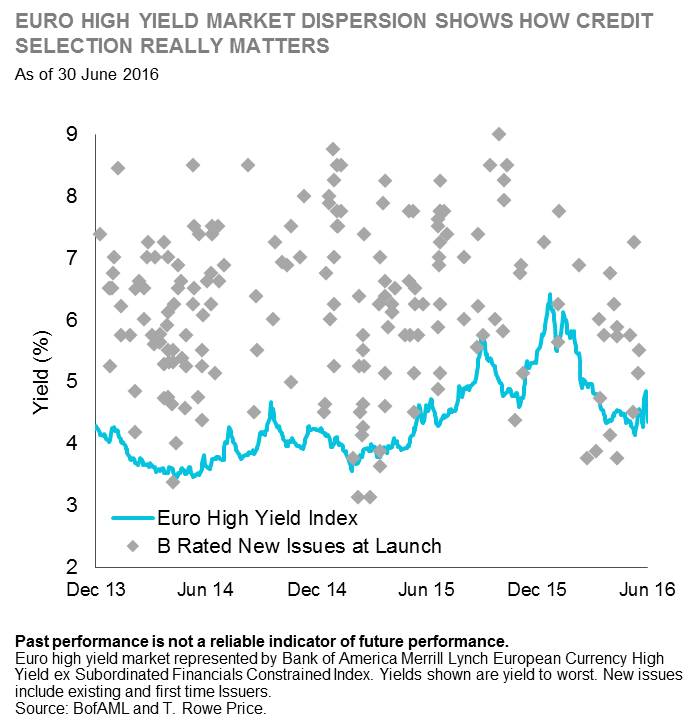
In the single-B space, by contrast, there is a huge dispersion of valuations between names, as shown in the chart. Such a spread of valuations within one credit rating implies inefficiency, and where there is inefficiency, there are opportunities. There are a number of single-B names whose fundamentals are strong and are strong candidates to be upgraded to double-B in the future, but whose valuations remain cheap. Identifying these issuers requires the kind of extensive research and deep fundamental analysis discussed above, but success in doing so can bring significant rewards. Over the past few years, our security selection within the single B space was by far the biggest contributor to relative performance.
We will continue to use the same combination of technical and fundamental analysis, drawing on our global platform and proprietary credit and capital market research, to identify potential investments over the next five years and beyond. The European high yield market is growing rapidly, creating more opportunities. Succeeding in this environment over the long term will require flexibility – no type of opportunity should be discounted simply because it hasn’t been seen before. As the market gets bigger and more complex, the ability to select the strongest individual names will only become more important.
2016-GL-4918
重要資訊
本文件(包括其中所載的任何陳述、資訊、數據和內容)以及與本文件一併提供的任何資料、資訊、圖像、連結、聲音、圖像或視頻(統稱為「資料」)乃由普信提供,並僅作一般資訊用途。本資料並不擬供在禁止或限制分發本資料的司法管轄區和在本資料須按特定要求提供的若干國家之人士使用。本資料不擬派發予任何司法管轄區的散戶投資者。在任何情況下,本資料的全部或部分內容均不得在未經普信同意下複製或再分發或出示予任何人士。本資料並不構成於任何司法管轄區分銷、要約、邀請、建議或徵求發售或購買任何證券。本資料並未經由任何司法管轄區的任何監管機關審閱。本資料並不構成任何投資意見,不得加以依賴。投資者務請在作出任何投資決策前先尋求獨立法律和財務意見(包括有關稅務後果的意見)。
