

E.M. Debt: Three Reasons To Go Local
Investors in emerging market (EM) local currency bonds have faced headwinds in recent years as factors such as US dollar strength, slowing growth in China and commodity price weakness have put pressure on returns. But this year we’ve seen a revival in the emerging debt and currency markets as these pressures have eased. Investors have been returning to the asset class, motivated by the pull factor of stabilising EM fundamentals on one hand, and the push factor of low or negative developed-market interest rates on the other. We believe the time is right to re-engage with EM Local debt.
1. THE ACTIVE OPPORTUNITY IN EMERGING CURRENCIES
The US Federal Reserve’s very gradual path of tightening monetary policy has supported EM currencies. Although a potential Fed rate increase in December would create short-term headwinds for EM currencies, in our view they remain attractive in the longer term. The stabilization of commodity prices throughout the year has also benefited EM currencies relative to developed bond markets.
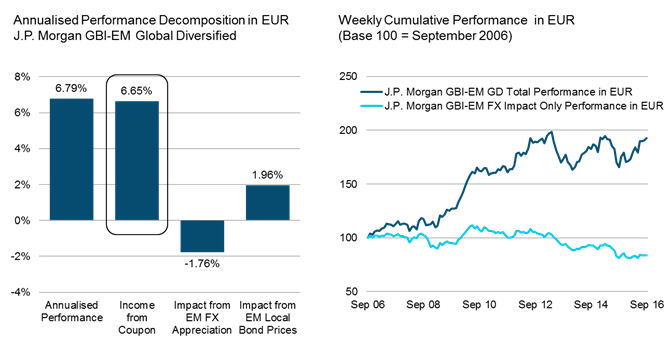
Over the past decade, currency has represented both the biggest risk to EM local bond investors and the biggest opportunity to add value through active currency selection. Figure 1 shows how coupon has been by far the largest driver of broad market performance, while currency exposure has been a detractor. The implication for investors is that, by seeking to reduce risk on one hand and successfully identifying currency opportunities on the other, they can potentially achieve a significantly better information ratio (the risk-return trade-off from active management) than passive currency exposure would afford. The EM currency market is highly fragmented and in many cases under-researched. This creates opportunities to gain an edge through fundamental analysis.
FIGURE 1: EMERGING MARKET LOCAL BOND PERFORMANCE OVER THE PAST DECADE
30 September 2006–30 September 2016
Past performance is not a reliable indicator of future performance. Source: J.P. Morgan Chase & Co.
2. ATTRACTIVE YIELD—WITH LOWER DURATION
From a relative value perspective, yields are more attractive in emerging market local debt than in developed markets, where a growing number of securities are trading with negative yields (Japanese government bonds in maturities up to 10 years are currently trading in negative territory.) Markets such as Mexico, Brazil, India, and Indonesia currently offer some of the most attractive local rates.
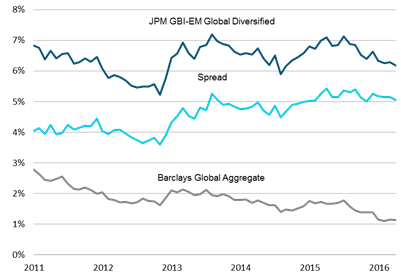
As shown in Figure 2, by the end of September EM local was offering a yield pickup of about 5% over developed markets as measured by the Barclays Global Aggregate. Spreads to developed market bonds have remained relatively stable, and increasingly attractive as core yields fell over recent quarters.
FIGURE 2: EMERGING MARKET LOCAL BOND SPREAD ADVANTAGE OVER DEVELOPED MARKETS
As of 30 September 2016
Source: Barclays, J. P. Morgan Chase
Another aspect to note is that these yields are available with significantly less interest rate exposure than many other fixed income sectors, including developed market sovereign debt. At the end of September, the average duration of the Barclays Global Aggregate was 6.8 years, compared with 5 years for the JPMorgan GBI-EM Global Diversified index.
3. SOUND AND IMPROVING FUNDAMENTALS
EM local debt has historically been an investment-grade asset class. Currently, about 80% of the J. P. Morgan GBI-EM Global Diversified Index is rated BBB and above, with an average overall rating of BBB. We think emerging market fundamentals remain sound, with solid government balance sheets and higher growth profiles relative to developed markets. The growth differential between emerging and developed markets has stabilized, with growth in larger emerging economies such as China, Brazil and Russia steadying in recent quarters. As China continues to rebalance its economy toward domestic services and consumption, the country faces an ongoing structural downward growth trend that poses a risk to growth in Asia as well as in a number of other EM economies. But we anticipate a “soft landing” outcome for the Chinese economy, supported by easy fiscal and monetary policy.
While in recent years developed countries have been pursuing unorthodox policies such as quantitative easing, emerging markets, which have to compete for a finite amount of global capital, have been heeding pressure from market forces to implement more orthodox policies. A number of EM countries are undertaking reforms and making difficult adjustments that should enhance economic growth in the future, and this should be supportive for their investment prospects. Political sentiment in countries such as Indonesia, Argentina and Brazil, for example, has turned around. This has already led to critical structural reforms in these countries, and we expect the trend to continue. Amid market concerns about the long-term growth model of emerging market economies in general, countries that are undertaking structural reforms should benefit in relative terms from investor flows.
IN CONCLUSION…
From a currency perspective, the US dollar rally has now been running for six years and, to us, looks somewhat extended. But even if we continue to see dollar strength, we believe that an active, relative-value driven approach to currency selection can help to manage the inherent risks and add excess returns along the way, helping to generate performance in a higher yielding and diversified asset class.
Whereas many developed bond markets currently offer low yields, high duration and unorthodox economic policies, emerging market sovereigns are offering higher yields, lower duration, and economic policies that have been moving closer in line with “best practice”.
2016-GL-5243
重要資訊
本文件(包括其中所載的任何陳述、資訊、數據和內容)以及與本文件一併提供的任何資料、資訊、圖像、連結、聲音、圖像或視頻(統稱為「資料」)乃由普信提供,並僅作一般資訊用途。本資料並不擬供在禁止或限制分發本資料的司法管轄區和在本資料須按特定要求提供的若干國家之人士使用。本資料不擬派發予任何司法管轄區的散戶投資者。在任何情況下,本資料的全部或部分內容均不得在未經普信同意下複製或再分發或出示予任何人士。本資料並不構成於任何司法管轄區分銷、要約、邀請、建議或徵求發售或購買任何證券。本資料並未經由任何司法管轄區的任何監管機關審閱。本資料並不構成任何投資意見,不得加以依賴。投資者務請在作出任何投資決策前先尋求獨立法律和財務意見(包括有關稅務後果的意見)。
