

Choose your location
United Kingdom
English
Belgium
Denmark
Estonia
Finland
France
Iceland
Ireland
Latvia
Lithuania
Luxembourg
Netherlands
Norway
Portugal
Sweden
United Kingdom

T. ROWE PRICE GLOBAL EQUITIES
Weekly Market Recap
4 May, 2026
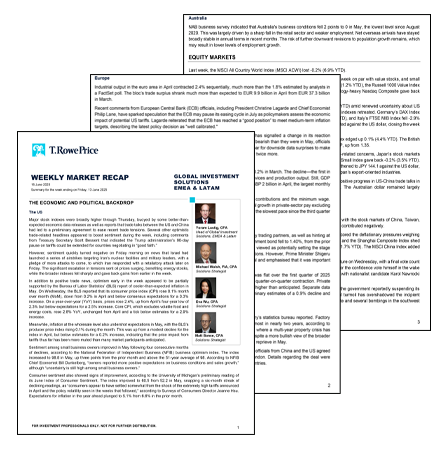
Our Global Investment Solutions team produce a weekly market recap which aims to summarise the previous week’s major events and developments that may impact markets. They try to include points that may aid you in your decision making or conversations with clients. This is supplemented by a market data sheet, offering a summary of financial market performance. Last week’s summary is below.

Economic and political backdrop
The Bank of England (BoE) kept interest rates on hold at 3.75% as expected in an 8-1 vote, with Chief Economist Huw Pill the sole dissenter, favouring a rate increase. In the accompanying statement, the central bank’s Monetary Policy Committee (MPC) noted that prospects for energy prices are “highly uncertain”, that consumer price index inflation has increased to 3.3%, and that it “stands ready to act as necessary.” BoE Governor Andrew Bailey stated he was not giving a "clandestine message" that rates will rise. The decision came as policymakers assessed the economic impact of the war in Iran and soaring oil prices, which briefly approached USD 130 per barrel. Several MPC members signalled they might consider future rate hikes, with the central bank warning that inflation is expected to remain above 3% for the rest of the year.
The Bank cut its growth forecasts, now estimating GDP growth of 0.7-0.8% for 2026 and 0.8-1.0% for 2027, down from previous forecasts of 0.9% and 1.5% respectively.
The Confederation for British Industry’s measure of retail sales fell in April to -68, its lowest level since the series started in 1983.
Political uncertainty emerged when Greater Manchester mayor Andy Burnham predicted this week's local and regional elections would be "challenging" for the governing Labour Party, causing gilt yields to briefly hit session highs.
The Federal Open Market Committee (FOMC) held rates steady, as was widely expected, with a statement that continued to note an easing bias. Three members dissented from the decision to incorporate the easing language, and one dissented in favour of cutting rates. This was the largest number of dissents during Jerome Powell’s time as Federal Reserve chair. Markets interpreted the dissents in favour of removing “easing” from the FOMC statement as a hawkish signal.
While the April FOMC meeting was Powell’s last as Fed chair, at his post-meeting press conference, Powell said that he would remain on the Fed’s Board of Governors for an undetermined time period. While Powell’s term as a central bank governor runs through January 2028, it is unusual for a Fed chair to remain as a governor after their tenure as chair ends. Powell cited political interference, in the form of legal actions against the Fed, as the reason for his decision to remain on the Fed board.
The European Central Bank (ECB) held the deposit rate, its key rate, at 2% at its meeting on Thursday. However, officials acknowledge that the risks to the eurozone’s economy had “intensified” as a result of the conflict in the Middle East and that the governing council had discussed “at length and in depth” a potential interest rate rise.
The Economic Sentiment Indicator fell in April to 93.5, its lowest level since November 2020, according to data released by the European Commission. Consumer confidence was particularly weak, while industrial and construction confidence was more resilient.
Preliminary data indicated that consumer price inflation in Germany hit 2.9% year-over-year (YoY) in April, up from 2.7% in March. This was slightly lower than market expectations of 3%, largely due to a surge in energy prices.
Data released last week showed that the unemployment rate in Spain climbed to 10.83% in the first quarter of 2026, which was markedly higher than expected. More encouragingly, the number of jobless people in the country was lower than in the same period in 2025.
Rating agency Moody’s revised China’s credit outlook to “stable” from “negative” while affirming its A1 rating, citing resilience in growth and fiscal capacity despite domestic and external headwinds. Although it expects the government’s debt burden to increase, the agency believes downside risks are contained as low interest rates and high domestic savings will help limit debt-servicing costs. It also highlighted that China’s large and diversified economy, coupled with increased competitiveness in higher value-added sectors, will offset pressures from an ageing population. China’s Finance Ministry welcomed the agency’s decision and pledged to pursue economic restructuring and strengthen fiscal sustainability.
The Communist Party’s Politburo, the top decision-making body, which sets the broad direction for economic and policy priorities, acknowledged a solid start to the year but flagged that the foundation for the country’s sustained economic recovery needs to be consolidated. It called for continued support for domestic demand, employment, and strategic industries alongside efforts to strengthen the country’s energy security. The Politburo emphasised accelerating the development of a “modern industrial system,” expanding AI adoption, and enhancing technological self-reliance and supply chain control.
Industrial profits in China rose 15.8% YoY in March, supported primarily by equipment and high-tech manufacturing sectors. It was up from the 15.2% increase in the January-February period. In the first quarter, industrial profits rose 15.5% YoY, the fastest pace since 2017. That said, the pickup masked a widening divergence across sectors. It reinforced the strength of China’s production and export-driven recovery, particularly in policy-supported industries such as machinery, power equipment, and advanced manufacturing. Robust demand for AI and electronics drove surging profit growth for companies in sectors such as high-tech manufacturing and intelligence products, while oil and metals producers also fared well. In contrast, businesses in other segments were hurt by rising raw materials costs.
Heightened currency volatility was a key market driver during the week, including a sharp yen rebound widely attributed to suspected official intervention. At the same time, evolving Bank of Japan (BoJ) policy expectations also influenced markets, as the central bank held rates steady but signalled further tightening.
Currency markets came into sharp focus during the week, as the yen, which had been trading near its weakest level in roughly four decades, staged a sharp rally on Thursday, strengthening to JPY 157.0 against the US dollar, from JPY 159.4. Market participants broadly interpreted the abrupt move as indicative of official intervention, with authorities likely buying yen and selling dollars to stem further depreciation. The move followed increasingly explicit rhetoric from Finance Minister Satsuki Katayama, who had signalled that the time to take bold steps was approaching, particularly after the yen breached the 160 level—a threshold widely seen by markets as a trigger for action, and one that preceded intervention episodes in 2024.
At its 27-28 April meeting, the BoJ left its key policy rate unchanged at around 0.75%, in line with expectations, but delivered a hawkish hold. The decision was split 6–3, with three board members calling for a rate hike to 1%, signalling growing momentum toward further policy normalisation.
The BoJ faces a difficult trade-off as a negative supply shock—linked to the conflict in the Middle East—pushes inflation higher while weighing on growth. BoJ Governor Kazuo Ueda noted that confidence in the baseline outlook has declined significantly, while also indicating that the bank may look through supply-driven price pressures, even as the risk of more persistent inflation rises. At the same time, he reiterated that the BoJ will continue to raise rates if its economic and price projections are realised, underscoring that the broader normalisation path remains intact despite heightened uncertainty.
Against this backdrop, the BoJ revised up its fiscal year 2026 inflation forecast to 2.8% (from 1.9% in January) while halving its growth forecast for the same period to 0.5%. The combination of higher inflation forecasts and a more divided policy board points to a growing likelihood that interest rates could move higher in the coming months, depending on how economic conditions evolve. The yield on the 10-year Japanese government bond rose to 2.50%, from 2.43% at the end of the previous week.
Australia's headline consumer price index (CPI) rose sharply to 4.6% YoY in March, a bit below the market consensus of 4.8% YoY. The 33% month-on-month (MoM) fuel price increase drove the entirety of the increase. Trimmed mean CPI rose only 0.3% MoM, 3.3% YoY in the month. Total private-sector credit edged up to 0.7% MoM in March, slightly above expectations. YoY growth accelerated to 8.1%, its fastest pace of growth since late 2022. Growth in Australian capital-city dwelling prices decelerated 20bps to 0.2% MoM in April, the slowest monthly pace of growth since January 2025.
The Bank of Canada projected GDP growth of 1.2% for 2026, 1.6% for 2027, and 1.7% for 2028, with inflation expected to peak near 3% in April, then ease to 2% in 2027. The central bank indicated it may raise interest rates if elevated oil prices—forecast to fall to USD 75 per barrel by mid-2027—continue to fuel inflation, though the impact of the war in Iran on Canadian growth is expected to be small. On the fiscal side, Canada released its budget projections, showing a deficit of CAD 66.9 billion for 2025-26 (down from a previous estimate of CAD 78.3 billion) and CAD 65.3 billion for 2026-27, with the debt-to-GDP ratio expected to rise from 41.5% this year to 41.9% by 2028. Additionally, Canada announced the establishment of a new sovereign wealth fund with a CAD 25 billion endowment.
Markets
Last week, the MSCI All Country World Index (MSCI ACWI) rose 0.8% (7.1% YTD).
The S&P 500 Index finished the week higher by 0.9% (6.0% YTD). The Index returned over 10% in April, its best monthly performance since November 2020. Stocks largely shrugged off a stream of sometimes conflicting headlines about the war in the Middle East and a surprisingly hawkish Federal Reserve policy meeting, posting solid gains in most major indexes.
With more than half of the companies in the S&P 500 reporting quarterly earnings, generally robust results drove the market’s gains. This more than offsets the negative sentiment about the potential drag from higher energy and other commodity prices. Oil prices were volatile, and West Texas Intermediate oil (the US benchmark) finished the week up more than 7%.
Five of the “Magnificent Seven” companies reported earnings, with financial results generally meeting or exceeding expectations for these bellwether firms. Alphabet shares jumped after the Google parent noted that strong demand for its artificial intelligence (AI) and cloud products showed that its heavy investment in AI is starting to pay off. On the other hand, Meta Platforms plummeted after it said it would boost its AI spending even further this year. The company issued USD 25 billion of new corporate bonds on Thursday.
Large-cap growth stocks underperformed their value counterparts, as another increase in oil prices lifted the energy sector, and small caps modestly outperformed large caps. The Russell 1000 Growth Index returned 0.2% (1.6% YTD), the Russell Value Index 1.4% (10.2% YTD) and the Russell 2000 Index 1.0% (13.8% YTD). The technology-heavy Nasdaq Composite put on 1.1% (8.2% YTD).
In Europe, the MSCI Europe ex-UK Index nudged 0.1% up (3.4% YTD). The corporate earnings season continued, with signs of positive earnings momentum. However, the ongoing stalled negotiations between Iran and the US, the ongoing closure of the Strait of Hormuz, and higher oil prices kept sentiment in check. Major stock indices were mixed. Germany’s DAX Index added 0.7% (-0.8% YTD), France’s CAC 40 Index slipped -0.2% (0.3% YTD), and Italy’s FTSE MIB Index rose by 1.2% (8.5% YTD). Switzerland’s SMI decreased by -0.3% (1.6% YTD). The euro was little changed against the US dollar, closing the week at USD 1.17 for EUR. Most European markets, with the exception of the London Stock Exchange, were closed for International Workers’ Day on Friday.
The FTSE 100 Index in the UK edged -0.1% lower (5.6% YTD), while the FTSE 250 Index was also down -0.1% (1.5% YTD). The British pound strengthened against the US dollar, closing the week at USD 1.36 for GBP, up from 1.35.
Japan’s equity markets posted gains over the week. The TOPIX Index added 0.3% (10.5% YTD), and the TOPIX Small Index increased by 0.8% (10.9% YTD).
In Australia, the S&P/ASX 200 Index declined 0.6% (1.7% YTD) as the impact of a war-induced energy supply shock began to show in March inflation figures. Australian government bond yields moved higher, with the curve largely unchanged. The Australian dollar strengthened against the US dollar by 0.7%.
In Canada, the S&P/TSX Composite was little changed (7.7% YTD).
The MSCI Emerging Markets Index lost -0.5% (14.7% YTD). The Chinese, Taiwanese, South Korean and Indian markets contributed positively, while the Brazilian market contributed negatively.
Mainland equities ended the holiday-shortened week broadly stable, with sentiment supported by Moody’s revision of China’s sovereign outlook to “stable” from “negative.” The onshore CSI 300 Index, the main onshore benchmark, gained 0.8% (4.2% YTD), while the Shanghai Composite Index also returned 0.8% (3.8% YTD). Hong Kong's benchmark Hang Seng Index slipped -0.8% (1.0% YTD), reflecting softer offshore risk appetite ahead of the Labour Day holiday. The MSCI China Index, which primarily comprises offshore-listed stocks, lost -1.6% (-5.0% YTD). Mainland markets are closed from 1 May to 5 May for Labour Day and will resume trading on 6 May, while Hong Kong markets are closed from 1 May and resume trading on 4 May.
Elsewhere, the United Arab Emirates (UAE) announced on Tuesday that it was leaving the Organisation of the Petroleum Exporting Countries (OPEC) and OPEC+. The UAE’s decision to leave the group marks a significant break within one of the world’s most influential oil alliances, reflecting a fundamental disagreement over oil strategy. The UAE has increasingly favoured maximising production volumes, based on the view that global oil demand could decline over time as the energy transition progresses. In contrast, Saudi Arabia—OPEC’s de facto leader—has sought to restrict supply to support higher prices, which are critical to its fiscal position. These opposing priorities have strained coordination within the group and ultimately led to the split.
The decision also underscores a broader rift between the UAE and Saudi Arabia that extends beyond oil policy. The UAE has taken a more independent stance in the region, diverging from Saudi Arabia on key geopolitical issues and signalling a shift in regional power dynamics. While oil prices have remained supported in the near term by ongoing geopolitical disruptions, the UAE’s exit raises longer-term questions about OPEC’s ability to coordinate supply effectively, increasing the risk of greater competition and price volatility in global oil markets.
Colombia faced a week of mixed signals for investors, marked by proactive debt management and rising policy uncertainty. The government announced a USD 4.4 billion bond buyback ahead of upcoming elections, a move intended to improve its fiscal position and reduce borrowing costs. On the other hand, uncertainty increased after the high court temporarily suspended a pension reform decree that would have shifted significant private savings into the public system. Because pension funds are key buyers of government bonds, the ruling raised questions about future demand for local debt.
Additionally, the central bank unexpectedly paused interest rate hikes, suggesting growing concern about economic growth even as inflation remains elevated. The move raised concerns among investors about the central bank’s independence, as political pressure—including threats to disrupt the meeting and a potential increase in the minimum wage—appeared to play a role in the decision. Markets reacted cautiously: While the bond buyback initially supported debt prices, bonds and equities remained range-bound as investors weighed political and legal risks.
Last week, the Bloomberg Global Aggregate Index (hedged to USD) returned -0.3% (0.2% YTD), the Bloomberg Global High Yield Index (hedged to USD) ended the week flat (1.5% YTD), and the Bloomberg Emerging Markets Hard Currency Aggregate Index returned -0.1% (0.8% YTD).
Over the week, the 10-year Treasury yield increased by 7bps to 4.37% from 4.30% (up 20bps YTD). The 2-year Treasury yield rose by 10bp, ending the week at 3.88% from 3.78% (up 41bps YTD).
The US investment-grade corporate bond market also generated negative returns, performing slightly worse than Treasuries. The beginning of the week saw heavy new issuance, though most new deals were oversubscribed. High-yield bonds exhibited similar weakness before improving sentiment toward risk at the month-end boosted the high-yield market.
Over the week, the 10-year German Bund yield increased by 5bps, ending at 3.04% from 2.99% (up 18bps YTD). The 10-year UK gilt yield rose by 5bps, ending the week at 4.96% from 4.91 (up 49bps YTD).
Our Weekly Market Recap is designed to keep you updated on the previous week's major events and developments. It includes:
- Concise summaries of key market events and trends
- Insights and analysis from our expert team
- Market perspectives to aid your client conversations
Yoram Lustig, CFA
Head of Multi-Asset Solutions,
EMEA and LATAM

Michael Walsh, FIA, CFA
Solutions Strategist

Eva Wu, CFA
Solutions Strategist

Matt Bance, CFA,
Solutions Strategist

202605 - 5453893
Notes
All data and index returns cited herein are the property of their respective owners, and provided to T. Rowe Price under license via data sources including Bloomberg Finance L.P., FactSet & RIMES, MSCI, FTSE and S&P. All rights reserved. T. Rowe Price seeks to cite data from sources it deems to be accurate, but it cannot guarantee the accuracy of any data cited herein. Neither T. Rowe Price, nor any of its third-party data vendors make any express or implied warranties or representations and shall have no liability whatsoever with respect to any data and index returns contained herein. The data and index returns cited herein may not be further redistributed or used as the basis for other indices, as a benchmark or as the basis for any other financial product.
The specific securities identified and described are for informational purposes only and do not represent recommendations.
CFA® and Chartered Financial Analyst® are registered trademarks owned by CFA Institute.
Important Information
The specific securities identified and described are for informational purposes only and do not represent recommendations.
This material is being furnished for general informational and/or marketing purposes only. The material does not constitute or undertake to give advice of any nature, including fiduciary investment advice, nor is it intended to serve as the primary basis for an investment decision. Prospective investors are recommended to seek independent legal, financial and tax advice before making any investment decision. T. Rowe Price group of companies including T. Rowe Price Associates, Inc. and/or its affiliates receive revenue from T. Rowe Price investment products and services. Past performance is not a guarantee or a reliable indicator of future results. The value of an investment and any income from it can go down as well as up. Investors may get back less than the amount invested.
The material does not constitute a distribution, an offer, an invitation, a personal or general recommendation or solicitation to sell or buy any securities in any jurisdiction or to conduct any particular investment activity. The material has not been reviewed by any regulatory authority in any jurisdiction.Information and opinions presented have been obtained or derived from sources believed to be reliable and current; however, we cannot guarantee the sources’ accuracy or completeness. There is no guarantee that any forecasts made will come to pass. The views contained herein are as of the date written and are subject to change without notice; these views may differ from those of other T. Rowe Price group companies and/or associates. Under no circumstances should the material, in whole or in part, be copied or redistributed without consent from T. Rowe Price.The material is not intended for use by persons in jurisdictions which prohibit or restrict the distribution of the material and in certain countries the material is provided upon specific request. It is not intended for distribution to retail investors in any jurisdiction.
Information and opinions presented have been obtained or derived from sources believed to be reliable and current; however, we cannot guarantee the sources’ accuracy or completeness. There is no guarantee that any forecasts made will come to pass. The views contained herein are as of the date written and are subject to change without notice; these views may differ from those of other T. Rowe Price group companies and/or associates. Under no circumstances should the material, in whole or in part, be copied or redistributed without consent from T. Rowe Price.
The material is not intended for use by persons in jurisdictions which prohibit or restrict the distribution of the material and in certain countries the material is provided upon specific request. It is not intended for distribution to retail investors in any jurisdiction.