

Corporate Earnings – A New Hope?
Eight years into the second longest bull market in history, macroeconomic complexity is high and it’s hard to argue against the view that macro and political events are dominating markets in 2016. However, while top-down uncertainty will remain part of the near-term investing environment, it’s important to take a step back and remember that over the long term, stock returns are driven by starting valuations, changes in earnings power and long-term cash flow generation. Regardless of any twists and turns on the macro front (and there will be more), we believe these fundamental pillars will ultimately hold through the next stage of the current equity cycle and that given today’s starting point, the outlook remains a reasonable one for equity investors.
On the earnings front, we have said for some time that it is crucial to believe a degree of improvement lies ahead. Figure 1 gives a sense of why; recent trends in corporate profits have been poor and this earnings recession has dragged on much longer than expected, fuelled over the past year by the collapse of oil, materials and industrial profits. A key question now is whether this summer’s ‘stop getting worse’ earnings trend has the stamina to ‘start getting better’ as we head into 2017. We believe the probability of this scenario is rising, albeit the backdrop remains very uneven and the selectivity aspect remains important.
Figure 1: Regional Profits (EPS in USD) since last cycle peak (October 2007)
As at 30 September 2016
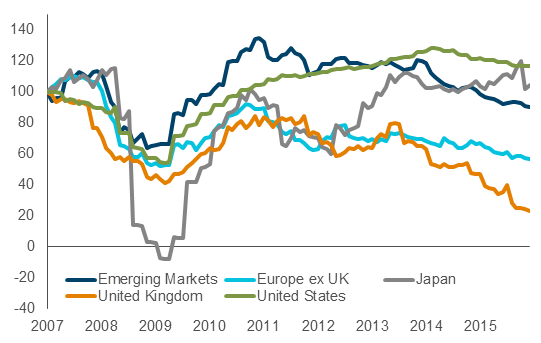
Source: FactSet Economics
One helpful if unexpected trend when we look at corporate earnings has been the pattern of rising oil prices since February which has lifted both investor and business sentiment from a distinct trough. Alongside the year-over-year boost to earnings that any stabilisation of the sector may bring, the deflationary impact of oil’s collapse should begin to ease as we move into 2017. Focusing on the US, a temporary lift in inflation driven by a rally in oil and commodity prices will not raise interest rates by itself. However, when put alongside a domestic wage cycle which continues to strengthen, a continuation of the pick-up in inflation will provide Fed doves with much harder questions to answer. In other words, we could finally be on the verge of a modest US Fed interest rate hike cycle, albeit this opinion has a strong sense of déjà vu about it looking back over the past twelve months.
On this point, predicting the path of US interest rates has become somewhat of an obsession in markets. Who would have thought a decade or two ago that such a constant and microscopic analysis of the Fed’s every word would be normal? While it’s hard to have a defined edge versus consensus, we would advocate the importance of being aware of the direction of corporate profitability and how growth is impacting the interest rate environment.
The following chart (Figure 2) speaks to this point. For several years, the equity cycle has been defined by falling rates as a function of global QE and an improvement in global corporate earnings, led by the US. This is the top left quadrant and has been a very fertile backdrop for global equity returns. Backed by cheap starting valuations, this has driven annual returns of over 11% p.a. for the MSCI All Country World Index over the five years ending 30 September 20161. Not bad given five years ago the headlines were centred on the death of equities and the lost decade for equity investors!
Figure 2: Corporate Profits and Interest Rates – Where Next?
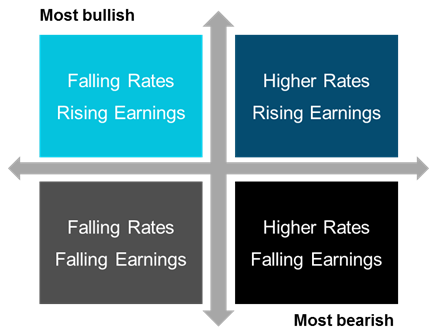
However, the regime has shifted and this is important to recognise. Volatility in the past year has centred on headline macro concerns as investors have largely ignored fundamentals, but the scarcity of growth in the past 12-18 months can be summarised by the regime described in the lower left hand quadrant. More QE as a response to anaemic economic growth, falling interest rates and an earnings recession thrown in for good measure; this is clearly a scenario that cannot be good for equity returns over the long term. Therefore, the regime we see develop from here seems central to the battle between market bulls and bears today.
At the two extremes, the battle being played out in markets in 2016 has centred on whether interest rates begin to rise as economies heal and inflation and profits growth trends up. This is the top right scenario which could very well encapsulate the US outlook for 2017. In contrast, bearish voices in early 2016 focused on rates rising for the ‘wrong reason’ as concerns abounded that economic weakness would turn into a crisis originating from oil prices, China or the European banking system. This scenario is shown in the bottom right hand quadrant and would undoubtedly create a pullback of some magnitude for equity markets as equity market fundamentals deteriorate.
While we thought these macro concerns were valid points of debate and analysis in early 2016, they did not merit the magnitude of the equity market pull back in the opening weeks of the year. Today, we still do not see crisis as the most likely outlook for markets, with our view remaining one of slow and steady improvement for the global economy. Set against valuations, which we believe remain reasonable in isolation and versus other alternatives, this is a solid starting point from an equity return outlook perspective.
While there will be bumps in the road, it could be very meaningful for market sentiment and market leadership if we see a transition to an improved earnings and growth backdrop, even if mild. If we do see a transition, as per this summer just past, it will likely pay to be optimistic, or not overloaded with defensive stocks at a minimum. One thing we can say with certainty is that if we see a positive transition, it will pay to be invested in advance. Part of this stems from the reality that it is not a crowded space to be an optimist these days.
1 Source: MSCI
GCC76567
MSCI makes no express or implied warranties or representations and shall have no liability whatsoever with respect to any MSCI data contained herein. The MSCI data may not be further redistributed or used as a basis for other indices or any securities or financial products. This report is not approved, reviewed or produced by MSCI.
重要資訊
本文件(包括其中所載的任何陳述、資訊、數據和內容)以及與本文件一併提供的任何資料、資訊、圖像、連結、聲音、圖像或視頻(統稱為「資料」)乃由普信提供,並僅作一般資訊用途。本資料並不擬供在禁止或限制分發本資料的司法管轄區和在本資料須按特定要求提供的若干國家之人士使用。本資料不擬派發予任何司法管轄區的散戶投資者。在任何情況下,本資料的全部或部分內容均不得在未經普信同意下複製或再分發或出示予任何人士。本資料並不構成於任何司法管轄區分銷、要約、邀請、建議或徵求發售或購買任何證券。本資料並未經由任何司法管轄區的任何監管機關審閱。本資料並不構成任何投資意見,不得加以依賴。投資者務請在作出任何投資決策前先尋求獨立法律和財務意見(包括有關稅務後果的意見)。

