

China's Rising Debt - When Does A Bubble Become Trouble?
Executive Summary
China’s spiraling level of debt is an increasing source of concern. The investment-intensive growth model that has driven spectacular economic gains in China in past decades is no longer working, yet authorities continue to increase debt and investment in pursuit of evermore difficult growth targets.
The combination of rising debt and slowing growth has pushed China’s debt-to-GDP ratio to unprecedented levels. With capital efficiency declining, many believe that China may be facing a full-blown debt crisis.
However, while China’s high debt is concerning, we do not subscribe to the view that a crisis is imminent. Importantly, liquidity risk remains low in our view, with the government ready and able to step in, if required, to ensure that liquidity is maintained.
While efforts to reduce China’s growing debt have been made in recent years, the overriding priority for authorities has been to deliver targeted economic growth. As such, they have been relatively content to allow debt to accumulate in pursuit of this aim. However, there are various measures that authorities can implement to put growth on a more sustainable path and, in turn, work through problem loan issues.
Global markets are growing increasingly nervous about China’s spiraling level of debt. Over the past decade, China’s investment-driven growth has become increasingly credit funded, and the double-digit results have been quite spectacular. However, in recent years, this formula seems to have stopped working. Despite rapidly rising credit growth in China, the economy continues to stagnate. With cracks in the system beginning to appear, could China be looking over the edge of a potential debt crisis?
DEBT RATIO HAS RISEN TO UNPRECEDENTED LEVELS
The scale and pace of China’s debt buildup in recent years has been breathtaking as authorities have looked to engineer a debt-fueled stimulus to offset weak global export demand. However, the hoped-for turnaround has failed to eventuate and, with China’s debt-to-gross domestic product (GDP) ratio rising to unprecedented levels, some are speculating that a full-blown credit crisis is all but unavoidable.
Although we agree that China’s high level of debt needs to be addressed, and some tough decisions taken, we do not subscribe to the view that a crisis is imminent. While authorities have generally been content to let debt accumulate in the pursuit of growth, if necessary, they have various measures that can be implemented to ensure that a debt crisis is avoided.
Exactly how China got to this point is largely attributable to two factors. First, in the wake of the global financial crisis in 2008, the government turned on the stimulus taps in order to support growth and, at the same time, ordered banks to lend aggressively. However, once the immediate threat had passed, the taps were never turned off with credit growth essentially rising continuously ever since. The second is the deceleration of the Chinese economy. GDP growth in China is decelerating as the economy becomes more mature and returns on past investments decline. The government’s response to this has been to throw more and more money at the problem, with limited results. The combination of these two factors has seen China’s debt-to-GDP ratio balloon to almost 250%,1 raising fears of an impending crisis.
Figure 1: The rise and rise of China’s debt
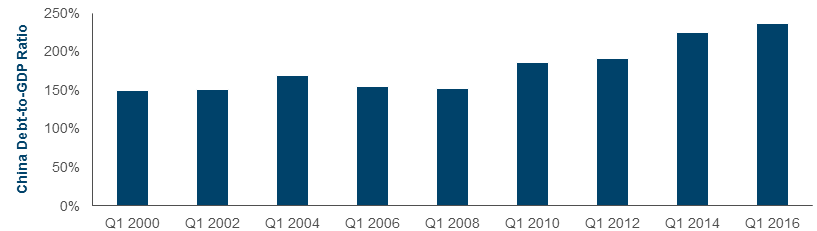
Sources: Bank of International Settlements, PBOC, and IMF, as of March 31, 2016.
LIQUIDITY RISK APPEARS LOW
It must be remembered that China’s economy is not like most others. China has huge foreign currency reserves, a strong balance of payments position, and a low level of external debt. China also boasts one of the world’s highest savings rates. The fact that China is still a relatively closed system, with administrative barriers limiting the free outflow of capital, is also significant. As long as a degree of control over capital outflows is maintained, policymakers will have the flexibility to bail out companies and individuals where necessary, thereby preventing a potential run on the system. If you consider what has triggered financial crises in the past, it has most often come down to issues of liquidity, not solvency. If the central bank can ensure ongoing liquidity, then the risk of a financial crisis is modest in our view.
HOWEVER, CAPITAL EFFICIENCY IS FALLING
In analyzing China’s debt, it is clear that the real area of concern is the corporate sector, where ever-rising leverage is coupled with a declining capacity to pay. Nonfinancial corporates have seen a sharp rise in leverage in recent years, particularly within industries plagued by excess capacity, such as construction and property development, and in the commodity and energy sectors. As leverage continues to rise, these companies are borrowing more just to cover their debt obligations, some of the worst offenders being large state-owned enterprises, many of which are unproductive or failing. The result is a vicious economic circle, with increasing amounts of capital being allocated to the most inefficient borrowers, which inevitably leads to lower productivity and growth. Consequently, despite credit expanding at a rapid rate, its contribution to new growth-generative investment is diminishing. Capital efficiency in China is clearly declining, and if there is any prospect of this situation being reversed, the government cannot continue to shore up these struggling enterprises. Clearly, reform of some kind is necessary, be it consolidation, mergers, or allowing them to fail.
TACKLING THE DEBT PROBLEM
1. Recapitalizing China’s banks
2. Securitizing loans/debt-to-equity swaps
3. Evergreening loans
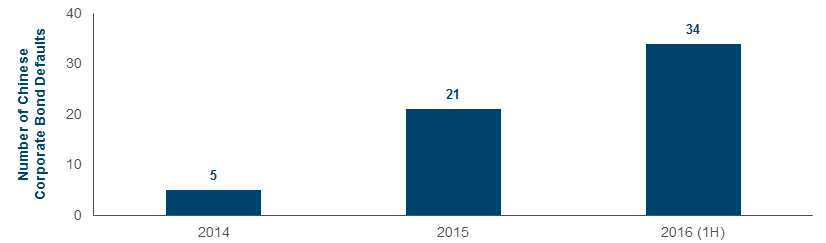
Chinese authorities have so far shown little inclination to make the hard decisions that will lead to tangible improvement in China’s debt situation. What we continue to see are measures that, instead of dealing with the problem, simply push it down the road. A prime example of this is the practice of “evergreening” loans. Rather than cutting off lending to troubled companies or penalizing them for defaults, banks are instead being directed to extend these problem loans, or provide new ones, in order to support the companies in question. Increasingly, we are seeing instances of companies defaulting on payments and nothing happens, with the owed interest and capital possibly being paid at some point in the future. This evergreening of loans once again allows unprofitable companies to remain afloat, which keeps excess capacity high and contributes to falling prices. The practice also impacts the profitability of China’s banks and is a contributing factor in the rise in banks’ nonperforming loans seen in recent years.
ISSUES OF TRANSPARENCY
While signs of stress in China’s system are evident, the opaque nature of official data makes it very difficult to assess just how serious the problems might be. Manipulation and misrepresentation by authorities is an ongoing problem and makes any official data unreliable. The China Banking Regulatory Commission, for example, recently announced that the ratio of nonperforming loans within China’s commercial banking sector rose to 1.81% in the second quarter of 2016. Despite this being the highest level since the global financial crisis, it is still widely regarded as significantly understating the actual level of nonperforming loans in China, with some observers placing the true figure as high as 20%.
CHINA’S SHADOW BANKING SYSTEM—MIRACLE OR MENACE?
At least some of the potential discrepancy between official and actual nonperforming loan data, for example, can be attributed to the increasing amount of lending being carried out on China’s shadow banking system, much of which is simply not captured in official data. The shadow banking system—an intermediary network actively lending under the official radar—emerged in direct response to companies and individuals looking for more informal and flexible financing options, outside of official channels. The system flourished, in part, because the traditional banks also saw benefits in evading capital requirements and charging higher fees. The authorities initially took a tolerant view, seeing it as a form of financial innovation and a means of broadening China’s financial system. However, over time the investment structures have become increasingly complex and opaque, with growing instances of bad loans and increasing levels of risk.
Claims that the shadow banking network is a serious structural threat to China’s financial system seem extreme. While concerns about transparency and regulation are valid, nonbank financing offers an additional source of credit to individuals and businesses in an environment where formal banking is either expensive or absent. Prior to the development of shadow banking, China’s financial system was dominated by a handful of large state-owned banks supported by a network of provincial banks. These banks were discouraged from lending to certain industries and mandated to offer frustratingly low interest rates on deposits. The initial function of the shadow banking sector in China was to provide investors with an alternative to the banks for deposits. In this way, it is important to distinguish between the type of shadow banking that genuinely represents a broadening of financial alternatives (money market-like funds, the development of a corporate bond market, private lending) and that which is designed to deliberately evade regulations—either to hide bad loans or engage in aggressively speculative activity.
重要資訊
本文件(包括其中所載的任何陳述、資訊、數據和內容)以及與本文件一併提供的任何資料、資訊、圖像、連結、聲音、圖像或視頻(統稱為「資料」)乃由普信提供,並僅作一般資訊用途。本資料並不擬供在禁止或限制分發本資料的司法管轄區和在本資料須按特定要求提供的若干國家之人士使用。本資料不擬派發予任何司法管轄區的散戶投資者。在任何情況下,本資料的全部或部分內容均不得在未經普信同意下複製或再分發或出示予任何人士。本資料並不構成於任何司法管轄區分銷、要約、邀請、建議或徵求發售或購買任何證券。本資料並未經由任何司法管轄區的任何監管機關審閱。本資料並不構成任何投資意見,不得加以依賴。投資者務請在作出任何投資決策前先尋求獨立法律和財務意見(包括有關稅務後果的意見)。


