

Post-Brexit Opportunities in Central and Eastern Europe
The UK’s decision to leave the European Union (EU) looks likely to have a significant impact on financial markets worldwide. This has been widely discussed over the past few months, but so far, most of the focus has been on the UK’s future relationship with its major developed-country partners. Less attention has been given to how Brexit will affect Central and Eastern European (CEE) countries—yet the impact here, too, is potentially significant.
Central and Eastern European countries’ direct exposure to the UK takes three main forms: money transfers home from CEE nationals living in the UK, exports from CEE countries to the UK, and the UK’s contribution to EU structural funds going into CEE countries. The effect of Brexit on remittances to CEE countries will be determined by any future trading agreement between the UK and EU, which will also cover the movement of labour. However, the impact here is likely to be small as these payments only compose a small portion of the gross domestic product (GDP) of CEE countries.
The impact on trade between the UK and CEE countries will also depend on the nature of the future trading arrangements between the UK and EU. But while overall trade levels may well be reduced, it is difficult to predict by how much until such arrangements are in place. The Czech Republic, whose exports to the UK account for 4.3% of GDP, stands to be the most affected, followed by Hungary (2.9%) and Poland (2.7%).1
Where we can be much more certain about Brexit’s impact is on EU structural funds to CEE countries. The UK is the third-largest net contributor to the EU, responsible for about 12% of the bloc’s overall budget. When the UK stops paying into the pot, the EU’s budget will fall from €135 billion to €117.5 billion, having a major impact on a number of CEE countries that rely heavily on EU funding for infrastructure projects. In Poland, for example, we estimate that EU funding will decline by almost 13%, from 3.5% of GDP currently to 3.1%. Other countries that will be heavily affected are Hungary (from 5.6% of GDP to 4.9%) and Lithuania (4.4% to 3.9%).
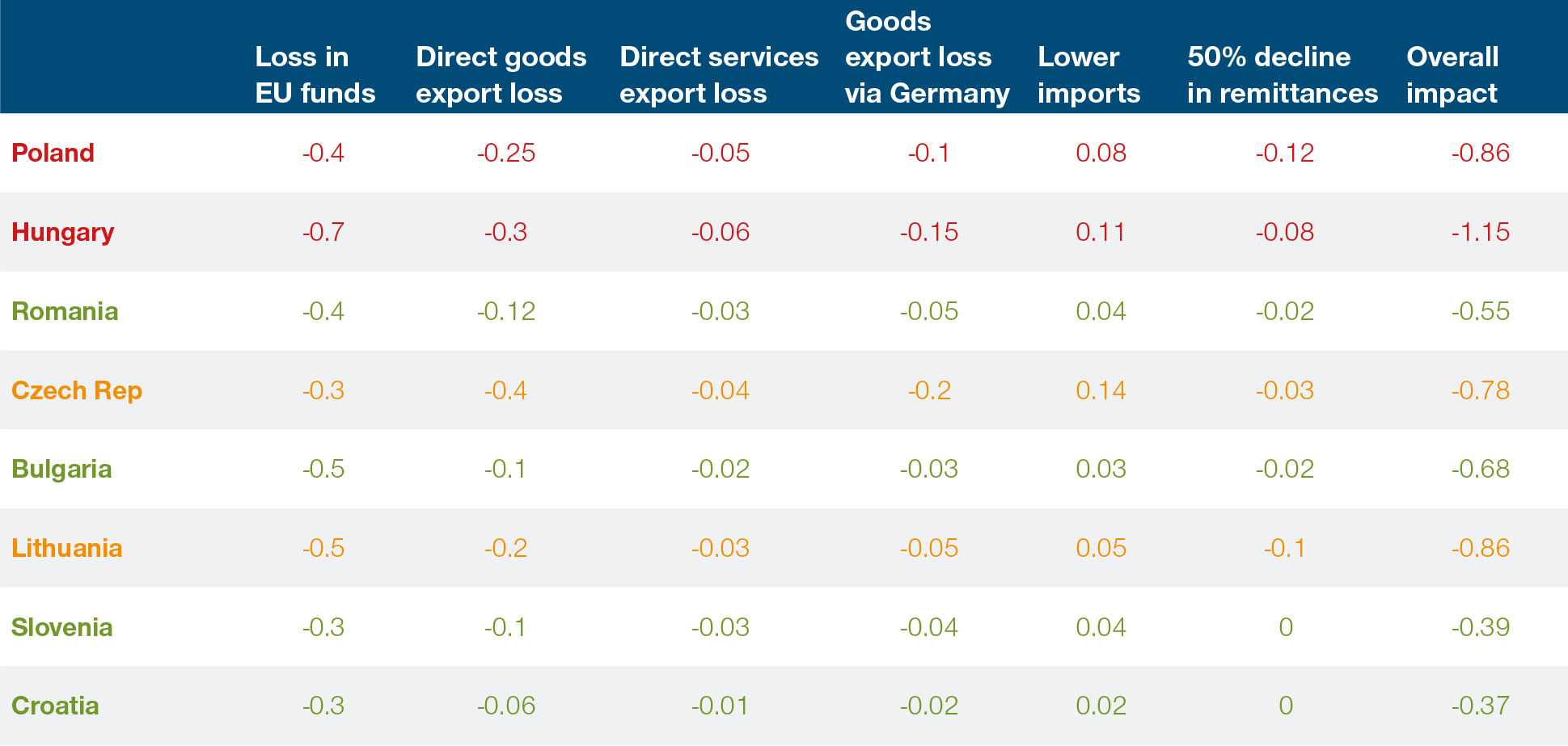
When these factors are added together with the effect of reduced supply chain exports to countries such as Germany, it becomes clear that the UK’s exit from the EU will have a significant impact on growth levels in Poland, Hungary, the Czech Republic, and Lithuania, as shown in the table below. Lower potential growth could lead to fiscal expansion, lower interest rates, and weaker currencies as the governments of these countries seek to rebalance their economies to offset the impact of export losses.
The prospect of lower rates in certain CEE countries when the UK leaves the EU makes the local currency bonds of these countries potentially attractive investment opportunities. In other words, investors can benefit from locking in attractive yields today, with additional potential for capital gains if yields fall in the future.
In short: when appropriately currency hedged, local bonds in countries such as Poland, Hungary, Romania, and Serbia are likely to offer strong long-term return opportunities.
Potential Impact of Brexit on Central and Eastern European Countries’ Growth
(Percent of GDP)
Source: T. Rowe Price
1Source: FactSet
2016-GL-4861
重要資訊
本文件(包括其中所載的任何陳述、資訊、數據和內容)以及與本文件一併提供的任何資料、資訊、圖像、連結、聲音、圖像或視頻(統稱為「資料」)乃由普信提供,並僅作一般資訊用途。本資料並不擬供在禁止或限制分發本資料的司法管轄區和在本資料須按特定要求提供的若干國家之人士使用。本資料不擬派發予任何司法管轄區的散戶投資者。在任何情況下,本資料的全部或部分內容均不得在未經普信同意下複製或再分發或出示予任何人士。本資料並不構成於任何司法管轄區分銷、要約、邀請、建議或徵求發售或購買任何證券。本資料並未經由任何司法管轄區的任何監管機關審閱。本資料並不構成任何投資意見,不得加以依賴。投資者務請在作出任何投資決策前先尋求獨立法律和財務意見(包括有關稅務後果的意見)。

