

Growth is Dead! Long Live Growth!
EXECUTIVE SUMMARY
- Despite all the talk of living in a low-growth economic environment, growth today is more important than ever. The equity markets offer many attractive growth companies to build “quality growth” portfolios. The age of income sourced from Australian equities with no valuation discipline looks to have exhausted itself. High yield equity investments are unlikely to re-rate further and provide high returns as they have been in the recent past.
- For the past 30 years we have been in a bull market for fixed income, with interest rates by and large declining across most developed markets. We are now entering a new phase that many investors have not seen before—rising rates! The world is changing at a rapid pace with growing areas of the economy creating new investment opportunities for equity investors. Aged care and IVF are two recent examples.
- Income through equity dividends will continue to remain an important feature of the Australian equity market. We are not suggesting that this will cease. However, to blindly invest into these companies without an eye on growth opportunities and valuation can be fraught with danger.
WHY IS GROWTH IMPORTANT?
Growth is important because, in economic terms, it is vital to generate the income required to fund our health care, education, defense or welfare systems. Economic growth is also synonymous with employment growth and, therefore, the wages people need to meet their individual needs and wants. Without economic growth, societies typically wither on the vine, decline and can eventually go into recessions.
Similarly, growth is also vital to investing. It can enable us to meet our individual financial objectives. This is particularly important now that the financial burden of retirement resides with individual investors and managed funds, following the move to defined contribution (DC) schemes over the past 25 years.
The key objective for many individuals is to accumulate sufficient capital to fund a comfortable lifestyle in retirement. A key consideration here is the ability to maintain or grow real purchasing power after considering the effects of inflation. It is clear that the biggest risk for individuals is not having sufficient funds or purchasing power in retirement.
So how can we give ourselves the best chance to be successful in meeting this key objective? The key is having a healthy “growth” allocation in an investment portfolio. It is clearly very important to consider many factors when building client portfolios, particularly risk exposure and time to retirement, but growth should be a fundamental component.
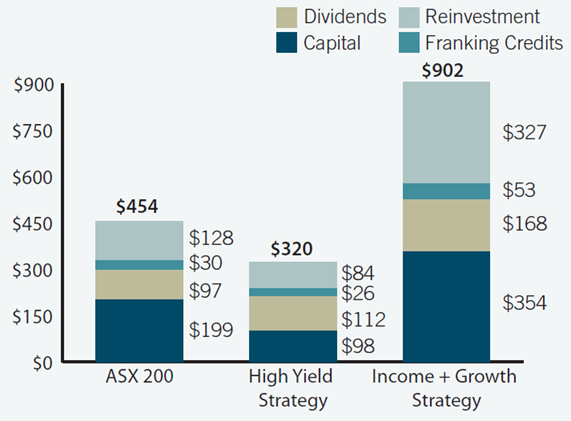
Growth in equity investing typically refers to companies which can grow their earnings at a faster rate than the overall market rate of earnings growth. Such portfolios can not only outperform equity markets over time but also help avoid the risk of insufficient funds in retirement. Without a decent exposure to growth assets or “quality growth” companies, we are unlikely to achieve the lifestyles we desire. The chart below illustrates the benefits of a portfolio strategy which can generate “income and growth” compared with typical yield-oriented strategies or the broader market.
Figure 1: Decomposition of strategy returns from Jan 2000 to June 2014 on a $100 initial investment
Data to 30 June 2014
Sources: FactSet. I/B/E/S. Goldman Sachs Global Investment Research Past performance cannot guarantee future results.
It is important to put into perspective the recent fascination with income or yield strategies. The strong performance of such strategies in the “new normal” environment has almost all been due to re-rating rather than income generation. This one-off re-rating of yield has been driven by the significant compression of global bond yields, which we believe has largely run its course. The problem going forward is that the companies favored for income typically generate little if any earnings growth and, therefore, will most likely see dividends stagnate. The risks associated with this approach were apparent amongst listed infrastructure and REIT’s in the years leading up to the global financial crisis. This ultimately resulted in a recapitalisation of these sectors and considerable losses for shareholders.
CHARACTERISTICS OF “QUALITY GROWTH” COMPANIES
If growth is the key to meeting financial objectives, what are its defining features? As previously mentioned, growth companies are typically defined by their ability to sustainably grow earnings above the market average. To achieve that, key factors include:
- A structural demand profile for the product or service, often with little dependence on the cyclical swings in the economy. Health care, for example, serves an aging population with higher medical bills, particularly in the later stages of life.
- A capital investment profile relative to the income opportunity, which results in high rates of return on this capital. This is also usually associated with good market structure and/or other unique features which limit the level of competitive activity. For example, the high barriers to entry and economies of scale of a pallet pooling business such as Chep, which is owned by Brambles. Frequently, these businesses also have some degree of pricing power. Higher rates of earnings growth is usually the outcome of such “quality” businesses and the industries in which they operate.
AUSTRALIAN “QUALITY GROWTH” STOCKS
Quality growth stocks can typically be found in areas where there is good ongoing and often increasing demand for the product or service. These companies might also offer a unique product or service in niche parts of the market. These areas of structural growth are not overly abundant, but neither are they extremely scarce.
In the Australian market such companies can be found among online businesses, health care and education. Companies with unique products or services include: Brambles (market leader in the provision pallet pooling solutions for FMCG’s), James Hardie (superior fibre cement cladding product for the US market) and Veda (leading provider of credit reporting data and software solutions). It is important to note that these growth sectors tend to see more companies being listed on stock exchanges over time, creating even more attractive investment opportunities. Two recent examples are the listings of aged care and IVF companies.
Aged care is expected to be a growth industry in coming years due to the growing shortage of accommodation for chronically ill patients. Additionally, the industry is very fragmented and is expected to consolidate, much like the hospital industry in Australia. Australia is the world leader in IVF with key industry players expected to leverage this technology advantage globally with a particular focus on emerging markets. Two years ago neither industry sector was represented on listed markets. Today we have a growing pool of such companies with more expected to be listed over the next few years.
“QUALITY GROWTH” PERFORMANCE
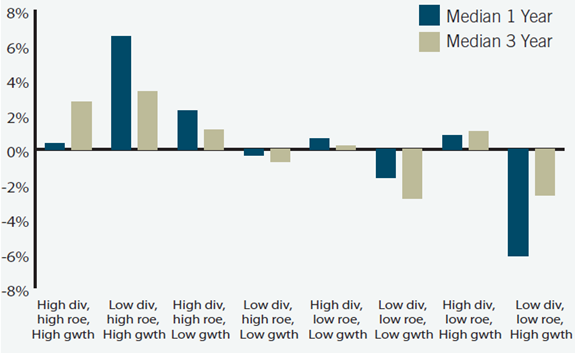
Over the long term a portfolio of quality growth companies has outperformed the broader Australian market. However, we also know that over short-term periods the performance of different investment strategies can vary significantly. One example is the recent strong performance of yield-oriented and low-volatility strategies. With this in mind, it is important to consider when we would expect “quality growth” strategies to perform well or poorly.
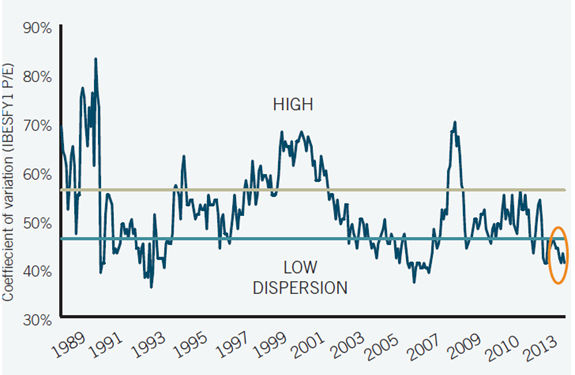
One approach is to view the market through the lens of P/E dispersion. Given the differing earnings growth rates and returns on capital of companies across the market, we should expect companies to trade at differing valuations or P/E’s, reflecting these characteristics. When these differentials are wide, quality growth investing should be performing well as a strategy. Conversely, when these differentials or dispersion is low, quality growth investing is probably not performing well. In these environments there is no proper pricing for growth and returns and value strategies should be outperforming.
The chart below shows valuation dispersion in the Australian market over time as measured by the difference between high and low P/E multiples. As can be seen, valuation dispersion in the market has been steadily declining in 2014 and has recently reached multi-year lows—not an ideal environment for quality growth investing. The chart also shows that these moments of extreme contraction of valuation dispersion are generally fleeting in nature.
Figure 3: Periods of low valuation dispersion in the Australian market
Source: Source: Credit Suisse, IBES Largest 300 Australian stocks by market cap, 0 < IBES FY1 P/E < 50
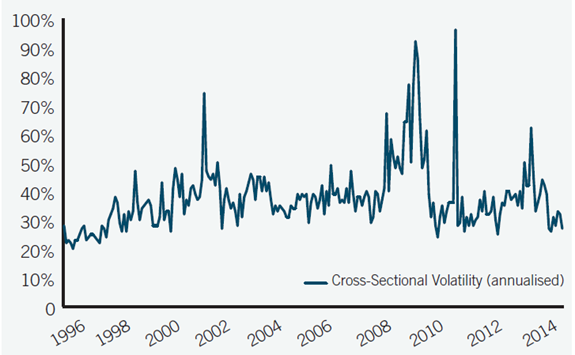
The other key aspect to consider in assessing the environments and how different strategies may be expected to perform is the level of cross-sectional volatility (a measure of the dispersion of investment returns over a certain period of time—e.g., monthly using daily returns). We know that active managers typically perform better during periods of higher cross-sectional volatility because this environment is conducive to stock picking, as managers take advantage of large mispricing of companies in the opportunity set. I would argue that these environments are also conducive for quality growth strategies because the market also better reflects differences in fundamental growth rates and returns. As you can see from the chart below, cross-sectional volatility has recently fallen to multiyear lows and is likely to rise going forward.
More recently, we have seen equity market volatility pick up considerably to more normal levels, largely due to concerns about the withdrawal of QE (quantitative easing) by the US Federal Reserve and an expectation of higher interest rates going forward. This has led to a change of leadership in the market as investors reposition themselves for the new environment.
Figure 4: Cross-Sectional Volatility (annualised)
Source: UBS
As of 30 Sept 2014
CONCLUSION
To meet our long-term financial objectives, we need to invest in growth. Portfolios of “quality growth” companies offer the best opportunity for capital appreciation and income to meet our retirement needs. The outperformance of yield strategies is unlikely to be sustained. Whilst “quality growth strategies” may have struggled in the short term due to a significant fall in valuation dispersion, this is likely to change and provides a buying opportunity.
We expect the quality growth opportunity set to continue to increase over time and provide investors with more opportunities to build attractive quality growth portfolios. We believe this will further enhance the positive risk and return dynamics of the strategy to the benefit of investors.
2014-GL-942
重要資訊
本文件(包括其中所載的任何陳述、資訊、數據和內容)以及與本文件一併提供的任何資料、資訊、圖像、連結、聲音、圖像或視頻(統稱為「資料」)乃由普信提供,並僅作一般資訊用途。本資料並不擬供在禁止或限制分發本資料的司法管轄區和在本資料須按特定要求提供的若干國家之人士使用。本資料不擬派發予任何司法管轄區的散戶投資者。在任何情況下,本資料的全部或部分內容均不得在未經普信同意下複製或再分發或出示予任何人士。本資料並不構成於任何司法管轄區分銷、要約、邀請、建議或徵求發售或購買任何證券。本資料並未經由任何司法管轄區的任何監管機關審閱。本資料並不構成任何投資意見,不得加以依賴。投資者務請在作出任何投資決策前先尋求獨立法律和財務意見(包括有關稅務後果的意見)。
