

Choose your location
Canada
English
Belgium
Denmark
Estonia
Finland
France
Iceland
Ireland
Latvia
Lithuania
Luxembourg
Netherlands
Norway
Portugal
Sweden
United Kingdom
 On the Horizon
The Long View: Interview with Darren Woods, Chairman and CEO of ExxonMobil Corporation
Overview
In these special episodes of “The Angle,” Eric Veiel, head of Global Investments and chief investment officer at T. Rowe Price Associates, welcomes CEOs and industry leaders to share their personal stories, leadership strategies, and lessons learned from running successful companies. Listen as we pull back the curtain on what it truly takes to lead a company in today’s fast-paced and ever-changing business landscape.
In this episode of “The Angle,” Darren Woods, chairman and chief executive officer of ExxonMobil, discusses the future for the energy industry, how we can better achieve net-zero targets, and his views on what makes a good CEO.
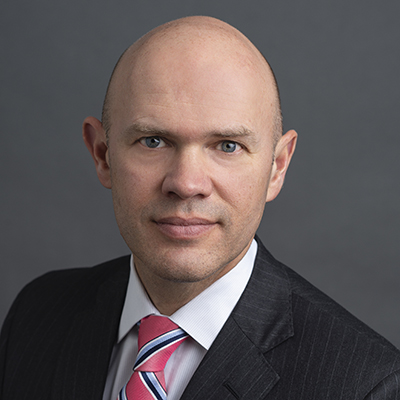
Eric L. Veiel, CFA® (Host)
Head of Global Investments and CIO
View Transcript
The Long View: Interview with Darren Woods, Chairman and CEO
of ExxonMobil
Disclaimer
This podcast is for general information purposes only and is not advice. Outside of the United States, this episode is intended for investment professionals use only. Not for further distribution. Please listen to the end for complete information.
Cold OPEN: “…Even as you project out to 2050, and even if you take very aggressive assumptions about a transition or an evolution where you move more, you know, more electrification and moving more nuclear. The timescale to make the change and the size of what needs to change means that you're going to continue to need oil and gas. And it will probably be providing, you know, still around 50% of the world's energy mix, even out in
2050…”
Eric Veiel
Welcome back to “The Angle from T. Rowe Price”, a podcast for curious investors. I'm Eric Veiel, head of global investments and chief investment officer here at T. Rowe Price Associates. In this episode, I'm excited to welcome Darren Woods, chairman and chief executive officer of ExxonMobil, one of the world's largest publicly traded energy providers and chemical manufacturers. Darren's time with ExxonMobil spans over three decades. He became CEO in January of 2017 and his commitment to balancing economic growth with environmental stewardship has been a hallmark of his tenure.
Welcome to Baltimore, Darren. Thank you for being on The Angle.
Darren Woods
That's great to be here. Thanks for inviting me. Looking forward to it.
Eric Veiel
ExxonMobil is one of these companies, and I think everybody thinks they know and understand. Right? Oh, it's really big. You've got 60,000 employees, 350 billion in revenue. I know what ExxonMobil is. One of the things that I think people don't recognize is 100 million barrels per day produced in the world. You guys are, what, 4%?
Darren Woods
That's right. Yeah. Exactly.
Eric Veiel
So what do you think are the biggest misconceptions about ExxonMobil?
Darren Woods
Well, I think for a long time we've let external publications define who we are, or at least talk about who we are. We've been, more recently, really trying to make sure that we're telling our own story, being faithful to who we are. The first job I had with the company, my supervisor said, let me give you some advice. And this was like day two or something. He said, if you're ever doing in this company, if you're ever doing something, you'd be embarrassed for your mother to read about on the front page of the paper, stop doing it. The other thing he said to me was, if you, you you said you got to get up every morning, look yourself in the mirror, make sure you like what you see. Okay, they’re very simple things, but they've stuck with me for 33 years and, you know, this philosophy that we have as a company and one that I've grown up with for the last 33 years, is do the right thing in the right way. And so that for all of my career, there's not been a decision that I've made that. There have been hard ones, for sure, but one that I haven't felt like was the right decision for the company, for the best interest of our shareholders, our employees, the communities that we've been operating in.
And so, I think that is if there was anything that summarized what we try to do as a company is the right thing in the right way. We hold ourselves to a very high standard. Integrity is a really important value for us. Intellectual integrity is an important value for us. Courage is one of our values. We believe, you know, you have to be. You have to stick, stick to what you believe is right and be willing to fight for it, and take the blows that come with that.
Resilience is another one of our values. You know, this industry and the jobs that we have to do, the challenges that we face, will not be easy. You will get knocked down. No shame in being knocked down.
There's a lot of shame in not getting back up again. And so, fight your way back up and just keep after it. I think that's who we are as a company. That's why I joined 33 years ago. I never thought I'd be here this long on. I can still remember when I, the HR manager was talking my first joined the company. He was talking about our long-term benefits and all this. And I'm remember, I can still remember telling her, you know, you're talking like we just got married. As far as far as I'm concerned, this is a date, and I really felt like that for I don't know how long. I don't know when I realized I was actually married, but for a long time I thought we were dating, but it just worked out that, I'd found and I guess my life mate with respect to the company, it's been a great kind of great ride.
Eric Veiel
Let's talk a little bit about the industry. You know, I had a Jensen Huang, the CEO of NVIDA, on, last month, and we were talking about AI, and he mentioned, and we talked a lot about the fact that the biggest limiter right now in AI is actually power. Power generation. And that almost what seems insatiable demand from that one area, of the, of the market for, for energy. You guys put out a really interesting report, the 2050 Global Outlook piece. There was a stat in there that I was fascinated by, which was basically I, I won’t misquote it I hope – even if every new car sold in the world in 2035 were electric, 2050 would still need 85 million barrels per day, based on your, on your estimates. So given all of that, how are you all investing today to meet these growing needs, and then at best, flat, but likely growing needs.
Darren Woods
You know, it's a constant challenge. And what often gets overlooked, primarily because it's people who aren't in the industry and dealing with the daily challenge, you know, don't have a perspective on it. And frankly, the industry's done such a good job that they don't have to worry about it is we're in a depletion business. So every barrel you produce is a barrel less available. It's it's not like general manufacturing where you build a facility and facilities there for the next 200 years, and you just got to keep putting feedstock through it. In this case, you got to keep finding, you know, a replacement. So it's a little bit like having a bottle of water and you drinking the water out of it. Eventually the bottle goes empty and you better have another bottle sitting around somewhere for the next drink. So that's the big challenge.
With the unconventional shale play that's come into the energy mix and the crude supply and gas supply, for that matter, that has a much faster decline rate. And it's gotten to be such a large part of the global energy supply that it's actually changed the decline rate, the depletion rate of the global crude supply. So today, if no other investments were going into the industry to produce more crude, we estimate that the decline rate is 15 million barrels a day. And so, if you know, people talk about stop investing, leaving it in the ground, the world would very quickly run out of crude oil with that kind of; give me 100 million barrels a day. You're losing 15 million barrels a day. Doesn't take you long as you drop off every year, 15% decline, that you you quickly run out of resource. If you start making incremental investments. So no new exploration and, but just start to offset some of the decline by some of the things you can do on the periphery of what's already operate. And you can you can slow that down to about 4%, but it's still a significant decline rate.
So it is a huge challenge for the industry to not only, support growth, but just to offset the depletion. And so everyone in the industry, including ourselves, are constantly looking for the next barrel, for squeezing more out of what you what we have, finding new technologies to become more productive. It is a, it is a nonstop challenge. And so we've always from the very beginning, and we were doing a lot of this in the 2018, 2019, timeframe, getting a lot of criticism for it because at that time there was a view that you should stop because the energy transition was coming and these investments weren't going to, you know, we're going to get stranded. We never believed that because of this depletion dynamic and worked very hard to invest and bring those barrels on. And I'm glad we did because we now have that resource to take advantage of. But it is a huge; there's a technology play that we're spending a lot of time investing in to make sure that we're finding ways to better extract, more effectively find, more effectively squeeze the resources out of what we do find, so that we keep filling that hole. But it is a significant challenge.
Eric Veiel
So one of the, you know, major projects that you guys have is in Guyana, and our analyst Priyal was out there. And the images that I've seen, the description that she gives is an amazing amount of just material and a huge; the scope of that is huge. If we think 20 years into the future, do you envision the industry starting projects like that new, or do you think we've moved to, to a different technology or a different way of powering our world?
Darren Woods
No, I think, I think you're going to continue to need, you know, oil and gas. Even as you project out to 2050, and even if you take very aggressive assumptions about a transition or an evolution where you move more, you know, more electrification and moving more nuclear, the timescale to make the change, and the size of what needs to change means that you're going to continue to need oil and gas. And it will probably be providing, you know, still around 50% of the world's energy mix, even out in 2050, even with aggressive assumptions about that, just because the system is so large that to change it. And if you go back in time, there's been no energy transition that's happened quickly.
The bigger challenge, even with that, the size and the time it's going to take is the affordability issue. And I think it's easy for many of us and, you know, very developed nations, very prosperous nations to talk about making a change and paying for that. You know, there are 4 billion people around the planet that are living in absolute energy poverty that I think, desperately, strive for and frankly deserve a much higher standard of living, which will require more energy.
There are economies around the world that have, the need to to grow and the potential to significantly grow. That's going to require more energy. And so, we can look at some of the more developed nations who can start to make progress and pay for that. But there's a whole chunk of the world, and it's a big one that still very early on that curve, and they're going to need to come up and they're going to need affordable, reliable energy, and today we don't have good options other than the system that we have.
That, I'm still optimistic, though, because we do believe strongly that the world needs to find ways to reduce emissions. You know, one of my, concerns, or complaints has been that we've lost sight of the objective statement. That through the debate, and I think a lot of the ideology that's been out there for many years is, it’s turn the need to reduce emissions into the need to reduce oil and gas. I don't think oil and gas will ever go away because it's a critical component to chemical products, and chemical products that we make and others make form the foundation of modern living today. I don't think people realize that how much hydrogen and carbon molecules go into day-to-day life and the appliances, the tools, the clothing and just about everything that they use.
Eric Veiel
The technology.
Darren Woods
Everything. It's, you know, it's buried in that and it's it's an inherent part of that, and so it's going to be for around for a long, long time. But we've got to focus on is less combustion of hydrogen and carbon molecules. And when we do have to combust and find ways to deal with the emissions. I think if we get a more, sophisticated or better objective statement and get focus back on the real objective. Let's deal with the emissions, we can make a lot faster progress at a lot lower cost.
Eric Veiel
One of the things that I've always appreciated, about you, Darren, is, you tell it like it is and you've been very clear, climate change is real. You’ve acknowledged it many times, but you've also said we need pragmatic solutions, which is sort of what you're referring to here. In your mind, what are the foundations of those pragmatic solutions that will help us in, obviously capture is probably part of it, but I'm curious.
Darren Woods
No, I think. You know, the the, I think if I go back in
time, probably the biggest mistake, I’ll say society made is we jumped to an
answer, a solution set, that I think was defined by, frankly, a very narrow set
of ideologues who did not have any practical experience. And, certainly the
energy system, let alone probably manufacturing or, you know, running and
making products that society needs, and so. And for a long time, I think the
mistake we made was we criticized a lot of the policies that were coming out
and the approach without offering a thoughtful alternative. One of the things
that we challenge ourselves with; okay, we don't like, we think what's
happening and some of the approaches are flawed. What would we do? If at the
end of the day, they gave us the keys and said, you guys figure this out, what
would be your approach?
And so we challenge ourselves to think through what would we
recommend, based on what we know. I'm not, so, naive to think that I can figure
out a solution for the whole. But we do understand our industry and the sector
that we operate, and so for our sector, what do we think would be a, a
reasonable solution that's consistent with macroeconomic policies? It doesn't
impede economic growth. It doesn't, impinge people's lifestyle or standard of
living. And, what we started with is, first and foremost, we need a carbon
accounting system. The thing that blows me away is that we have, and the world
talks about getting to net zero and eliminating all the carbon emissions, but
we have no system for accounting for carbon emissions. And so I wonder, how do
you eliminate something that you're not accounting for? I don't know of any
example that anyone can point to.
Eric Veiel
You manage what you measure. And if you can't measure it,
you can't manage it. That's a pretty basic principle.
Darren Woods
Absolutely. And I think even measuring can be hard, but at
least you should account for it so that at the end of the day, you have a
system that when you add it all up, it's equal to the total emissions of the
planet. So now I can begin to characterize where are the emissions coming from
in my society and the products. So that's job one. And the point I make with, a
number of constituencies I talked to, whether you think you need that right now
or not, I think ultimately everyone can agree that if you're ever going to get
down to zero, you're going to have to have it at some state. So let's start
working on it now, because I think if you had a carbon accounting system, we
could start to move down the emissions reduction path much quicker.
Because the second step is once you know how to, you know,
properly account for them, and you’ve agree that around the planet. You can
calculate the carbon intensity of every product and service, services society
uses. Once you can, calculate the carbon intensity of a product, you can put a
spec on it. And so our our approach would be let's go do carbon accounting.
Let's start calculating carbon intensity. And I don't you know, again that's a
hard problem to solve, but we can make some simplifying assumptions. The
important thing is we do it in a consistent way that reflects some level of
realism and reality and then put a carbon intensity specification. All the
government needs to do is specify the carbon intensity, and then get out of the
way, and let industry figure out how to meet that carbon intensity
specification.
And that then starts to bring in the market forces as a
producer. And I would offer up do it for gasoline, do it for diesel. So take
the transportation pool in the U.S., put a carbon intensity specification on
it, and then let us figure out how we meet that carbon intensity specification.
That will drive me to find ways to do it at a lower and lower cost to get a
competitive advantage. If I find that, that advantage accrues to me because the
marginal supplier with the highest cost will set the price in the marketplace.
That gives me an advantage, it incentivizes me to invest in technology. It gets
the government out of picking winners and losers. It gets the government out of
collecting revenues and redistributing them and paying subsidies.
And then you pick the, the, core products that are driving
most of the emissions. You don't have to do it economy wide, but you could, you
know, 20% of it's causing 80% of the problem. Go focus on those 20% and work
like crazy on those. And then, you know, if you want to, if you're in the camp
that will transition to something brand new. I'm okay with that as well. It
gives us the time to do that and then and then natural, time horizon its going
to take. And so I think we've done the math on that. You could decarbonize.
Think about decarbonizing the transportation system today and all of the cars
and trucks that are out there today. You can incrementally reduce the carbon at
a small amount of carbon emissions from all that, across such a large volume,
that the cost would be small, the volume impact would be big, and the time
scale to achieve it much, much faster than EVs. And so we could start to affect
real emissions reductions at a much lower cost, much faster.
Eric Veiel
So at the start of that, the accounting that we need, is
that something that comes from the industry, from the government, needs to be
globally?
Darren Woods
Right, I think that needs to be a broad. In fact, I've been
having conversations, talked to a group at the World Economic Forum there
other. We've got a coalition that we're talking about forming that you need a
cross-industry group. I don't think it's our industry that does that. I don't
think it's our company that does that. We can contribute, can bring some
thinking. But I think you need a much, you know, academics need to be involved,
the right kind of academics, some governments. But ultimately, you know, it's
like calories on food. Somehow the world figured out how to calculate calories
consistently all around the planet. And we kind of stick to that. There's,
there is a mechanism, and we've got accounting standards today. And financial
accounting is very different than the kind of accounting that I'm talking
about, but the fact that the world has arrived at standards and approaches that
everyone conforms with, demonstrates to me that this can happen. We just got to
put the right body together, go make that work.
Eric Veiel
Carbon capture is an area you guys have invested a lot in
over time, but I think you've been pretty clear that it's really not
economically feasible in a lot of ways in its current form. Is there is there a
path where that becomes some part of the solution or a bigger part of the
solution?
Darren Woods
So, you know, our approach in that space, you know, for a
long time, a lot of pressure the company came under to invest in wind and solar
because this idea that you're an energy company and therefore, as an energy
company and one that's, where the world's worried about emissions, you should
move to electrons. And the point I kept making is we don't know anything about
wind and solar. We're a molecule company. We're not an electron company. So
let's focus on, how we can address the societal need, which is emissions
reductions, using our capabilities in molecules. That's I'd say the, the simple
formula that we landed on. And it sounds rather simplistic, and I think
somewhat intuitive is do the things you know how to do.
So in the molecule space, what can we do? What makes sense?
Carbon capture and storage is a very good fit with our core capabilities.
Biofuels is another area. We've got refineries all around the world. We can
process biofeeds and produce fuels, have lower emissions profiles. So another
area and then we're looking at low carbon hydrogen. So those were the areas
that we felt like lend themselves to our molecule technology and where we could
bring something to bear.
So our view is carbon capture is going to be needed. It's
going to be, a competitive technology. We're doing a lot of work on the
technology, bring the cost down because we have to do that. But typically when
you don't need it and you don't have to bring costs down, you won't. So that's
the work that I think has to happen. I'm not sure when, when that will take off
or if society will ever, commit, truly commit to the ambition of reducing the
emissions. But, when they do, and we think they should, we're going to be in a
position to, to, help provide that.
And, actually, with respect to your AI question, and Jensen,
we now have because of those investments that we've made the opportunity to
offer low carbon data centers. And in the time frame that many of the tech
companies are talking about needing that low carbon data centers, we’re
uniquely positioned to provide that.
Eric Veiel
Let's pivot a little bit to your personal journey as a
leader. You know, you started off as you said, you know, thinking you were
dating. And here you're, you're, well, married to, to, ExxonMobil at this
point. Began as an electrical engineer. How do you think that training in that
background sort of formed your decision-making strategies and, and led you to,
to be CEO?
Darren Woods
Well, when I was an undergraduate, I wanted to be a Ph.D. I
wanted to go into electromagnetic field. I wanted to do R&D. And, my senior
year in college, I did a, some research that, I guess for lack of a better
term, burned me out on that whole whole idea. And so I decided to go work for a
little while, with the intention of going back to school. And, I got out and
got a job as a technical consultant, advising the Air Force on a missile
system. And it became, very clear to me early on that you could be the best
engineer in the world, but if you didn't know how to make money or to get
funding that you couldn't fund the ideas. And it wasn't, you know, you only I
can only advanced stuff that you could afford to advance. And so, I felt like I
didn't have a good understanding of how to make money or the whole financial
world or business. And so, after three years working as this technical advisor,
I went back and got an MBA.
And so I think, you know, my foundation as an engineer, you
know, that helped me throughout my career because we deal with a lot of
engineering problems. And while I can, I think, honestly say I've never done a
day's work of electrical engineering, the principles that you'll learn and how
you think about engineering and the problem-solving skills, and how do you take
these large, ambiguous problems and break them down into pieces that you can
think about and solve – the logical approach associated with doing that, that's
all been, absolutely critical, throughout my career and even today, continue to
use those core foundations of how you think about solving engineering problems.
And then, of course, I do not discount the education I got
within my company, within ExxonMobil. I'm very proud of the fact that we bring
in people early in their careers, usually right out of school, and we invest a
lot of time to develop them. And, I spend today and throughout my career, I've
always had - everyone who joins the company and supervises or manages somebody.
You're told your job is to develop the next CEO. You don't know who is going to
be, but that's your job. Find the next CEO, develop people to their full
potential. And so from the very early days in my career, always looking at how
do you help get help people reach their full potential.
Your potential can change with time and your performance. It
can go up because you've you hit a growth spurt, spurt, so to speak, or you got
into a groove. You began. And so we've seen people just surprise us and do
things that we didn't anticipate. We've seen other people reach a level where
they, that what's required to advance the next wasn't something that they
wanted to invest in. And so that was a potential. So it's a it's a very dynamic
thing, but I would say less transparent in the past than we are today, and
still not as transparent as I hope we'll get to as we develop.
Eric Veiel
Learning from mistakes is an important part of being a good
investor and having sort of the intellectual honesty to critique what you got
wrong. Own it, and then try to move on from it. What's a mistake you've made
and a lesson you've learned from it through some point in your career, Darren.
Darren Woods
You know, it's a funny thing. I, talk, so we are very, like
our company. We're very critical of ourselves. And so we're constantly looking
for where we could have done better. We do a lot of after-action things, and I
think most people who grew up in the company will tell you, we tend to focus on
what we could do better, rather than what we did well. Again, that's something
that we want to try to strike a little better balance on.
I think, you know, the probably one of the, the very early,
mistakes that I made in my career that really shaped me for a long time to
come. I was very early, in a refinery. I was working in a plant. I had a
supervisor who recognized I came in as an MBA, so didn't have the same
development through operations that many of our young engineers that come in
get to start at a plant, work their way up, and then get into more management
jobs. I kind of came in at management levels and didn't have the benefit of the
experience of being in a plant and being in operations.
I had a supervisor, when I was over in the UK that said, you
need that experience, and so dropped me into one of those roles, which, was a
step down from a hierarchical standpoint, but really critical development step
that I needed. In that role, we had some unit issues that I thought I
understood what we needed to do, and the more experienced manufacturer around
me thought there was a different approach that we needed to take. And so, I
didn't necessarily agree with it, but I deferred to their experience and
judgment. And then in hindsight, turned out I was right and they were wrong.
But we only learned that by doing it their way and then had to go back, and at
the time it probably cost us several millions of dollars with lost throughput
and what have you. And for me, I can still remember that whatever that number
was, it's in the scheme of what I think about today, it's a very small number,
but at the time it seemed enormous and it, it bothered me. I for I can't, I
can't tell you how long at that ate at me that. The regret that you knew what
the right thing to do was in and you were too afraid to stand up and fight for
it.
I said, I don't want to experience this ever again. And so
from that point forward, I I've lived up to that commitment. And I've always
made sure that everybody understands my point of view, whether you agree with
it or not. And I try to make as a compelling argument as possible. I think that
has. Most people that have worked with me through my career, I think they would
recognize that, that how I behaved since then. But it was it came from a very
hard lesson that I taught myself. And I just I just didn't want to feel that
way ever again. And it's served me well so far.
Eric Veiel
It's really interesting. One of the mistakes we see young
analysts make is they try to anticipate what they think the portfolio manager
wants the answer to be on the stock, as opposed to having their own conviction
and then staying with it, even if their research has led them a certain, a
certain place. It's very similar to what you experience. They're having, you
know, strong views. We like to say strong views held lightly. Right. So have
those strong views but be willing to think about new information that might
change them.
Darren Woods
Yeah. We talk about courage of conviction. You've got to
have courage of conviction. And so we need to be convinced of something
obviously, but then have the courage to represent it.
Eric Veiel
So, what do you want your legacy to be at ExxonMobil? You're
far away from having to, like, put that in stone, but it's important to think
about those things before you get to the end.
Darren Woods
You know, I, I really, I don't think of a legacy maybe, in
the way others do. I mean, I, I came to this job in an unusual way. I never
aspired to it. It wasn't something that. I wasn’t ambitious in that respect.
You know, my my love of the company and the career I've had with this company
is just getting lots of hard problems to solve and being recognized for that
and giving me another, another hard, hard problem to solve. I get to travel all
around the world. I had some great experiences and so I've always enjoyed. And
so I hadn't I didn't come to this job with this ambition to have it. I came to
the job and when I took it was, if you need me to, I will.
And so I would just say my ambition is to basically realize
the full potential of this company. I came into the job with a, the weight of
the, what I would say is the legacy that I inherited, the, you know, the 100
plus years of, of, you know, employees and leaders and, you know, this company
that that I was now responsible for. I just felt a huge, sense of
responsibility to deliver and to make the best out of the thing that was given
to me to be responsible for and to leave something better for the next person.
I think, you know, every job ever have the company you are,
you go into with the mindset of how do I make this better for the person who's
going to take it from me. And I would say, I've taken this, this job with that
same mindset, how do I make this better for the person who comes in behind me.
It will always be an opportunity to make it better. So my view is, you know
this and I've never criticized the things left for me to pick up in jobs I've
inherited over the years because I've, I don't know what they started with. And
everybody starts with something. And your job is to make it better and leave it
for the next person to carry on. So, I think that's, you know, my, I really
want to leave a company a better place. I want to leave a company that the people
who work for it are proud.
Eric Veiel
These are obviously stressful times and stressful role. What
do you do to try to ease some of that, that stress when you're not in the
office? Any go to ways to unwind?
Darren Woods
I,I, I like to get away, and, solitude and family. So, I
have, I'm lucky enough to, we have some property in the hill country of Texas,
which we can escape to on some long weekends. And it's, out in the middle of
nowhere and very few people, and a lot of nature very, very pretty place. And
so, the family often congregates there and just quiet time alone. We've got a
place on a lake up north that we get to on occasion and spend there. It's
really around getting out of the flow, quiet time, it’s really around nature
and family. It's kind of what I like to do. And, yeah.
Eric Veiel
Turn your phone off when you're out there.
Darren Woods
The phone always stays on. I think, you know, most people
don't want to call me. I’ve generally found, but I'm always available. But I
think, I think we all respect the fact that every one of the employees that we
have, all our folks work really hard. And, you know, we recognize that when
you're off work, I certainly feel this way. I try not to send emails, you know,
significantly out of hours. I try not to send emails over the week. I just
don't want to have people feel like they need to be responding on the instant.
So we, we, I try to be very respectful of other people's time. Often times the
job doesn't allow that, but I am conscious of that, and I think everybody else
is conscious. They don't. You know, if there's something that can wait to talk
about or email or what have you, the people will wait until after the weekend.
I think that's a good practice. And then the things that do come in, you give
it your attention.
Eric Veiel
Well, speaking of being respectful of time, I've already
taken more of yours than than I said I would. So, let's end it there. But, you
know, Darren, thank you so much. This has been great. Really interesting
conversation. Really appreciate you spending the time with us.
Darren Woods
Thank you. Thanks for the time. Enjoyed it.
Eric Veiel
Absolutely. Thanks.
Eric Veiel
Again. I'm Eric Veiel. Thank you for listening to The Angle. We look forward to your company on future episodes. You can find more information about this and other topics on our website. Please rate and subscribe wherever you get your podcasts. The Angle. Better questions, better insights. Only from T. Rowe Price.
This podcast is copyright 2025 by T. Rowe Price.
ID0008169
202506 - 4485660
Further Listening
The Long View: Interview with Jensen Huang, Founder and CEO of Nvidia Corporation
In this episode, Eric is joined by Nvidia Founder and CEO, Jensen Huang, as he talks about the advancements coming in artificial intelligence, the importance of being more energy efficient, and AI’s potential to boost economic growth.

The Long View: Interview with Meredith Kopit Levien, President and CEO of the New York Times Company
In this episode, Eric chats with New York Times Company President and CEO, Meredith Kopit Levien, about leadership, the transformation of the newspaper industry, and the need to be a digital first business.

The Long View: Interview with H. Lawrence Culp, Jr., Chairman and CEO of General Electric Aerospace
Join host Eric Veiel in these special editions of ''The Angle'' as we welcome CEOs and Industry leaders to share their personal stories, leadership strategies and lessons learned from running successful companies.

The Angle from T. Rowe Price
The Angle podcast brings you sharp insights on the forces shaping financial markets. With dynamic perspectives from the T. Rowe Price global investing team and special guests, curious investors can gain an information edge on today’s evolving market themes. The Angle - only from T. Rowe Price.
Better Questions. Better Insights.

Subscribe to never miss an episode
With a new episode available every week, subscribe on your favourite podcast service and be the first to be notified!
Disclaimers
Important Information
This podcast is for general information purposes only and is not advice. Outside the United States, this episode is intended for investment professional use only. Please listen to the end for complete information.
This podcast episode was recorded in December 2024 and is for general information and educational purposes only. Outside the United States, it is for investment professional use only. It is not intended for use by persons in jurisdictions which prohibit or restrict distribution of the material herein.
The podcast does not give advice or recommendations of any nature; or constitute an offer or solicitation to sell or buy any security in any jurisdiction. Prospective investors should seek independent legal, financial, and tax advice before making any investment decision. Past performance is not a reliable indicator of future performance. All investments are subject to risk, including the possible loss of principal.
Discussions relating to specific securities are informational only, are not recommendations, and may or may not have been held in any T. Rowe Price portfolio. There should be no assumption that the securities were or will be profitable. T. Rowe Price is not affiliated with any company discussed. Some T. Rowe Price portfolios are invested in New York Times Company.
The views contained are those of the speakers as of the date of the recording and are subject to change without notice. These views may differ from those of other T. Rowe Price associates and/or affiliates. Information is from sources deemed reliable but not guaranteed.
Distribution Information
EEA—Unless indicated otherwise this material is issued and approved by T. Rowe Price (Luxembourg) Management S.à r.l. 35 Boulevard du Prince Henri L-1724 Luxembourg which is authorised and regulated by the Luxembourg Commission de Surveillance du Secteur Financier. For Professional Clients only.
Switzerland—Issued in Switzerland by T. Rowe Price (Switzerland) GmbH, Talstrasse 65, 6th Floor, 8001 Zurich, Switzerland. For Qualified Investors only.
UK—This material is issued and approved by T. Rowe Price International Ltd, Warwick Court, 5 Paternoster Square, London EC4M 7DX which is authorised and regulated by the UK Financial Conduct Authority. For Professional Clients only.
All Spotify trademarks, service marks, trade names, logos, domain names, and any other features of the Spotify brand are the sole property of Spotify or its licensors.
CFA® and Chartered Financial Analyst® are registered trademarks owned by CFA Institute
202506-4613227