

Choose your location
Sweden
English
Austria
Belgium
Denmark
Estonia
Finland
France
Iceland
Ireland
Italy
Latvia
Lithuania
Luxembourg
Netherlands
Norway
Portugal
Spain
Sweden
Switzerland
United Kingdom
 12 October 2026
Weekly Market Recap
Our Global Investment Solutions team summarise the week's key market events and developments — with insights to support your client conversations and decision-making.
Key resources
Weekly Market article


Weekly Market data

Economic and political backdrop
The UK
The UK Composite PMI declined to 52.0 in September, down from 52.5 in August. This was marginally weaker than expected. The data showed activity remained in expansionary territory, but growth slowed.
The Lloyds House Price Index showed that UK house prices were stagnant both MoM and year-over-year (YoY) in September. This followed a 0.3% monthly decline in August.
The US
Oil prices were volatile throughout the week as investors weighed Middle East developments and the energy supply outlook. Crude prices moved lower midweek following news that the International Energy Agency would accelerate a planned release of oil reserves. However, prices rallied Thursday sharply amid reports of further attacks on tankers in the Strait of Hormuz and speculation that the US was considering additional military strikes against Iran. Brent crude briefly topped USD 105 per barrel on Thursday before retreating somewhat after President Donald Trump said the US would not attack Iran ahead of November’s midterm elections, though reports of additional attacks on Friday kept volatility high.
Minutes from the Federal Reserve’s September policy meeting—where officials unanimously voted to raise interest rates by 25bps—showed that most policymakers anticipated another rate increase by year-end amid persistent inflation pressures. However, the minutes provided little clarity on the timing of the next increase, noting that “decisions at future meetings would depend on incoming information.” Fed Governor Christopher Waller echoed this sentiment on Thursday, saying that he expected the Fed to continue raising interest rates to combat inflation but that “there is some flexibility about when those hikes will occur.”
Economic data released during the week also highlighted continued inflation pressures. The Institute for Supply Management reported that its services Purchasing Managers’ Index (PMI) remained in expansion territory in September, coming in at 54.9 versus 55.4 in August. However, the survey’s prices index climbed 1.4 points to 74.0, its highest level since July 2022.
Separately, the New York Fed’s Survey of Consumer Expectations showed that year-ahead inflation expectations rose to 3.9% in September, the highest since May 2023. Meanwhile, the University of Michigan’s preliminary October Index of Consumer Sentiment reading dropped to a five-month low of 46.3, while year-ahead inflation expectations edged up to 4.7%.
Europe
Minutes from the European Central Bank (ECB) September meeting indicated that policymakers believed inflation risks were skewed to the upside when they raised interest rates for the first time since 2023. The minutes acknowledged that “inflation was set to remain well above target for an extended period” and that “the full inflationary impact of the energy shock had yet to play out.” The central bank also noted that it was “neither suggesting that the current decision was another step in a predetermined tightening cycle nor that it was the last rate hike.”
Germany’s exports fell 0.8% month on month (MoM) in August. This was below the 0.5% drop recorded the previous month and the 0.6% increase expected. Germany’s factory orders fell sharply in August, tumbling 10.6% MoM. In contrast, industrial production climbed 2.0% MoM in August. This rebounded from the 1.2% drop in July.
Official data showed French industrial production fell 0.3% MoM in August. This contrasted with the expected 0.3% rise. Extractive industries, energy, and water were particularly weak, down 2.4% because electricity production fell.
China
China's seven-day National Day holiday saw 826 million domestic tourist trips, up 6.3% YoY, generating RMB 738.4 billion in tourism revenue, up 4.3%, with both growth rates calculated on a comparable daily-average basis, according to the Ministry of Culture and Tourism. Slower spending growth relative to visitor numbers, alongside weaker holiday box office receipts, suggested household demand remained uneven rather than signalling a broad-based consumption recovery. Attention now turns to China's third-quarter gross domestic product release on 19 October and the Communist Party's fifth plenum on 26 to 29 October for further indications of the economic backdrop and broader policy direction.
Japan
The yield on the 10-year Japanese government bond fell to 3.01%, from 3.08% at the end of the previous week. Despite the week’s decline, yields remained elevated amid concerns over Japan’s debt burden and the fiscal implications of the government’s policy agenda. Prime Minister Sanae Takaichi sought to reassure investors about Japan’s fiscal outlook, pledging to control bond issuance and stressing that fiscal sustainability remained a prerequisite for the government’s responsible, proactive fiscal policy. Her Cabinet approved legislation to reduce the consumption tax on food from 8% to 1% for two years from April 2027, alongside income-linked financial support for lower- and middle-income households, with the government indicating that the measures would not be financed through additional deficit bonds.
Among the week’s economic releases, data pointed to continued improvement in household purchasing power that has yet to translate into a sustained recovery in consumption. Average nominal wages rose 3.8% YoY in August, slightly ahead of consensus expectations for 3.7%, although growth slowed from a revised 4.3% in July. Real wages rose 1.5% in line with expectations, down from a revised 2.0% in the prior month. Household spending nevertheless remained weak: Expenditures fell 3.1% YoY versus an expected 3.6% decline and the prior month's 3.6% drop, while seasonally adjusted spending rose just 0.1% MoM versus expectations for a 0.5% increase.
Australia
Australian consumer sentiment fell 4.7% MoM to 80.4 in October, following a similar-sized decline in September. The decline remained broad-based, with cost-of-living pressures, higher interest rates, and the broader housing downturn weighing on households.
Canada
Canada shed 68,300 jobs in September—far below the consensus estimate of +10,000 and the largest year-to-date employment loss since the 2009 financial crisis (excluding 2020)—pushing the unemployment rate to 6.5% and triggering a broad repricing of Bank of Canada rate expectations. The Canadian dollar weakened to its lowest level since April 2025, and Canadian bonds rallied sharply.
Markets
Equity markets
Last week, the MSCI All Country World Index (MSCI ACWI) rose 0.7% (14.7% YTD).
The S&P 500 Index finished the week up 1.2% (15.1% YTD) amid volatility in artificial intelligence (AI)-related stocks, Middle East developments and sharp moves in energy prices and Treasury yields. At the sector level, consumer staples, utilities, and energy led performance, while industrials and information technology stocks declined.
Large-cap growth stocks underperformed their value counterparts, while small caps finished behind large caps. The Russell 1000 Growth Index returned 0.7% (8.6% YTD), the Russell Value Index 1.7% (22.0% YTD), and the Russell 2000 Index of small companies -0.9% (14.3% YTD). The technology-heavy Nasdaq Composite gained 0.6% (18.3% YTD).
In Europe, the MSCI Europe ex-UK Index gave back -0.3% (8.3% YTD). European equities were volatile as renewed Middle East tensions, a more hawkish ECB backdrop, and mixed eurozone industrial data shaped investor sentiment over the week. Among major stock indexes, Germany’s DAX Index declined -0.6% (2.4% YTD), France’s CAC 40 Index lost -1.2% (-1.4% YTD), and Italy’s FTSE MIB Index decreased by -1.5% (14.2% YTD). Switzerland’s SMI put on 0.9% (7.1% YTD). The euro weakened against the US dollar, closing the week at USD 1.12 per EUR, down from 1.13.
The FTSE 100 Index in the UK rose 0.9% (9.0% YTD), while the FTSE 250 Index of smaller companies edged up 0.1% (10.6% YTD). The British pound was little changed against the US dollar for the week, closing at USD 1.32 per GBP.
Japan’s stock markets gained over the week. The TOPIX Index added 0.3% (22.9% YTD), and the TOPIX Small Index advanced 0.3% (22.4% YTD). Equities rallied strongly early in the period, led by AI- and semiconductor-related shares, as recent weaker-than-expected US employment data reduced expectations for a near-term Federal Reserve rate hike and lifted global technology stocks. Those gains partially reversed later in the week as investors reassessed AI-related valuations and growth expectations. Concerns over Japan’s fiscal outlook, persistently high bond yields, yen weakness, and rising oil prices amid renewed Middle East tensions also weighed on sentiment. The yen weakened modestly over the week to around JPY 158 against the US dollar from the high end of the JPY 157 range.
In Australia, the ASX 200 Index added 0.4% (3.8% YTD) as falling oil prices eased inflation concerns. Australian government bond yields remained stable over the week. The Australian dollar strengthened 0.3% against the US dollar as risk appetite improved.
In Canada, the S&P/TSX Composite finished the week up 0.5% (14.5% YTD).
Emerging markets and other markets
The MSCI Emerging Markets Index ended the week broadly flat (23.9% YTD). Taiwan, India and Brazil contributed positively, while China and South Korea contributed negatively.
Chinese equities diverged during a holiday-shortened trading week, with mainland shares declining while Hong Kong recovered to finish higher. The CSI 300 Index, the main onshore benchmark, was down -0.9% (-5.0% YTD), while the Shanghai Composite Index declined -0.7% (-2.1% YTD). Hong Kong's benchmark Hang Seng Index gained 1.1% (-2.9% YTD). The MSCI China Index, which primarily comprises offshore-listed stocks, put on 1.2% (-11.5% YTD).
Mainland exchanges reopened on Thursday after being closed from 1 to 7 October for the National Day Golden Week holiday, with technology shares leading losses amid elevated global bond yields, higher oil prices, and renewed concerns over potential US restrictions on Chinese optical communications products. In Hong Kong, energy shares benefited from higher oil prices earlier in the week, while a sharp rebound in internet and technology stocks on Friday, alongside easing oil prices, helped lift the Hang Seng into positive territory.
Mainland technology stocks were among the week's main laggards, particularly semiconductors, AI hardware, and optical communications companies. On Thursday, the technology-heavy STAR 50 Index plunged 4.8% as rising global yields and oil prices pressured growth stocks, while speculation about possible US restrictions on advanced Chinese optical transceivers added to selling pressure. Losses extended into Friday morning before mainland benchmarks rebounded in the afternoon, led by media and entertainment, with broad market exchange-traded fund volumes rising sharply.
In Brazil, financial markets rallied sharply this week after Senator Flávio Bolsonaro delivered a stronger-than-expected showing in Sunday's first-round election. Bolsonaro secured approximately 47% of the vote, ahead of incumbent President Luiz Inácio Lula da Silva's 45%, setting up a closely watched runoff on 25 October. The result surprised investors, who had anticipated a Lula lead, and raised expectations for a shift toward more fiscally conservative policies. Brazilian equities surged, with the benchmark Ibovespa index reaching a record high on Monday, while the Brazilian real strengthened and government bond yields declined. Foreign investors also increased their exposure to Brazilian stocks, reflecting optimism that a change in leadership could support efforts to contain government spending, improve public finances, and create room for lower interest rates. The rally also spilled into the region, with Argentine sovereign bonds rising on the Brazil result.
However, uncertainty remains over the election outcome and the next administration’s ability to deliver meaningful fiscal reforms. Although Bolsonaro has pledged to restrain spending and cut taxes, he has not yet outlined a detailed economic plan. Meanwhile, September inflation accelerated to 4.58% year over year, exceeding the central bank’s 4.5% target ceiling, partly due to higher electricity costs. The stronger inflation reading could complicate the outlook for further interest rate cuts, even as investors anticipate a more favourable fiscal environment. While markets initially welcomed the election results, sentiment is likely to remain sensitive to developments ahead of the runoff, with the credibility of future fiscal policies and the direction of inflation important factors for Brazilian assets.
In India, markets navigated a volatile week as the Reserve Bank of India (RBI) shifted toward tighter monetary policy in response to broadening inflation pressures and persistent currency weakness. The RBI unanimously raised its benchmark repo rate by 25bps to 5.50%, its first increase in nearly four years, and changed its policy stance from neutral to “calibrated tightening.” The central bank also raised its inflation forecast for the fiscal year ending March 2027 to 5.2% and upgraded its growth forecast to 7.1%. Policymakers said additional tightening remained possible, reflecting higher energy costs, rising food prices after a weak monsoon season, and the inflationary effects of a weaker rupee.
The rate increase provided limited support to the rupee, which remained near its record low as elevated oil prices, foreign equity outflows, and demand for dollars from importers continued to weigh on the currency. RBI intervention helped contain the decline, although foreign exchange reserves have fallen substantially from September’s peak. The central bank subsequently announced additional measures to withdraw liquidity from the banking system, including government bond sales, reinforcing its shift toward tighter financial conditions. Indian equities were volatile but recovered later in the week, while government bond yields rose as investors adjusted to the prospect that the RBI’s tightening cycle could extend into upcoming meetings.
Fixed income markets
Last week, the Bloomberg Global Aggregate Index (hedged to USD) returned 0.3% (-1.1% YTD), the Bloomberg Global High Yield Index (hedged to USD) 0.4% (0.8% YTD), and the Bloomberg Emerging Markets Hard Currency Aggregate Index 0.5% (-1.8% YTD).
US Treasuries were volatile during the week as investors weighed geopolitical developments, persistent inflation concerns, and the prospect of further monetary tightening by the Fed. Yields on the 10-year and 30-year US Treasuries rose to their highest levels since 2002 before retreating after stronger-than-expected auctions, while President Trump’s promise not to attack Iran ahead of November’s midterm elections also appeared supportive. Over the week, the 10-year Treasury yield decreased by -3bps to 5.24% from 5.27% (up 107bps YTD). The 2-year Treasury yield decreased by -4bps, ending the week at 4.79% from 4.83% (up 131bps YTD).
Meanwhile, US investment-grade corporate bonds outperformed Treasuries for most of the week, and new issues were generally oversubscribed. The high yield bond market was volatile amid renewed inflation concerns, rising oil prices, and higher Treasury yields.
Over the week, the 10-year German Bund yield rose by 2bp, ending at 3.48% from 3.46% (up 63bps YTD). The 10-year UK gilt yield rose by 7bps, ending the week at 5.44% from 5.37 (up 97bps YTD).
Sign up to receive our weekly market recap every Monday at 9am BST
Our Weekly Market Recap is designed to keep you updated on the previous week's major events and developments. It includes:
- Concise summaries of key market events and trends
- Insights and analysis from our expert team
- Market perspectives to aid your client conversations
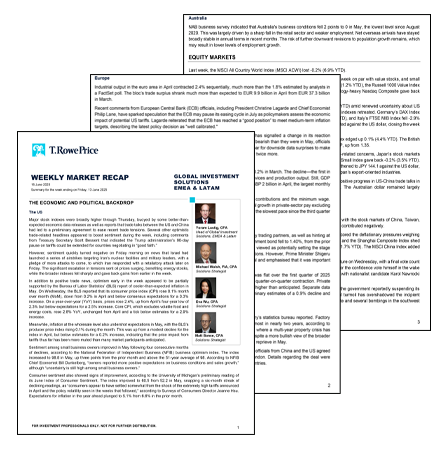
Global Investment Solutions Team
 Yoram Lustig, CFA, PRM™
Head, Global Investment Solutions, EMEA
Yoram Lustig, CFA, PRM™
Head, Global Investment Solutions, EMEA
Yoram Lustig is the head of Global Investment Solutions, EMEA, and a portfolio manager in the Multi-Asset Division. He also is the chair of the UK and European Investment Committees and a member of the Multi-Asset Steering Committee.
 Michael Walsh, CFA, CAIA®, FIA
Solutions Strategist
Michael Walsh, CFA, CAIA®, FIA
Solutions Strategist
Michael Walsh is a London-based solutions strategist on the Multi-Asset Solutions team for EMEA. He is a vice president of T. Rowe Price Group, Inc., and T. Rowe Price International Ltd.
 Eva Wu, CFA
Associate Solutions Strategist
Eva Wu, CFA
Associate Solutions Strategist
Eva Wu is an associate solutions strategist on the Multi-Asset Solutions team in the Multi-Asset Division. She is a vice president of T. Rowe Price International Ltd.
 Matt Bance, CFA
Solutions Strategist
Matt Bance, CFA
Solutions Strategist
Matt Bance is a solutions strategist and portfolio manager on the Multi-Asset Solutions team for the Europe, Middle East, and Africa region. He is a vice president of T. Rowe Price International Ltd.
202610 - 6008605
Notes
All data and index returns cited herein are the property of their respective owners, and provided to T. Rowe Price under license via data sources including Bloomberg Finance L.P., FactSet & RIMES, MSCI, FTSE and S&P. All rights reserved. T. Rowe Price seeks to cite data from sources it deems to be accurate, but it cannot guarantee the accuracy of any data cited herein. Neither T. Rowe Price, nor any of its third-party data vendors make any express or implied warranties or representations and shall have no liability whatsoever with respect to any data and index returns contained herein. The data and index returns cited herein may not be further redistributed or used as the basis for other indices, as a benchmark or as the basis for any other financial product.
The specific securities identified and described are for informational purposes only and do not represent recommendations.
CFA® and Chartered Financial Analyst® are registered trademarks owned by CFA Institute.
Important Information
The specific securities identified and described are for informational purposes only and do not represent recommendations.
This material is being furnished for general informational and/or marketing purposes only. The material does not constitute or undertake to give advice of any nature, including fiduciary investment advice, nor is it intended to serve as the primary basis for an investment decision. Prospective investors are recommended to seek independent legal, financial and tax advice before making any investment decision. T. Rowe Price group of companies including T. Rowe Price Associates, Inc. and/or its affiliates receive revenue from T. Rowe Price investment products and services. Past performance is not a guarantee or a reliable indicator of future results. The value of an investment and any income from it can go down as well as up. Investors may get back less than the amount invested.
The material does not constitute a distribution, an offer, an invitation, a personal or general recommendation or solicitation to sell or buy any securities in any jurisdiction or to conduct any particular investment activity. The material has not been reviewed by any regulatory authority in any jurisdiction.Information and opinions presented have been obtained or derived from sources believed to be reliable and current; however, we cannot guarantee the sources’ accuracy or completeness. There is no guarantee that any forecasts made will come to pass. The views contained herein are as of the date written and are subject to change without notice; these views may differ from those of other T. Rowe Price group companies and/or associates. Under no circumstances should the material, in whole or in part, be copied or redistributed without consent from T. Rowe Price.The material is not intended for use by persons in jurisdictions which prohibit or restrict the distribution of the material and in certain countries the material is provided upon specific request. It is not intended for distribution to retail investors in any jurisdiction.
Information and opinions presented have been obtained or derived from sources believed to be reliable and current; however, we cannot guarantee the sources’ accuracy or completeness. There is no guarantee that any forecasts made will come to pass. The views contained herein are as of the date written and are subject to change without notice; these views may differ from those of other T. Rowe Price group companies and/or associates. Under no circumstances should the material, in whole or in part, be copied or redistributed without consent from T. Rowe Price.
The material is not intended for use by persons in jurisdictions which prohibit or restrict the distribution of the material and in certain countries the material is provided upon specific request. It is not intended for distribution to retail investors in any jurisdiction.