

Choose your location
Canada
English
Austria
Belgium
Denmark
Estonia
Finland
France
Iceland
Ireland
Italy
Latvia
Lithuania
Luxembourg
Netherlands
Norway
Portugal
Spain
Sweden
Switzerland
United Kingdom
 Active Management Study
T. Rowe Price strategies: More return. More often.
Our strategies beat their benchmarks more often—and at a higher level—than competitors.
Ten-year periods, rolling monthly, over the last 20 years ended 12/31/25.
T. Rowe Price equity and fixed income strategies delivered higher average returns than their benchmarks 75% of the time. Plus, they beat their benchmark more frequently—and with better returns—than the average of all active managers. Dive into our active management composite study and learn more about how we achieved this.
View standardized returns and other information about the T. Rowe Price composites in this analysis.
Our study covers both equity and fixed income strategies. Learn more about the results of each asset class.
Active Management Makes a Difference
Ten-year periods, rolling monthly, over the last 20 years ended 12/31/25.
Our strategies delivered higher average returns than their benchmark over time. Plus, they beat their benchmark more frequently—and with better returns—than the average of all active managers.
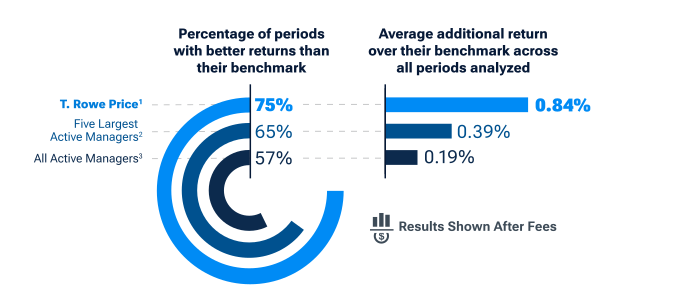
More return. More often.
That's the T. Rowe Price difference.
To learn more about T. Rowe Price funds, view our Standardized Returns (PDF).
Past performance is no guarantee of future results.
U.S. Equity
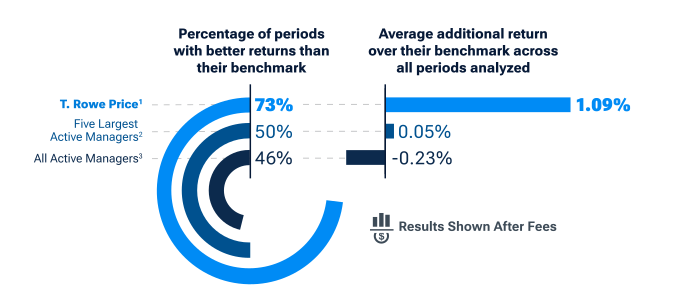
Ten-year periods, rolling monthly, over the last 20 years ended 12/31/25.
Limiting investors' losses is just as important as—and goes hand in hand with—delivering growth. Our experience and approach have allowed us to both identify potential long-term winners and limit losses in the U.S. market in a variety of economic environments.
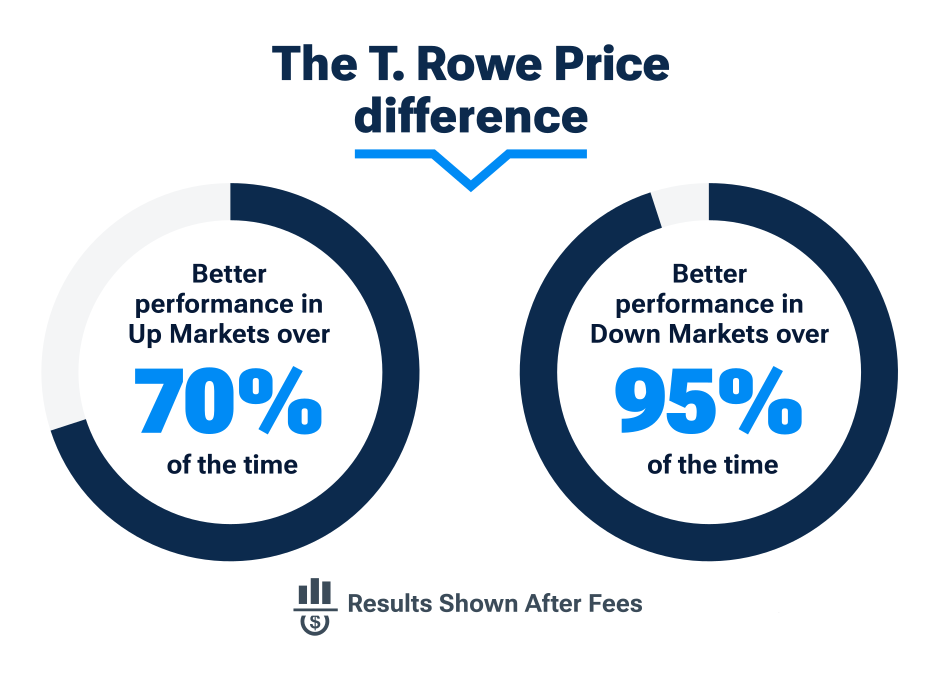
In both up and down markets, our U.S. equity strategies delivered higher average returns than their benchmarks over time—that’s the T. Rowe Price difference.
Five-year periods, rolling monthly from 12/31/95 to 12/31/25.
Our U.S. equity strategies delivered better returns in up and down markets. Helping to limit investors’ losses is just as important as—if not more important than—delivering growth. Our U.S. equity strategies have beaten their benchmarks time and time again in both up and down markets from 12/31/95 to 12/31/25. Also includes: It’s about more than just higher returns. Our U.S. equity strategies analyzed beat their benchmarks over 70% of the time in five-year periods, rolling monthly, when their designated benchmarks were positive.4
More return. More often.
That's the T. Rowe Price difference.
To learn more about T. Rowe Price funds, view our Standardized Returns (PDF).
Past performance is no guarantee of future results.
All Fixed Income
High Yield Fixed Income
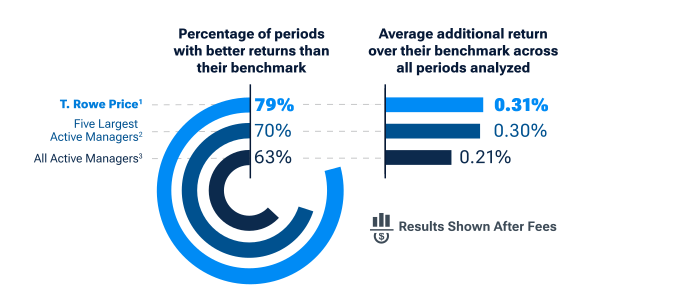
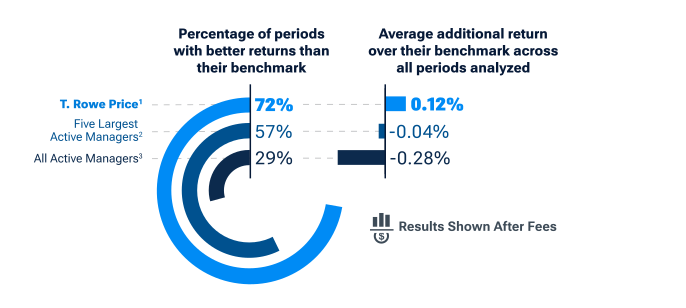
Ten-year periods, rolling monthly, over the last 20 years ended 12/31/25.
Our fixed income strategies also delivered higher average returns than their benchmark as they also benefit from our rigorous global research and independent thinking, leading to fresh insights. Our investment professionals collaborate to develop better questions for better decisions, knowing that identifying risks is as important as identifying opportunities.
Ten-year periods, rolling monthly, over the last 20 years ended 12/31/25.
The outperformance of our strategies stemmed from our experience and our commitment to rigorous global research, which uncovered opportunities with strong return potential and a low risk of defaults and downgrades. Our flexible process enables us to explore the full capital structure, identifying high-conviction ideas by rating class, industry, and issuer.
More return. More often.
That's the T. Rowe Price difference.
To learn more about T. Rowe Price funds, view our Fixed Income Standardized Returns (PDF) and High Yield Fixed Income Standardized Returns (PDF).
Past performance is no guarantee of future results.
All Equity
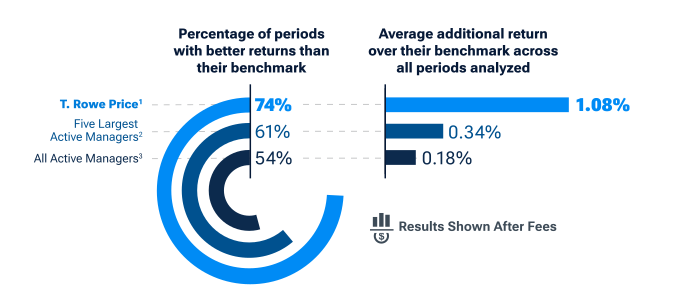
Ten-year periods, rolling monthly, over the last 20 years ended 12/31/25.
The outperformance of our equity strategies stemmed from our experience and commitment to rigorous global research, which allowed us to uncover equity investment opportunities with long-term growth potential
More return. More often.
That's the T. Rowe Price difference.
To learn more about T. Rowe Price funds, view our Standardized Returns (PDF).
Past performance is no guarantee of future results.
Learn how this works in practice.
Head of Global Equity Josh Nelson and Head of Global Equity Research Jay Nogueira recently discussed how the T. Rowe Price US Structured Research Strategy is a great example of how our collaborative culture and in-depth research inform our decision-making and help us in seeking to generate alpha for clients, both for the strategy itself and beyond.
View standardized returns and other information about the T. Rowe Price composites in this analysis.
Explore our related insights
Download the full study
Analysis by T. Rowe Price. Represents a comparison of all marketable institutional equity and fixed income composites compared with the official composite primary benchmark assigned to each. Excludes money market, asset allocation, and index/passive composites. In order to avoid double-counting in the analysis, specialized composites viewed as substantially similar to strategies already included (e.g. constrained strategies, ex-single country excluded strategies, etc.) are also excluded. Composite net returns are calculated using the highest applicable separate account fee schedule for institutional clients. An aggregated view of 10-year rolling monthly periods net returns from 1/1/06 to 12/31/25 is shown. All figures in USD.
All Strategies
182 composites covering 8,184 rolling 10-year periods
2415 composites covering 41,109 rolling 10-year periods. The assets under management (AUM) as of 12/31/25 across all composites considered in the analysis are aggregated and those composites offered by the largest five firms determined by total AUM, identified via eVestment, other than T. Rowe Price, are grouped together here. Source: Nasdaq’s eVestment Analytics database.
36,750 composites covering 603,299 rolling 10-year periods. Source: Nasdaq’s eVestment Analytics database.
Equity Strategies
153 composites covering 5,677 rolling 10-year periods.
2281 composites covering 27,592 rolling 10-year periods. The assets under management (AUM) as of 12/31/25 across all composites considered in the analysis are aggregated and those composites offered by the largest five firms determined by total AUM, identified via eVestment, other than T. Rowe Price, are grouped together here. Source: Nasdaq’s eVestment Analytics database.
34,606 composites covering 410,401 rolling 10-year periods. Source: Nasdaq’s eVestment Analytics database.
US Equity Strategies
133 composites covering 3,857 rolling 10-year periods.
2150 composites covering 15,520 rolling 10-year periods. The assets under management (AUM) as of 12/31/25 across all composites considered in the analysis are aggregated and those composites offered by the largest five firms determined by total AUM, identified via eVestment, other than T. Rowe Price, are grouped together here. Source: Nasdaq’s eVestment Analytics database.
32,181 composites covering 213,332 rolling 10-year periods. Source: Nasdaq’s eVestment Analytics database.
4Results based on an analysis of T. Rowe Price’s marketable institutional active, diversified U.S. equity composites. Index, sector, specialized, quantamental, and duplicative composites have been excluded. In cases of duplicative composites, the largest composite by assets under management was selected. Of T. Rowe Price’s forty marketable institutional active U.S. equity strategies with the requisite track record, twenty met the criteria for the analysis and are represented within. One of the twenty composites, U.S. Capital Appreciation, also has the ability to invest in fixed income assets but primarily focuses on U.S. equity and benchmarked to the S&P 500 Index. Additionally, the U.S. All-Cap Opportunities Equity composite represents a partial history in the study (beginning April 30, 2000); prior to this the strategy was a specialized sector mandate focused on the U.S. services sector. Results for other time periods will differ. All figures in USD and may increase or decrease due to currency fluctuations.All investments are subject to risk, including the possible loss of principal.
Fixed Income Strategies
129 composites covering 2,507 rolling 10-year periods.
2179 composites covering 18,177 rolling 10-year periods. The assets under management (AUM) as of 12/31/25 across all composites considered in the analysis are aggregated and those composites offered by the largest five firms determined by total AUM, identified via eVestment, other than T. Rowe Price, are grouped together here. Source: Nasdaq’s eVestment Analytics database.
32,144 composites covering 192,898 rolling 10-year periods. Source: Nasdaq’s eVestment Analytics database.
High Yield Strategies
13 composites covering 174 rolling 10-year periods.
29 composites covering 1006 rolling 10-year periods. The assets under management (AUM) as of 12/31/25 across all composites considered in the analysis are aggregated and those composites offered by the largest five firms determined by total AUM, identified via eVestment, other than T. Rowe Price, are grouped together here. Source: Nasdaq’s eVestment Analytics database.
3156 composites covering 14,116 rolling 10-year periods. Source: Nasdaq’s eVestment Analytics database.
202507-4634091