

Is Helicopter Money On Its Way - Or Is It Already Here?
Executive Summary
- Speculation is growing about the arrival of “helicopter money” as an alternative stimulus policy to existing quantitative easing (QE) and fiscal measures.
- Originally cited by Milton Friedman, helicopter money involves a central bank printing money to give to its government, which in turn distributes it to the population through an increase in fiscal spending.
- Advocates claim that helicopter money is needed to boost struggling economies, while opponents say its use could lead to dangerous fiscal consequences.
- While helicopter money differs in important respects to existing QE stimulus measures, the lines could become blurred if current monetary lending programs become permanent.
Speculation about the arrival of “helicopter money” in some corners has become so intense that you could be forgiven for thinking you can already hear the arriving chop-chop sound of copter blades. For its enthusiasts, helicopter money is a revolutionary break from monetary policy that will deliver an urgently needed boost to struggling economies; for its detractors, it is a dangerous step on the path to fiscal dangers and hyperinflation.
Originally cited by Milton Friedman, helicopter money is, in the words of former chairman of the U.S. Federal Market Open Committee Ben Bernanke, a “money-financed fiscal program.” Typically, a government issues zero-coupon bonds directly to its central bank, which pays for them with newly printed money. The government then uses that money to directly increase public spending or lower taxes. A key feature of helicopter money is that the central bank promises never to sell the bonds or withdraw from circulation the money it created. Instead, it incurs a permanent loss as it expands its liabilities without receiving an offsetting asset. This one-off spending splurge will never be recouped through increased taxation—the increase in private sector wealth is permanent.
This is different from QE, through which the central bank's purchase of government debt is recorded as an asset on its balance sheet. Here, a clear separating line is maintained between the fiscal and monetary authority: The central bank acquires bonds in the secondary market, and the government raises finance at market-determined terms. The independence of the central bank is preserved, and the financing arrangement is, at least conceptually, temporary.
According to its advocates, helicopter money is a more powerful tool than QE, for two main reasons: First, because it is presented as a monetary “gift” to the population, it helps households and businesses to feel wealthier, leading to an increase in consumption and economic activity; and second, because it involves a very visible expansion of the money supply, it increases inflation expectations.
Over the past half century, central banks have steered clear of using helicopter money. Go back a bit further, however, and there are numerous examples of governments that relied on newly printed money from central banks to finance their spending. Few can be regarded as a success. During the American Civil War, for example, the U.S. Confederacy increased its money supply 20 times over to finance the war effort, resulting in hyperinflation: a standard price index of commodities rose from $1001 at the beginning of the war to $9,200 by its end in April 1865. In the early 1920s, the Weimar Republic resorted to the mass printing of money to pay the huge reparations imposed on Germany after the end of the first world war. This led to a rapid depreciation of the deutsche mark—which had already been hugely devalued during the war. The end result was again hyperinflation.
A NEW MISSION?
Talk of helicopter money is bubbling up again. In a world economy characterized by weak demand, below-target inflation, and slow output growth, demand for alternative solutions has led some commentators and academics to argue that the copters need to be brought out of the hangar once more. But would the introduction of helicopter money really have a materially different impact relative to existing QE/fiscal stimulus programs? And are any governments genuinely considering it?
In some respects, the difference between helicopter money and recent examples of QE/fiscal stimulus appears academic. It seems probable that a large proportion of the bond purchases undertaken by central banks under the various QE programs over the past few years will eventually be turned into a permanent financing arrangement, effectively rendering them “helicopter money.” Until this occurs, however, QE/fiscal stimulus will continue to fall short of the conventional definition of helicopter money, which requires an explicit acknowledgment that the transaction is permanent and interest-free.
Media speculation has grown in recent months that Japan may become the first developed economy since 1945 to openly monetize its government debt. Suggestions have been put forward that the authorities could issue zero-coupon perpetual bonds to be purchased directly by the Bank of Japan (BoJ)—a clear example of “explicit” helicopter money. However, whether or not this financing arrangement materializes (and there are several obstacles to be overcome), the BoJ already effectively finances the fiscal deficit through its existing bond-buying program. As Figure 1 shows, the BoJ’s large-scale purchase of government debt over the past four years has enabled Japan to reduce its external levels of debt while continuing to increase overall debt as a percentage of gross domestic product (GDP). Given that the market acknowledges that the bonds purchased by the BoJ constitute a permanent financing arrangement, this is helicopter money in all but name.
Figure 1: Japan Government Debt by Holder
As of June 30, 2016
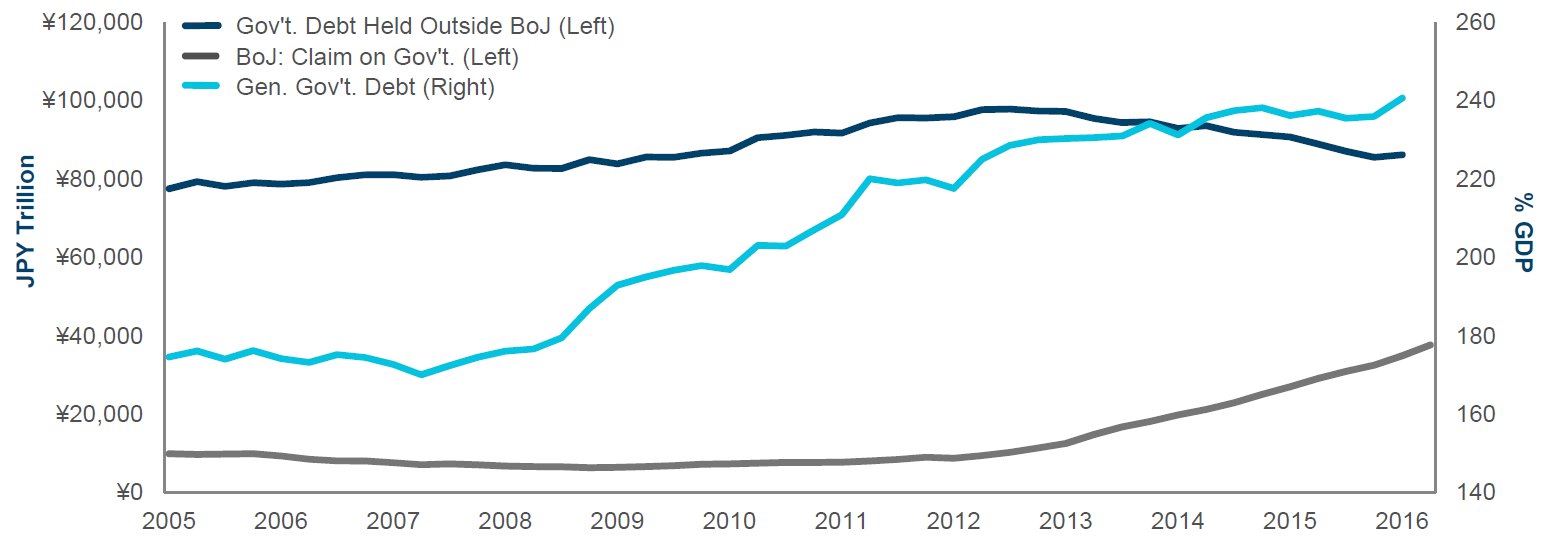
Source: FactSet.
But names are important, and it is unlikely that Japan—or any other developed market country—will embark on an explicit helicopter money program anytime soon, irrespective of how closely their existing stimulus programs resemble helicopter money in practice. In many countries, it would require a change in the law to do so, and the symbolic implications of such a move would be huge. Openly acknowledging that government debt is being monetized carries serious tail risks, chief among them high, uncontrolled inflation, political instability, and the erosion of central bank independence. Any advantage gained by calling a QE/fiscal stimulus “helicopter money” is likely to be small compared with these risks. For these reasons, we do not expect the helicopters to be revving up in public anytime soon. It is likely, however, that their cargo will continue to be delivered via different vehicles
If helicopter money is, in effect, already being delivered—albeit under the guise of QE/fiscal stimulus rather than explicitly—are its traditional negative outcomes an immediate risk? It seems unlikely. In the U.S. Confederacy and Weimar Republic examples described above, there was a catastrophic loss of confidence in the ability of the authorities to get a grip on their dire economic situations, which in turn led to a loss of confidence in their currencies as a store of value. At present, there is no evidence that an equivalent loss of confidence has occurred or will occur. Despite the economic challenges of the past few years, most developed governments are regarded as credible and trustworthy. I believe that the central banks can ease monetary policy further, if necessary, but also that they will raise rates again when the time is right. There is not a widespread perception that governments are uncontrollably printing money—and importantly, inflationary pressures remain muted.
The need to maintain trust underscores the importance of understanding how new coordinated fiscal and monetary initiatives affect public perceptions. It is essential that people believe that the authorities remain in control and can be trusted to take the right steps when required. So far, the evidence suggests that governments are succeeding in maintaining this trust.
2016-GL-4661
重要資訊
本文件(包括其中所載的任何陳述、資訊、數據和內容)以及與本文件一併提供的任何資料、資訊、圖像、連結、聲音、圖像或視頻(統稱為「資料」)乃由普信提供,並僅作一般資訊用途。本資料並不擬供在禁止或限制分發本資料的司法管轄區和在本資料須按特定要求提供的若干國家之人士使用。本資料不擬派發予任何司法管轄區的散戶投資者。在任何情況下,本資料的全部或部分內容均不得在未經普信同意下複製或再分發或出示予任何人士。本資料並不構成於任何司法管轄區分銷、要約、邀請、建議或徵求發售或購買任何證券。本資料並未經由任何司法管轄區的任何監管機關審閱。本資料並不構成任何投資意見,不得加以依賴。投資者務請在作出任何投資決策前先尋求獨立法律和財務意見(包括有關稅務後果的意見)。
