

European High Yield Market Goes Back to Basics
The climate for active bond investment has improved in the past month. We’ve seen a change in the market’s behaviour since the European Central Bank (ECB) first announced its corporate bond purchase programme, due to start in June. After the largely indiscriminate buying that we saw in April, investors have started to pay attention to fundamentals once more.
After the ECB’s announcement in March, there was a pickup in credit demand, and the rally gathered pace as it became clear how wide the ECB’s remit would be. This trend spilled over from the investment-grade market to high yield. The general upward pressure on high-yield prices led to an outperformance by higher-beta names that had come under pressure in recent months. CCC-rated credits and names in the energy, metals and mining sectors were among the winners in April. This trend eased in May, as the broad market moved more or less sideways, but this time the higher-quality names came into their own, outperforming the riskier credits. This “rerating” of risk is in line with our thesis that fundamental credit quality is the most important determinant of performance in the long run.
Among the fundamentally stronger credits that made a comeback in May, several were in the single B category: a segment that we believe continues to offer attractive opportunities on a risk-adjusted basis. One reason for this is higher coupons. In recent months we’ve seen new issues coming to the high yield market offering less than 3%: levels that offer very little cushion at times of market stress. We see more attractive opportunities in the single B category, especially in the shorter maturities.
A more important advantage in single Bs is wide dispersion in pricing. One illustration of this is the primary market, as shown in the chart. By the end of April, the average yield-to-worst of the euro high-yield market* was about 4.4%. But, between late March and the end of April, yields on new single B rated bond issues ranged from 3.75% to 12.5%. Wider dispersion implies greater returns to active management, or, to put it differently, successfully separating the winners from the losers can lead to greater outperformance.
By contrast, we see fewer opportunities in the double B segment. One factor is “tourism” from investment-grade players seeking additional yield, which has kept demand high and spreads relatively compressed. Much of this crossover buying activity focuses on the fallen angels (roughly 20% of the index*), partly because they are names with which investment-grade managers are already familiar. Whereas the double B category can become a crowded trade, we believe single B offers better opportunities for security selection.
Overall, our market outlook is reasonably sanguine, although we retain a defensive bias. We suspect that, at current spreads, the market is already pricing in much of the ECB bond buying programme. In other words, further gains are unlikely to be as strong as April’s. But we believe there will be some limitation of downside risk as long as the ECB continues to fuel demand for yield.
*Euro high yield market is measured in this case by the Bank of America Merrill Lynch European Currency High Yield ex Subordinated Financials Constrained Index. Yield to worst is a measure of yield that takes call options into account.
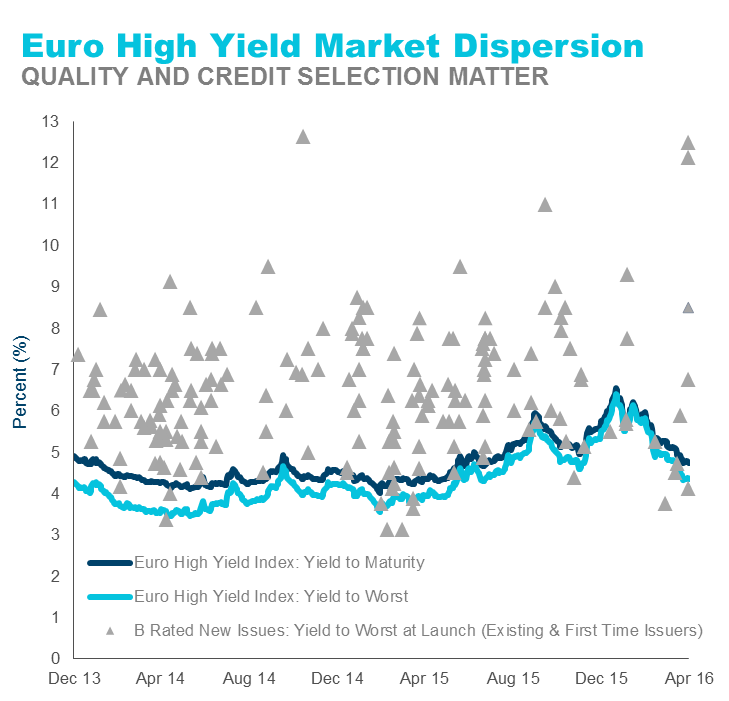
As of 30 April 2016
Euro High Yield is represented by the Bank of America Merrill Lynch European Currncy High Yield ex Subordinated Financials Considered Index.
Source: BofA/ML and T. Rowe Price
2016-GL-4100
For investment professionals only. Not for further distribution.
重要資訊
本文件(包括其中所載的任何陳述、資訊、數據和內容)以及與本文件一併提供的任何資料、資訊、圖像、連結、聲音、圖像或視頻(統稱為「資料」)乃由普信提供,並僅作一般資訊用途。本資料並不擬供在禁止或限制分發本資料的司法管轄區和在本資料須按特定要求提供的若干國家之人士使用。本資料不擬派發予任何司法管轄區的散戶投資者。在任何情況下,本資料的全部或部分內容均不得在未經普信同意下複製或再分發或出示予任何人士。本資料並不構成於任何司法管轄區分銷、要約、邀請、建議或徵求發售或購買任何證券。本資料並未經由任何司法管轄區的任何監管機關審閱。本資料並不構成任何投資意見,不得加以依賴。投資者務請在作出任何投資決策前先尋求獨立法律和財務意見(包括有關稅務後果的意見)。
