

Fixed Income: Why Adopt an Unconstrained Approach to Fixed Income?
Executive Summary
- Volatility returned to markets with a vengeance in the second half of 2015 amid growing concerns about China, sharp declines in commodity prices, and uncertainty over whether the U.S. Federal Reserve would raise rates in September.
- In addition, income remains very hard to come by as traditional sources are not delivering in the current environment.
- In circumstances like these, investors may benefit from looking beyond the benchmark and considering the full range of the fixed income universe, in particular, regions and countries that are less correlated to major markets such as the U.S. and China.
- To be truly “benchmark agnostic,” it is also important to be able to capture returns in both rising and falling markets through long and short positions.
- A portfolio that is not constrained by a benchmark, but still contains the best investment ideas, should fulfill fixed income’s role as a diversifier and a provider of sustainable income and capital preservation.
The second half of last year provided a useful—and sobering—reminder that volatility can strike suddenly and violently. At the beginning of August, global equity markets were calm to the point of being complacent; by the end of the month, they were in full-blown panic mode. The dramatic shift in mood was prompted by a number of factors, including the slowing Chinese economy, a slump in commodity prices, and continued speculation about whether or not the Fed would raise interest rates. Investor confidence remained frazzled throughout September, and the third quarter became the worst three months for global stock markets in four years.
Volatility fell in October but spiked again toward the end of the year and remains above its long-term average—and there are enough downside risks to the global economy in 2016 to suggest that it could surge higher at any time. Intensifying regional conflicts, the continuing slowdown in emerging markets, low commodity prices, and the possibility of a U.S. yield spike each have the potential to cause further panic; in combination, they could amount to a perfect storm of risks with the potential to wreak havoc.
At the same time, traditional income sources are not delivering in the current low-rate environment. For example, the Australian government bond rate and 12-month term deposit rate have both moved close to 2% over the past year. So in addition to downside risks, investors also face significant challenges in finding income.
In circumstances like these, it is more important than ever for bond investors to review their existing fixed income allocation to assess whether it provides them with enough freedom to both minimize risks and profit from relevant opportunities wherever they arise. Achieving this means adopting an unconstrained approach that considers the full spectrum of the fixed income universe, including government bonds and credit instruments and countries that are less correlated to major markets.
DIVERSIFYING AWAY EQUITY VOLATILITY
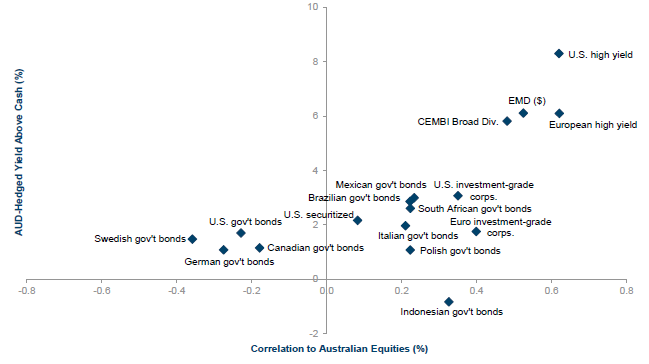
First, however, it is important to remind ourselves of the main reason why investors seek exposure to fixed income: to gain diversification from equities. Figure 1 shows that lower-risk fixed income assets such as high-quality government bonds have low or even negative correlation to equities. This inverse relationship helps to smooth a portfolio’s volatility during periods of equity market weakness. High yield and emerging market debt both have higher correlations to equities, which means they may not provide the same level of diversification as higher-quality fixed income assets during times of market stress.
Figure 1: Different Bond Instruments Have Varying Correlations to Australian Equities
As of December 31, 2015
Sources: UBS, Barclays, J.P. Morgan, Bank of America Merrill Lynch, S&P, MSCI, and T. Rowe Price.
Credit, especially high yield bonds, also has a higher correlation to equities than global sovereign bonds. It diversifies within fixed income, but not against equities. During periods of market stress, therefore, the ability of credit to diversify and protect capital is compromised. Investors with heavy allocations to credit may miss out on the defensive characteristics that a bond portfolio should typically provide during turbulent periods.
This is very important when it comes to portfolio construction. Australian investors tend to hold a fair amount of equity in their portfolios. In addition, our research has shown us that the fixed income allocations of Australian investors have become more credit-centric in recent years. This means that many Australian investors are not getting the diversification benefits they need from their fixed income portfolios and may benefit from readjusting their combination of government bonds and credit.
The good news is that fixed income investors today have more choice than ever before. In countries where interest rates are rising, for example, steepening yield curves can offer income opportunities, while rising volatility on foreign exchange markets can lead to currency opportunities. Emerging markets can offer the higher yields that investors look for but may come with added risk, while lower-yielding, less risky securities still offer benefits in a period of highly volatile equity markets.
The bad news is that greater choice does not necessarily make the job of fixed income investors any easier—with more options comes the need for more research, due diligence, and risk management. However, investors who actively embrace this wider opportunity set are ultimately likely to find their efforts rewarded, while those who do not seek access to different country bond markets could miss potential performance enhancement and diversification.
Figure 2: Illustrative Interest Rate Cycle
As of December 31, 2015
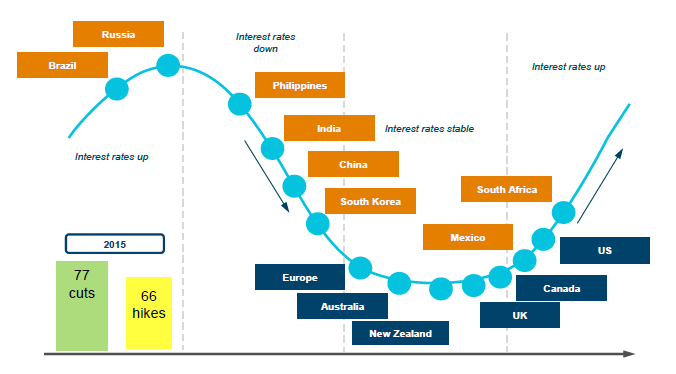
The two columns of cuts versus hikes are the actual cuts and hikes that occurred in 2015 across countries worldwide.
Sources: CRB rates and T. Rowe Price.
DIVERGENCE CREATES OPPORTUNITIES
Policy divergence among central banks across the world is expanding the opportunity set for investors seeking more diversification from their bond portfolios. Those with access to a broad range of markets can derive returns by taking positions in countries at differing stages of the interest rate cycle. Figure 2 illustrates the interest rate cycle of a selected number of developed and emerging markets. It shows how an investor can take advantage of relative country exposures in markets where interest rates are falling or stable versus countries where interest rates are rising. This enables investors to not only exploit interest rate differentials between countries, but also adjust duration (price sensitivity to changes in interest rates) and yield curve exposures within individual countries. If yields are attractive but currency valuations are not, currency risk can be neutralized to focus exclusively on country selection.
The latter point is worth exploring further. As some central banks begin raising rates, managing duration risk is going to become increasingly important—and there are different ways to achieve this. One approach is to buy securities with shorter maturity dates, where interest rate sensitivity is low. With rates at the front of the curve in many developed markets still around zero, this would clearly mean sacrificing yield, although some short-dated, high-quality corporate debt can provide modest yield over comparable sovereign debt with only marginally more risk.
Another approach is to consider floating rate notes such as bank loans, which feature virtually no duration as their coupons are adjusted in line with interest rates. Floating rates typically perform well in a rising-rate environment, particularly if those rises are fueled by strong economic growth. However, as quality is sacrificed in the pursuit of yield, credit and liquidity risk can replace duration risk.
It is important to stress that tightening cycles should not necessarily be regarded negatively. By considering the level of tightening that the yield curve has already discounted, it is possible to find valuation opportunities at different maturity points. Locally denominated debt is driven primarily by domestic economic conditions and policy responses, and when different countries are at different points in their rate cycles, investors can take advantage of this with targeted duration exposures.
Some developing countries—for example Brazil and South Africa—have been raising rates for a while to combat high inflation and depreciating currencies. This led to money flowing into these economies as rates in advanced economies remained at rock bottom, but the prospect of a U.S. interest rate hike saw those portfolios flow back out as investors moved their money in the expectation of improved returns. Many other countries continue to experience muted inflation and are adopting softer monetary policies, while some Eastern European countries—for example Romania and Hungary—have very low inflation rates but offer higher yields than in the eurozone’s periphery. Meanwhile, some local markets typically exhibit lower volatility than global rates. Stable markets such as these should fare relatively well even when rates are rising elsewhere.
THE IMPORTANCE OF BEING AGNOSTIC
The ability to capture returns in rising and falling markets through both long and short positions is a key component of the unconstrained approach. During the 30-year bond bull market, investors in traditional long-only fixed income strategies linked to benchmarks such as the Barclays Global Aggregate Index enjoyed relatively strong positive returns as yields fell and prices rose. However, as yields begin to rise again and prices fall, the ability to short certain markets and sectors and capture returns from falling prices will be extremely valuable.
By adopting an unconstrained bond strategy, an investor can seek value anywhere in the world irrespective of whether markets are going up or down. But this is not an easy strategy to adopt: The heterogeneous nature of the global bond universe means that the choices facing an unconstrained investor are seemingly endless. Success requires conviction—only those positions backed up with a high degree of confidence should be adopted.
This requires an in-depth analysis of the main macroeconomic indicators, such as economic growth, monetary policy developments, and inflation expectations, and an understanding of the impact these factors have on interest rates in the long term. Armed with this knowledge, investors can compare their expectations with the market consensus and identify where the best opportunities lie, both on the long and the short side.
GOING UNCONSTRAINED DOES NOT MEAN SACRIFICING QUALITY
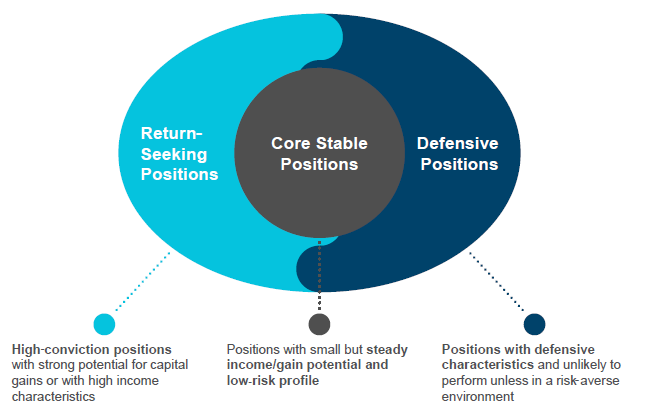
One way to accomplish this is to divide the portfolio into three core components: return-seeking positions, core stable positions, and defensive positions (see Figure 3). Return-seeking positions include high-conviction investments that have strong potential for capital gains or high income characteristics. They may include locally denominated emerging market debt and selected high yield products. Core stable positions are those with small but steady income or gain potential and a low risk profile and may also include long positions in locally denominated debt as well as shorter-dated investment-grade corporate products. Defensive positions are typically those that are unlikely to perform unless in a risk-averse environment, such as inflation-linked products and short positions in vulnerable currencies and sectors.
Figure 3: The Core Components of an Unconstrained Portfolio
As of December 2015
Source: T. Rowe Price.
A portfolio managed in this way can provide a number of benefits to investors, including stable predictable income, downside risk management, capital preservation, and diversification to equity markets. An unconstrained approach to fixed income is the best way to achieve this—investors should be prepared for the unexpected and be able to react quickly to changing circumstances, which means investing across markets and different types of bonds, on both the long and short side. Traditional approaches to fixed income market investing are often constrained by benchmarks that are dominated by the largest issuers of debt. Such approaches are unlikely to deliver optimal results, especially when interest rates are on the move. In a world of multispeed economic growth and differing interest rate cycles, the ability to shift positions quickly can make a huge difference to performance.
It is important to stress that adopting an unconstrained approach need not come at the expense of quality or bring additional transaction costs—it is possible to retain a high-quality, liquid profile while still being agile enough to manage risks. A portfolio that is not constrained by a benchmark, but still contains the best investment ideas, should fulfill fixed income’s role as a diversifier and a provider of sustainable income and capital preservation. Ultimately, the goal is balance: how to find the right mix between duration, country allocation, bottom-up security selection, and currency preservation to achieve optimal returns while effectively managing risk and protecting the portfolio.
2016-GL-3268
重要資訊
本文件(包括其中所載的任何陳述、資訊、數據和內容)以及與本文件一併提供的任何資料、資訊、圖像、連結、聲音、圖像或視頻(統稱為「資料」)乃由普信提供,並僅作一般資訊用途。本資料並不擬供在禁止或限制分發本資料的司法管轄區和在本資料須按特定要求提供的若干國家之人士使用。本資料不擬派發予任何司法管轄區的散戶投資者。在任何情況下,本資料的全部或部分內容均不得在未經普信同意下複製或再分發或出示予任何人士。本資料並不構成於任何司法管轄區分銷、要約、邀請、建議或徵求發售或購買任何證券。本資料並未經由任何司法管轄區的任何監管機關審閱。本資料並不構成任何投資意見,不得加以依賴。投資者務請在作出任何投資決策前先尋求獨立法律和財務意見(包括有關稅務後果的意見)。
