

Economies and Markets: China Aftershocks Rattle Global Markets
Executive Summary
Once again, developments in China have reverberated across global equity, currency, and commodity markets and revived fears that surfaced after China’s surprise currency devaluation and stock market crash last summer.
Markets likely will remain volatile, China’s economy will continue slowing, and the country’s currency may weaken further. However, T. Rowe Price does not anticipate an economic hard landing or a financial crisis in China.
Moreover, the recent turmoil in China’s market does not change our constructive longer-term view of prospects for investing in China and Asia more broadly.
THE CURRENCY
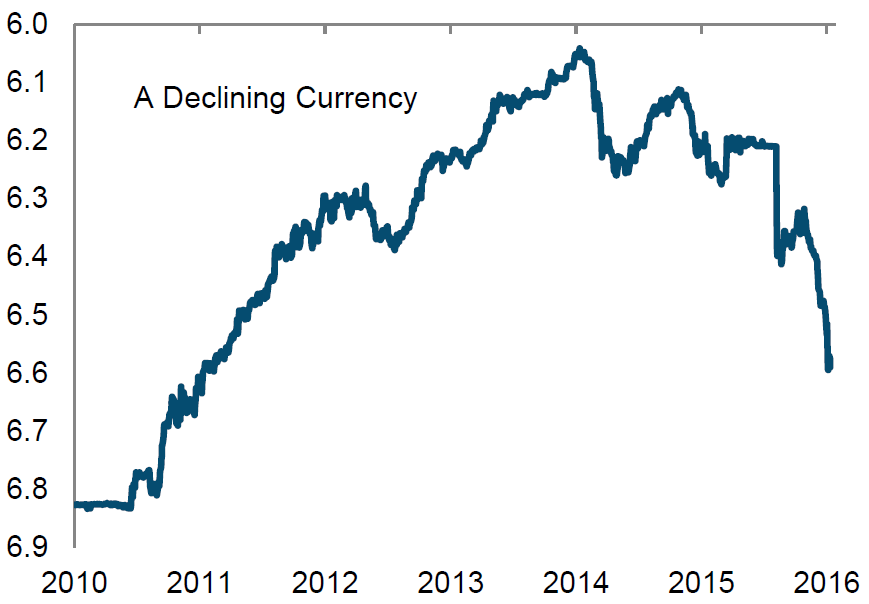
The Chinese currency, called the renminbi, has been under pressure, especially since a devaluation by China authorities in August of last year took investors by surprise. At the end of last year, its value also began to be pegged to a basket of currencies instead of solely to the U.S. dollar, which implies a further devaluation. The dollar has been appreciating against most major global currencies, and the renminbi recently hit its lowest level versus the dollar in five years.
The potential for a further unexpected and sharp decline in the renminbi is the key current risk in China, as this could hasten continuing capital outflows from China and put more pressure on its economy. Once global markets believe that China’s intent is to weaken the currency, it is very difficult to control the forces that seek to take advantage of that move.
Our expectation is that China will let the renminbi float within limits against the new basket of currencies, and that would suggest downward pressure this year, but in a fairly controlled fashion. However, managing that devaluation process is difficult to achieve. The government may need to continue drawing on its significant foreign exchange reserves to defend the currency over the coming quarters. China can afford to do this for a while, but not forever.
Figure 1: Chinese Yuan in One U.S. Dollar
Inverted scale to show decline in yuan
Source: Bloomberg. As of January 2016
THE ECONOMY
It was inevitable that China’s economy—the world’s second largest—would slow from the double–digit growth attained over previous decades, particularly with the government attempting to transition the economy from one led by manufacturing, investment, and exports to one more driven by domestic consumption and services.
Nevertheless, the slower pace of growth along with mounting concerns whether China’s leaders can effectively manage this transition have sent tremors through global emerging markets several times over the past three years—with fears now impacting developed markets as well.
The government’s recent heavy-handed intervention aimed at supporting its equity markets and currency, and its inconsistent communications, have undermined investors’ confidence in China’s leadership and spurred more capital outflows from the country.
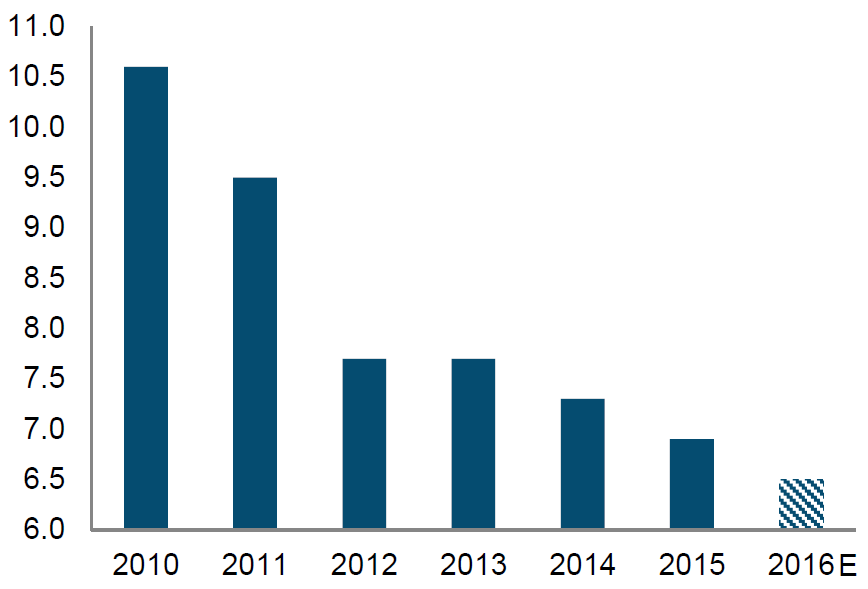
The Chinese government recently reaffirmed its expectation for economic growth to average 6.5% per year between now and 2020. We consider that to be difficult to achieve without also seeing some undesirable consequences.
While the risk of policy mistakes remains high and should be closely monitored, we don’t believe that a hard landing for China is the most likely outcome. Policymakers have every incentive to ensure that doesn’t happen; their very existence probably depends on it.
Several options, including the use of monetary and fiscal policy, are likely to be used to support growth and smooth the transition. Even if China grows at 6.3% this year as the International Monetary Fund forecasts, that is still a very impressive rate in the context of global growth.
THE DEBT BUBBLE AND FINANCIAL CRISIS
China has experienced a massive buildup of debt since the 2008 financial crisis and a significant rise in nonperforming assets in its banking system.
We believe that the level of nonperforming loans in China is substantially higher than the 1.5% rate reported by the central bank. China’s banking stocks have been trading at valuations that would indicate a nonperforming loan rate of about 6%. If China were to suddenly recognize all of those nonperforming assets, it could prove highly disruptive to the economy and could trigger a financial crisis at some point. But we think that outcome is extremely unlikely given China’s government control of the banking system and the financial system more broadly.
Figure 2: China Real GDP Y/Y%
A Sharp Slowing in Economic Growth
Sources: Bloomberg and China National Bureau of Statistics. As of January 2016
A much more likely outcome is that we see an “ever-greening” or a rolling over of bad debt over the next few years, given China’s unwillingness to let financial firms fail, its emphasis on stability, and its huge current account surpluses and foreign exchange reserves.
There is the risk that avoiding the pain of deleveraging swiftly and kicking the can down the road will exact a heavy toll on the economy longer term.
That is one reason why we expect growth to continue to slow unless China enacts more transformational reforms that will improve efficiency and productivity in the economy.
THE STOCK MARKET AND CHINA LEADERSHIP
Despite a decline of 45% in China’s Shanghai Composite Index last summer, China was one of the better-performing regional stock markets last year, with a gain of 9.4% in U.S. dollars, based on FactSet data. However, the steep decline at the start of this year reflected renewed fears about China’s economy, currency, and management.
So far this year, the government has had to reverse policy and suspend newly installed circuit breakers that shut down the market twice in one week. There is no doubt that Chinese policymakers are struggling to balance state control with more market-driven pricing mechanisms.
It is important to remember that China alone is not to blame for the turmoil in global equity markets early this year. Investors are also concerned about U.S. and global growth, the declining oil price, the outlook for corporate earnings, and the Federal Reserve’s move to finally begin raising interest rates.
OPPORTUNITY AND OUTLOOK
Despite the turmoil in China’s stock market, we continue to find attractive companies where the long-term benefits should outweigh the near-term risks. One key area of focus is disruptive technology. Investing in some of China’s high-growth Internet stocks has been very profitable.
We also find opportunity in the consumer and service sectors, with Chinese consumers moving up the value-added curve, buying more expensive, higher-quality items. In the services area, health care and logistics offer promising opportunities. We also see potential in reform beneficiaries—state-owned enterprises that should benefit from change in government policy over the next few years.
Recent events do not change our longer-term view on China or the rest of Asia. We expect the China market to offer attractive growth opportunities for many years to come. Also, the structural growth story in Asia remains robust. Economies are growing at healthy levels in a global context, supported by large, often young populations that are moving up the income curve.
As we get more clarity on China’s currency framework, we expect volatility to subside, allowing investors to focus on the more positive features of the China and Asia story once again.
2016-GL-3345
重要資訊
本文件(包括其中所載的任何陳述、資訊、數據和內容)以及與本文件一併提供的任何資料、資訊、圖像、連結、聲音、圖像或視頻(統稱為「資料」)乃由普信提供,並僅作一般資訊用途。本資料並不擬供在禁止或限制分發本資料的司法管轄區和在本資料須按特定要求提供的若干國家之人士使用。本資料不擬派發予任何司法管轄區的散戶投資者。在任何情況下,本資料的全部或部分內容均不得在未經普信同意下複製或再分發或出示予任何人士。本資料並不構成於任何司法管轄區分銷、要約、邀請、建議或徵求發售或購買任何證券。本資料並未經由任何司法管轄區的任何監管機關審閱。本資料並不構成任何投資意見,不得加以依賴。投資者務請在作出任何投資決策前先尋求獨立法律和財務意見(包括有關稅務後果的意見)。
