
How to gain the benefits of active management in an exchange-traded fund
April 2026, Multi-Asset
- Key Insights
-
- Actively managed strategies can adapt to changing market environments.
- T. Rowe Price offers active strategies specifically designed as exchange-traded funds (ETFs) that are based on some of our existing mutual fund strategies.
- Our actively managed ETFs benefit from the same skilled portfolio expertise as our active funds as well as the advantages of an ETF structure.
ETFs are designed to provide investors with a competitive alternative to mutual funds.
You can trade ETF shares throughout the day like a stock. ETFs generally have lower expense ratios compared to mutual funds. ETFs also are considered more tax efficient because of the way they handle capital gains when shareholders sell or redeem shares.
Until 2019, most ETFs pursued passive investment strategies designed to match the investments in a benchmark index. Today, investors have access to an increasing number of ETFs that employ active strategies. These strategies allow individual investors to benefit from the expertise offered by professional management.
Managers of active ETFs can adapt to changing market environments by pursuing opportunities for more attractive risk-adjusted returns. As a result, active ETFs are designed to outperform their benchmarks.
T. Rowe Price active strategies seek to deliver strong performance through our commitment to fundamental research and in-depth insight. T. Rowe Price Active ETFs combine the features and benefits of the ETF’s structure with the additional edge our strategic investing approach can deliver.
Learn more about how active ETFs can expand your investment opportunities at troweprice.com/exploreetfs
Important Information
Consider the investment objectives, risks, and charges and expenses carefully before investing. For a prospectus or, if available, a summary prospectus containing this and other information, visit troweprice.com. Read it carefully.
ETFs are bought and sold at market prices, not NAV. Investors generally incur the cost of the spread between the prices at which shares are bought and sold. Buying and selling shares may result in brokerage commissions, which will reduce returns.
This material is provided for general and educational purposes only. This material does not provide recommendations concerning investments, investment strategies, or account types. It is not individualized to the needs of any specific investor and not intended to suggest any particular investment action is appropriate for you nor is it intended to serve as the primary basis for investment decision-making. T. Rowe Price Investment Services, Inc., its affiliates, and its associates do not provide legal or tax advice. Any tax-related discussion contained in this material is not intended or written to be used, and cannot be used, for the purpose of (i) avoiding any tax penalties or (ii) promoting, marketing, or recommending to any other party any transaction or matter addressed herein. Please consult your independent legal counsel and/or tax professional regarding any legal or tax issues raised in this material.
Risk Considerations: All investments are subject to market risk, including the possible loss of principal. Active investing may have higher costs than passive investing and may underperform the broad market or passive peers with similar objectives. Passive investing may lag the performance of actively managed peers as holdings are not reallocated based on changes in market conditions or outlooks on specific securities.
T. Rowe Price Investment Services, Inc.
© 2025 T. Rowe Price. All Rights Reserved. T. ROWE PRICE, INVEST WITH CONFIDENCE, and the Bighorn Sheep design are, collectively and/or apart, trademarks of T. Rowe Price Group, Inc.
For most of the three decades they have existed, exchange-traded funds (ETFs) have largely pursued a passive investment strategy. Today, 89% of the USD 13.4 trillion invested in ETFs is held in passive strategies.1 However, the number of actively managed ETFs has surpassed the number of passively managed ETFs.2 Indeed, a majority of ETFs that launched in the past few years have offered active strategies.
Much of this surge in active ETFs stems from a 2019 change in the U.S. Securities and Exchange Commission (SEC) rules that streamlined the process of launching new ETFs. Many of the new active funds are being launched by asset managers with long track records in actively managed mutual funds, including T. Rowe Price. As a result, investors are now able to take advantage of the benefits of active management within the advantageous structure of an ETF.
What is an active ETF?
An ETF is very similar to a mutual fund in many ways, particularly in the fact that they both represent a basket of pooled securities, such as stocks or bonds. As with mutual funds, ETFs can be actively or passively managed. With an active ETF, portfolio managers take an active role in managing the pooled assets, typically making decisions about what securities to include and at what relative weighting, based on a predetermined strategy or set of criteria.
By comparison, passive ETFs are generally designed to match the investments in a benchmark index. Changes to the investments held in the ETF are typically made only to keep the fund in line with the holdings of the benchmark index.
How do active ETFs work?
In many ways, active ETFs work in much the same way as an actively managed mutual fund. Investors can invest in a diverse pool of securities that is managed professionally on behalf of all shareholders according to a stated objective or investment strategy. Both active ETFs and active mutual funds allow individual investors to benefit from the expertise offered by professional management
through an active strategy that typically seeks to outperform the target benchmark index. There are some important structural similarities and differences to be aware of, however (see Fig. 1).
Comparing active ETFs and active mutual funds
(Fig. 1) Actively managed mutual funds and ETFs share some similarities, along with a few important differences.
| Active mutual funds | Active ETFs | |
| Professionally managed | Yes, on behalf of all shareholders | Yes, on behalf of all shareholders |
| Trading | Shares are purchased and redeemed once per day at market close | Shares are purchased and sold throughout the day on an exchange, much like a regular stock |
| Minimum investment | Minimums depend on share class but can be low | No minimums; investors can invest as little as the cost of a single share |
| Fees | Includes management fees and shareholder servicing costs; fees vary by share class | Expense ratios are typically lower and with fewer layers of fees |
For educational purposes only. The table above is not a comprehensive list of investment vehicle features, benefits, or risks. Vehicle structures, portfolio strategies, investment objectives, and risks will vary. Consult your financial advisor or tax professional for more information.
ETFs are designed to outperform
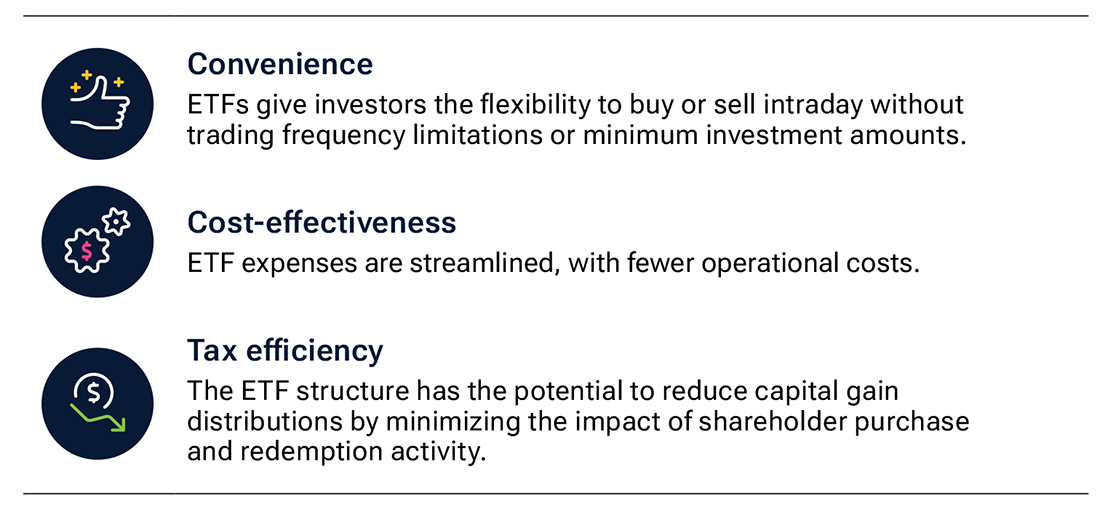
By their very nature, ETFs are designed to provide investors with a competitive alternative to mutual funds (see Fig. 2, on page 3). The ability to buy and sell shares of ETFs on an exchange throughout the day can make it easier for investors to build diversification into their portfolio, compared with buying or selling mutual funds once a day after the market closes. The relatively low expense ratios of ETFs compared with mutual funds are attractive to cost-conscious investors.
In addition, ETFs are considered to be a more tax-efficient alternative to mutual funds, in part, because of the way capital gains are handled when shareholders sell or redeem their shares.
The popular benefits of ETFs
(Fig. 2) ETFs offer investors a competitive alternative to mutual funds.
 close
close
The benefits of active strategies
With passive investment strategies, investors are at the whim of the market. Whether a passive investment is tied to a specific sector or broad market index, by definition, there is no objective to outperform. And in market downturns, passively managed ETFs have no discretion to make adjustments.
On the other hand, actively managed investment strategies can adapt to changing market environments in pursuit of more attractive risk-adjusted returns. Active funds tend to perform best in areas of the market where there is less efficiency, such as in the small-cap space or in emerging markets, for example. In these areas, the expertise and research capabilities of professional managers can provide a competitive edge.
For example, T. Rowe Price Active ETFs seek to outperform benchmark indexes through the added value of our investment management expertise and global research capabilities. Our global team of investment professionals goes beyond the numbers every day to evaluate markets and study opportunities. This depth of understanding helps inform better decision-making and prudent risk management for our clients. Regardless of market conditions, our experienced investment professionals have the flexibility to adjust their actively managed portfolios in pursuit of the most advantageous positions. None of this is possible with the limitations of passively managed ETFs.
We have long believed that we could deliver the benefits of our core investment approach in the form of an ETF. Managed through rigorous fundamental research and a forward-looking strategic perspective, T. Rowe Price Active ETFs are the latest vehicle that enables us to package this expertise for clients who may prefer the ETF structure.
Our commitment
T. Rowe Price active strategies have a compelling long-term track record. Regardless of the market environment, we seek to deliver strong performance through our commitment to fundamental research and in-depth insight. T. Rowe Price Active ETFs offer investors the benefits of ETFs while also offering the potential for outperformance.
For clients seeking returns that go beyond the limitations of an index, T. Rowe Price is committed to offering a different kind of ETF: one that combines the features and benefits of the ETF’s structure with the additional edge our strategic investing approach can deliver. We will continue to pursue innovative investment solutions and strategies to help clients feel confident in reaching their investing goals.
Learn how active ETFs can help you reach your goals
T. Rowe Price seeks to offer investors the potential for outperformance.
Visit troweprice.com/exploreetfs
 Christopher Murphy, CIMA®
Head of ETF Specialists
Christopher Murphy, CIMA®
Head of ETF Specialists
Guidance for your next step.
Our planners and professionals share perspectives to support your financial journey.
1 As of December 31, 2025. Source: Morningstar Direct.
2 As of December 31, 2025. Source: Morningstar Direct.
Additional Disclosure
© 2026 Morningstar, Inc. All rights reserved. The information contained herein: (1) is proprietary to Morningstar and/or its content providers; (2) may not be copied or distributed; and (3) is not warranted to be accurate, complete, or timely. Neither
Important Information
Consider the investment objectives, risks, and charges and expenses carefully before investing. For a prospectus or, if available, a summary prospectus containing this and other information, visit troweprice.com. Read it carefully.
ETFs are bought and sold at market prices, not NAV. Investors generally incur the cost of the spread between the prices at which shares are bought and sold. Buying and selling shares may result in brokerage commissions, which will reduce returns.
This material is provided for general and educational purposes only. This material does not provide recommendations concerning investments, investment strategies, or account types. It is not individualized to the needs of any specific investor and not intended to suggest any particular investment action is appropriate for you nor is it intended to serve as the primary basis for investment decision-making. T. Rowe Price Investment Services, Inc., its affiliates, and its associates do not provide legal or tax advice. Any tax-related discussion contained in this material is not intended or written to be used, and cannot be used, for the purpose of (i) avoiding any tax penalties or (ii) promoting, marketing, or recommending to any other party any transaction or matter addressed herein. Please consult your independent legal counsel and/or tax professional regarding any legal or tax issues raised in this material.
Risk Considerations: All investments are subject to market risk, including the possible loss of principal. Active investing may have higher costs than passive investing and may underperform the broad market or passive peers with similar objectives. Passive investing may lag the performance of actively managed peers as holdings are not reallocated based on changes in market conditions or outlooks on specific securities.
T. Rowe Price Investment Services, Inc.
© 2026 T. Rowe Price. All Rights Reserved. T. ROWE PRICE, INVEST WITH CONFIDENCE, the Bighorn Sheep design, and related indicators (see troweprice.com/ip) are trademarks of T. Rowe Price Group, Inc. All other trademarks are the property of their respective owners. Use does not imply endorsement, sponsorship, or affiliation of T. Rowe Price with any of the trademark owners.
- 202603-5325375